Mechanics ynamics (Newton's 2nd Law?)

Click For Summary

Homework Help Overview

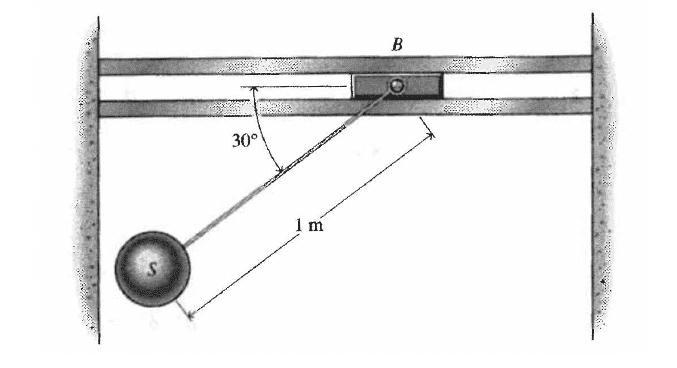
The problem involves a system consisting of a sphere and a block connected by a rigid rod, with the sphere having a mass of 5 kg and the block 1 kg. The scenario is set in a horizontal slot, and the system is released from rest. Participants are tasked with finding the tension in the rod and the accelerations of both blocks, relating to Newton's 2nd Law and potentially conservation of energy.

Discussion Character

  • Exploratory, Conceptual clarification, Mathematical reasoning, Assumption checking

Approaches and Questions Raised

  • Participants discuss the applicability of Newton's 2nd Law and conservation of energy, questioning whether the initial velocity can be assumed to be zero at the moment of release. There are considerations about the normal acceleration being zero and the need to account for relative acceleration between the sphere and the block.

Discussion Status

Some participants have provided guidance on using Newton's 2nd Law and have suggested that the initial conditions should be considered. There is an ongoing exploration of the relationships between the forces acting on the blocks and the sphere, with multiple interpretations of the problem being discussed.

Contextual Notes

Participants are navigating the constraints of the problem, including the initial conditions of the system being at rest and the implications for acceleration and tension in the rod. The discussion reflects uncertainty about the best approach to take given the dynamics involved.

Oblivion77
Messages
113
Reaction score
0
Mechanics:Dynamics (Newton's 2nd Law?)
Homework Statement


ic0ot2.png


A sphere S with a mass of 5 kg is attached by a rigid rod to 1 kg block B which is free to slide with no friction in a horizontal slot. The system is released from rest. At the instant when it is released, find the tension in the rod and the accelerations of both blocks.

Homework Equations


Sum of the forces in x = ma
Sum of the forces in y = ma

The Attempt at a Solution


I am not exactly sure how to tackle this problem. Would I need to solve this using Newton's 2nd law? Or would this question require conservation of energy?
 
Physics news on Phys.org


Using Newton's 2nd Law would definitely help.
And yes, your equations are correct.

Can u show your approach and the answer you are getting?


I have another question then. Since the problem is asking "the instant it is released from rest" can you assume the velocity is 0 at that instant? Therefore the component of normal acceleration is 0?


Oblivion77 said:
I have another question then. Since the problem is asking "the instant it is released from rest" can you assume the velocity is 0 at that instant? Therefore the component of normal acceleration is 0?

Yes, you can say that the initial velocity would be zero.. and yes, the normal acc.(due to circular motion) is also zero.
I guess you also have to use Work-Energy Conservation to solve.


blitz.km said:
Yes, you can say that the initial velocity would be zero.. and yes, the normal acc.(due to circular motion) is also zero.
I guess you also have to use Work-Energy Conservation to solve.

I don't think work and energy can be used here since you are looking for the accelerations.

Would relative acceleration need to be considered for this problem since the acceleration of the sphere is moving while the block is moving.


Oblivion77 said:
I don't think work and energy can be used here since you are looking for the accelerations.
Umm.. yeah.
But we would have used work-energy in case we needed acceleration after some time interval.

Oblivion77 said:
Would relative acceleration need to be considered for this problem since the acceleration of the sphere is moving while the block is moving.
YES.

Can u post your complete approach?


You need to relate the forces that act between the block and the sphere. I would pick the side of the wall as your reference frame, x.
I think you should get a pair of coupled differential equations with tension in there somewhere. Then use your initial conditions.


Would tangential acceleration of S = (m_s)*g*cos(30)=(m_s)(a_st)
so a_s tangential = 8.50 m/s^2?


and also since system is initially at rest wouldn't T=(m_s)*(g)*(sin(30)) = 24.525N
then solving for T in the horizontal dir. T_x=T(cos(30))

so T_x=(m_s)*(g)*(sin(30))*(cos(30)) =21.239
(T_x)/(m_b)= (a_b) = 21.239 m/s^2
 
  • #10


clampala said:
and also since system is initially at rest wouldn't T=(m_s)*(g)*(sin(30)) = 24.525N
then solving for T in the horizontal dir. T_x=T(cos(30))

so T_x=(m_s)*(g)*(sin(30))*(cos(30)) =21.239
(T_x)/(m_b)= (a_b) = 21.239 m/s^2

You need to take relative acceleration into account I am pretty sure.
 
  • #11


Let X, Y be the position of the sphere, and x the x-position of the block

A_x is the acceleration in the x direction of the sphere.
A_y is the acceleration in the y direction of the sphere.
a_x is the acceleration in the x direction of the block.

Find A_x. A_y, a_x as a function of T, the tension in
the rope.

Find another relation between A_x. A_yand a_x
by differentiating (X(t)-x(t))^2 + Y(t)^2 = L^2.

Solve for T
 

Similar threads

Replies
3
Views
2K
  • · Replies 42 ·
2
Replies
42
Views
6K
Replies
13
Views
3K
  • · Replies 5 ·
Replies
5
Views
2K
  • · Replies 5 ·
Replies
5
Views
3K
Replies
16
Views
3K
Replies
4
Views
1K
  • · Replies 13 ·
Replies
13
Views
2K
  • · Replies 3 ·
Replies
3
Views
3K
  • · Replies 5 ·
Replies
5
Views
7K