Meter Movement Magnet Activity: 600-800 CPM

Click For Summary
SUMMARY

The discussion centers on the detection of radioactivity from an old meter movement magnet using a Ludlum survey meter, which recorded activity levels between 600 and 800 counts per minute (CPM). The source of the radioactivity was identified as a rivet holding the laminates together, potentially containing trace uranium from historical manufacturing processes. Participants speculated on the rivet's age, suggesting it could date back to the 1920s or 1950s, and discussed the possibility of contamination from cobalt or uranium alloys used in steel production during that era.

PREREQUISITES
  • Understanding of radioactivity and detection methods, specifically using a Ludlum survey meter.
  • Knowledge of particle types, including alpha and beta particles, and their shielding requirements.
  • Familiarity with historical context regarding uranium and steel alloying, particularly in the early to mid-20th century.
  • Basic principles of metallurgy and the effects of atmospheric testing on materials.
NEXT STEPS
  • Research the specifications and usage of Ludlum survey meters, particularly models used in the 1950s.
  • Explore the historical context of uranium alloying in steel, focusing on the works of the Standard Alloy Company.
  • Investigate the effects of atmospheric nuclear testing on materials and potential contamination sources.
  • Learn about the properties and detection methods for cobalt-60 and other isotopes relevant to historical manufacturing processes.
USEFUL FOR

This discussion is beneficial for radiation safety professionals, historians of technology, metallurgists, and hobbyists interested in vintage electrical components and their potential radioactivity.

dlgoff
Science Advisor
Gold Member
Messages
4,441
Reaction score
3,264
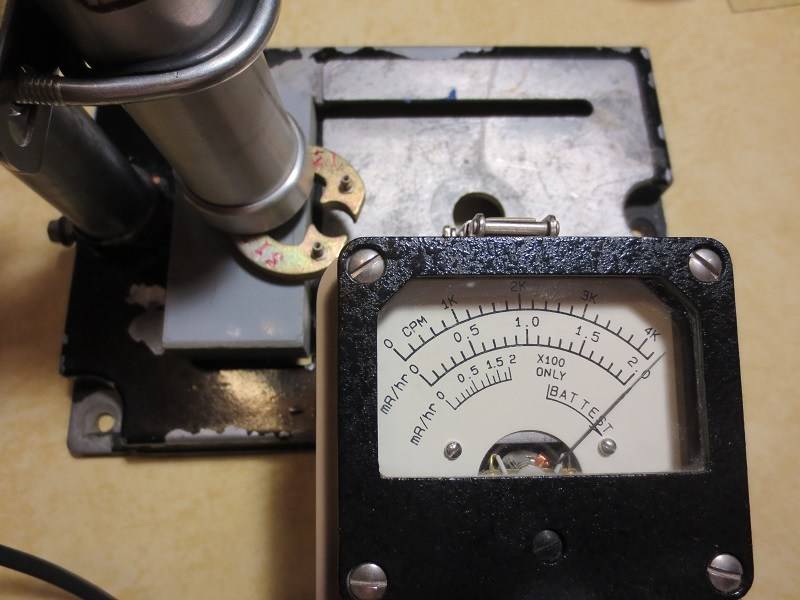
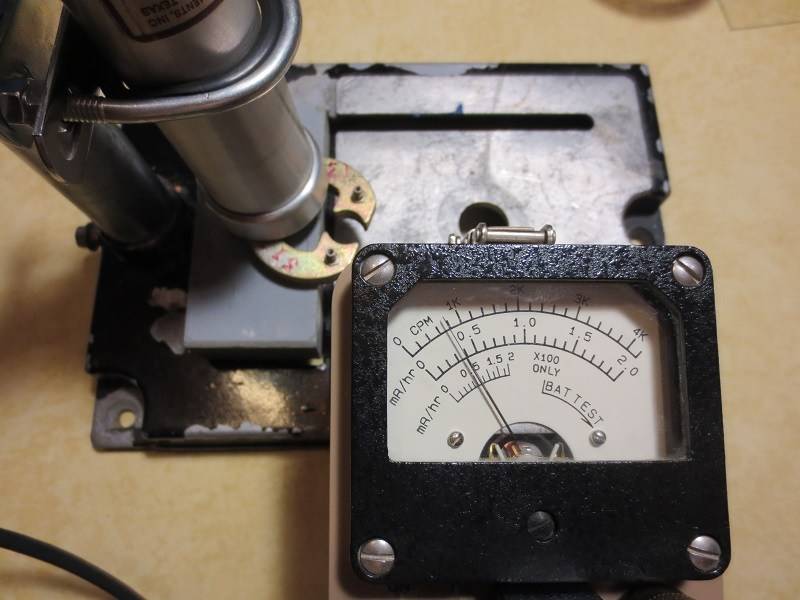
The other day I used my Ludlum survey meter to check out if any of my old junk electrical part may show any traces of radioactivity. I was rather surprised to find an old meter movement magnet showed some activity. Today I took some pictures while determining just how much activity there was. With the Ludlum meter can't tell what type of radioactivity it is, but since I had to have the detector really close, I guessing either beta or alpha. It turned out that the activity was coming from a rivet that's holding the laminates together. I'm getting somewhere between 600 and 800 Counts/minute. Any comments welcome.

The magnet laminates showing the rivet:
meter magnet.jpg

Activity on the X0.1 scale:
X0.1 scale.jpg


Activity on the X1 scale:
X1 scale.jpg
 
Engineering news on Phys.org
dlgoff said:
my old junk electrical part
How "old?"
 
Bystander said:
How "old?"
I don't know. Maybe in the '50s, but that's just a guess.
 
dlgoff said:
'50s, but that's just a guess.
Looking at the plating, lack of rust/corrosion, ink color, I'd agree, '50s to '70s.
 
Is that rivet copper plated?

Copper, Vanadium and Uranium ores run together in US southwest. When i visited the Phelps-Dodge Morenci mine about 1969 they used electrolytic refining and made mighty pure copper. I don't know how they did it in late 40's, early 50's though .

So my guess would be trace uranium in the vanadium alloy rivet steel and/or its copper plating. Just a GUESS with no real basis.

Guys down at Wolf Creek could identify the isotope but at that activity, even though it's a miniscule 600 cpm, they might not be able to give it back to you..
Know any HP techs there?

Hmmm 50's was the decade of atmospheric weapons testing.

old jim
 
jim hardy said:
Is that rivet copper plated?
It's doesn't look like copper and it appears that whatever it was "plated"(?) with was done on both the rivet and the laminates. Here's a couple of other close up pics.
plating.jpg

laminates.jpg


Depending on the angle of the light source you can get "coppery" hues on all of it.
 
A sheet or two of paper should shield alpha particles.
A thin sheet of glass or metal should shield beta particles.
[ref]

It may not identify the source element/isotope, but at least we'd know what the emitted particles are.
 
  • Like
Likes   Reactions: Asymptotic
My first thought was cobalt in the magnetic steel , but why would it be only in the rivet? Unless the rivet factory got a bar of contaminated steel...
Probably there was some Co60 floating around in the 50's.
 
That coating looks suspiciously like shellac. Or, maybe, some sort of chemical passivation.
 
  • Like
Likes   Reactions: Asymptotic
  • #10
  • #11
OmCheeto said:
A sheet or two of paper should shield alpha particles.
A thin sheet of glass or metal should shield beta particles.
Yes I know. That's why I said, "I had to have the detector really close, I guessing either beta or alpha". It appeared that the air was shielding particles as I couldn't detect one six inches away. I'm thinking, not only either alpha or beta particles but low energy ones at that. I'm no expert but I have worked a lot with 14C and Tritium.
 
  • #12
jim hardy said:
"... Standard Alloy Company" tried alloying uranium with steel , they claimed success in their book "Uranium in Steel"
How cool you finding this.
jim hardy said:
Could your rivet date back to 1920's ?
I haven't looked into when/what year panel meters of this size we were being used. I got this when I was a kid; probably in the late '50, early '60s. So maybe it does date to the 1920's. Here's a picture of the coil assembly I removed before testing if that sheds any light on it's year.
movement.jpg
 
  • #13
Well, this is a definite digression but Wikipedia has a section on Ferro-Uranium. They say post war Ferro-Uranium is made with depleted U.
https://en.wikipedia.org/wiki/Ferrouranium

FerroUranium was still around at beginning of Manhattan project. The Russians bought around 400 pounds of Uranium salts allegedly for research into alloying it with steel. General Groves also approved a Russian export request for twenty five pounds of Uranium metal . He only did it to find out if there was anybody in US able to fill the order. His project was quietly buying up all the Uranium they could find.
https://books.google.com/books?id=e...nepage&q=how to identify ferrouranium&f=false

It wouldn't surprise me at all if during the war there was a bin of Ferro-Uranium rivets in a meter factory. A WW2 surplus meter would have been only twenty years old when you got that one.

So it's plausible.Thanks Don for an interesting diversion !

old jim
 
  • Like
Likes   Reactions: dlgoff

Similar threads

  • · Replies 17 ·
Replies
17
Views
9K
  • · Replies 7 ·
Replies
7
Views
2K
  • · Replies 21 ·
Replies
21
Views
5K
  • · Replies 10 ·
Replies
10
Views
4K
  • · Replies 19 ·
Replies
19
Views
9K
  • · Replies 2 ·
Replies
2
Views
3K
  • · Replies 7 ·
Replies
7
Views
4K
  • · Replies 32 ·
2
Replies
32
Views
7K
Replies
20
Views
10K
  • · Replies 8 ·
Replies
8
Views
6K