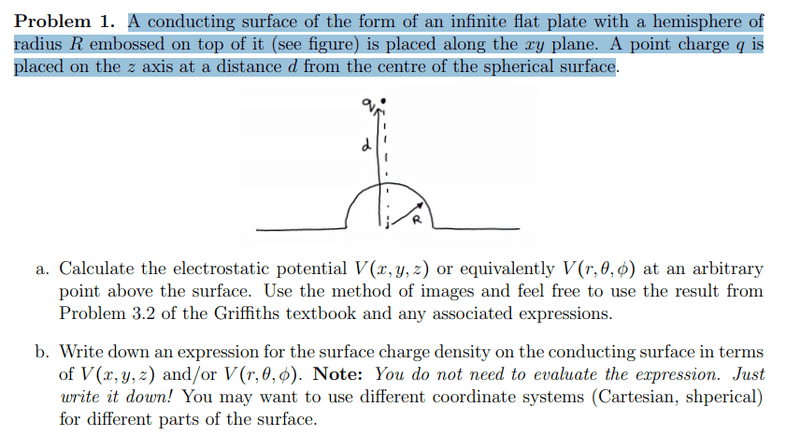
Method of Images, combination of an infinite plane and a hemisphere

Click For Summary
SUMMARY

The discussion focuses on solving a problem involving the Method of Images, specifically addressing the calculation of surface charge density on a combination of an infinite plane and a hemisphere. Participants clarify the use of spherical and Cartesian coordinates to evaluate the electric potential and its gradient. Key equations discussed include the surface charge density formula, $$\sigma = -\epsilon_0 \nabla V \cdot \hat{z}$$, and the evaluation of the gradient in spherical coordinates. The conversation emphasizes the importance of breaking the problem into parts for the curved and flat surfaces to accurately determine the induced charge.

PREREQUISITES
  • Understanding of the Method of Images in electrostatics
  • Familiarity with spherical and Cartesian coordinate systems
  • Knowledge of electric potential and surface charge density concepts
  • Ability to compute gradients in different coordinate systems
NEXT STEPS
  • Study the derivation of the surface charge density formula in electrostatics
  • Learn how to convert between spherical and Cartesian coordinates
  • Explore the concept of directional derivatives and their applications in physics
  • Investigate the implications of the Method of Images for different geometries in electrostatics
USEFUL FOR

Students and professionals in physics, particularly those specializing in electromagnetism, as well as educators looking to enhance their understanding of the Method of Images and its applications in solving electrostatic problems.

milkism
Messages
118
Reaction score
15
Homework Statement
Find the surface density on the conducting surface in terms of potential either in cartesian coordinates or spherical.
Relevant Equations
See solution.
Problem:

fdbe63ebb80b0df9684216216c3a3d78.png

I have done part a) in spherical polar coordinates.
For part b) I thought it would be just:
$$\sigma = -\epsilon_0 \frac{\partial V}{\partial r}$$
But I got confused by "You may want to use different coordinate systems .." So I assume partial derivative w.r.t to r is the spherical part, what would the cartesian part be? I assume for the cartesian part it would be the partial derivative with respect to z, but in my solution for part a) I don't have a z-component, do I have to find the potential in Cartesian coordinates also?
 
Last edited:
  • Like
Likes   Reactions: PhDeezNutz
Physics news on Phys.org
is there an expression for gradient in spherical coordinates on the back cover of Griffiths?

I’d evaluate the gradient of the expression from part a) generally and then set

##\theta = \frac{\pi}{2}##

And of course take the dot product with z-hat

There’s an expression on the back cover of Griffiths for z-hat in spherical basis as well.
 
PhDeezNutz said:
is there an expression for gradient in spherical coordinates on the back cover of Griffiths?

I’d evaluate the gradient of the expression from part a) generally and then set

##\theta = \frac{\pi}{2}##

And of course take the dot product with z-hat

There’s an expression on the back cover of Griffiths for z-hat in spherical basis as well.
So basically $$z=r\cos(\theta)$$. I put that in my potential in spherical coordinates then
$$\sigma = -\epsilon_0 \left( \frac{\partial V}{\partial r} \cdot \frac{\partial V}{\partial z} \right)$$
?
 
The gradient is always perpendicular to the equipotential. So you’re going to have to break this problem into two parts. Finding the surface charge on the curved part and then the flat part. Do them separately.

1) for the curved part ##\frac{\partial V}{\partial r}## will do just fine

2) for the flat part you’re going to have to get more general ##\sigma = - \nabla V \cdot \hat{z}##.

When you evaluate ##\nabla V## you’ll get something in spherical basis (the second expression)

FFF35B94-8A26-49BE-AE4E-AA437BBA6F64.jpeg


We have to express ##\hat{z}## in spherical basis
89AED7F6-63F3-4348-896B-B7421EE687CC.jpeg


Evaluate the dot product generally then plug in theta is pi/2.
 
  • Care
Likes   Reactions: milkism
PhDeezNutz said:
The gradient is always perpendicular to the equipotential. So you’re going to have to break this problem into two parts. Finding the surface charge on the curved part and then the flat part. Do them separately.

1) for the curved part ##\frac{\partial V}{\partial r}## will do just fine

2) for the flat part you’re going to have to get more general ##\sigma = - \nabla V \cdot \hat{z}##.

When you evaluate ##\nabla V## you’ll get something in spherical basis (the second expression)

View attachment 325229

We have to express ##\hat{z}## in spherical basis
View attachment 325231

Evaluate the dot product generally then plug in theta is pi/2.
How did you come up with the equation for the flat part? I have never seen it, and shouldn't there also be an epsilon_zero?
 
I didn’t come up with it. It’s a definition.

The “normal derivative” literally means “directional derivative in the direction of the normal”. Directional derivative is defined by the dot product of the gradient with the direction unit vector of interest”. For the flat part the direction of interest is z-hat (because that is the normal).

And of course there should be a ##-\epsilon_0## in front. I was being lazy.
 
  • Care
Likes   Reactions: milkism
PhDeezNutz said:
I didn’t come up with it. It’s a definition.

The “normal derivative” literally means “directional derivative in the direction of the normal”. Directional derivative is defined by the dot product of the gradient with the direction unit vector of interest”. For the flat part the direction of interest is z-hat (because that is the normal).

And of course there should be a ##-\epsilon_0## in front. I was being lazy.
Thanks! 😘:kiss:
 
  • Love
Likes   Reactions: PhDeezNutz
PhDeezNutz said:
I didn’t come up with it. It’s a definition.

The “normal derivative” literally means “directional derivative in the direction of the normal”. Directional derivative is defined by the dot product of the gradient with the direction unit vector of interest”. For the flat part the direction of interest is z-hat (because that is the normal).

And of course there should be a ##-\epsilon_0## in front. I was being lazy.
Last question should the total induced charge on the conducting surface be -q, or $$q' = \frac{-qR}{d}$$? If it was just a flat surface it would have been -q, if it was just a sphere it would have been the latter.
 
milkism said:
Last question should the total induced charge on the conducting surface be -q, or $$q' = \frac{-qR}{d}$$? If it was just a flat surface it would have been -q, if it was just a sphere it would have been the latter.

I’m not sure. I’d have to work it out.

At the very least it’s not going to be q.
 
  • #10
PhDeezNutz said:
I’m not sure. I’d have to work it out.

At the very least it’s not going to be q.
Well, question asked to find the charge without doing any calculation, because we didn't have to calculate the surface charge density either (we just had to give an expression), I only know that it will be a negative charge haha
 
Last edited:
  • #11
milkism said:
question asked to find the charge without doing any calculation
I assume that in the first part you came up with three point charges to represent the induced charge distribution. Is the total induced charge simply their sum?

Btw, I note the text of the question says q is at d from the spherical surface, but your diagram has it at d from the centre of curvature.
 

Similar threads

  • · Replies 2 ·
Replies
2
Views
2K
  • · Replies 14 ·
Replies
14
Views
2K
  • · Replies 9 ·
Replies
9
Views
8K
  • · Replies 4 ·
Replies
4
Views
2K
Replies
6
Views
3K
  • · Replies 2 ·
Replies
2
Views
10K
  • · Replies 11 ·
Replies
11
Views
7K
Replies
4
Views
2K
  • · Replies 4 ·
Replies
4
Views
2K
  • · Replies 7 ·
Replies
7
Views
6K