Minimize the following using K-Map and implement using universal gates

  • Thread starter Thread starter momentum
  • Start date Start date
  • Tags Tags
    Universal
Click For Summary

Discussion Overview

The discussion revolves around minimizing a Boolean function using Karnaugh Maps (K-Maps) and implementing the solution with universal gates. Participants are comparing their own solutions to a book's solution and addressing discrepancies between them.

Discussion Character

  • Debate/contested
  • Homework-related
  • Mathematical reasoning

Main Points Raised

  • One participant presents a problem involving the minimization of a Boolean function and shares their solution, which does not match the book's solution.
  • Another participant asserts that the book's solution is correct and suggests that the first participant may have incorrectly mapped the minterms to the K-map cells.
  • The first participant acknowledges the feedback and revises their solution, resulting in two potential solutions, questioning the validity of the first solution compared to the book's second solution.
  • A subsequent reply indicates that while the first solution is valid, the second solution is more simplified, emphasizing the importance of extending groups in K-map grouping.

Areas of Agreement / Disagreement

Participants do not reach a consensus on the validity of the first solution compared to the book's solution, with some asserting that both are valid while others suggest that the book's solution is preferred for its simplicity.

Contextual Notes

There are unresolved questions regarding the mapping of minterms to K-map cells and the criteria for determining the validity of multiple solutions.

Who May Find This Useful

Students and practitioners interested in Boolean algebra, K-map techniques, and digital logic design may find this discussion relevant.

momentum
Messages
111
Reaction score
0
Problem:
minimize the following using K-Map and implement using universal gates
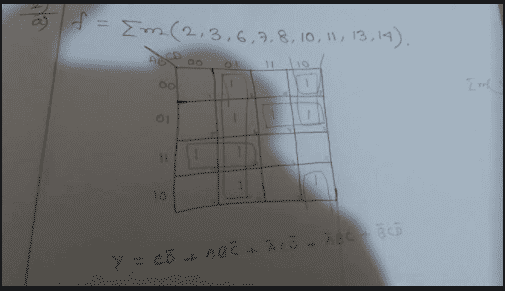
f=sum of m( 2,3,6,7,8,10,11,13,14)My Solution
Here is my solution

https://prnt.sc/jdyk0k
K map.png


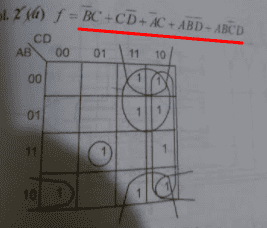
However, my solution is not matching with book solution

Book solution
https://prnt.sc/jdyj4n
K map 2.png

I'm confused. which solution is correct?
 

Attachments

  • K map.png
    K map.png
    19.7 KB · Views: 730
  • K map 2.png
    K map 2.png
    12 KB · Views: 399
Last edited by a moderator:
Physics news on Phys.org
The book solution is correct. You do not appear to be mapping the minterms to the K-map cells properly. If you could explain how you are mapping the minterm "3", for example, additional help could be provided.
 
  • Like
Likes   Reactions: Greg Bernhardt
Ok.. understood.
I did the correction. Now I have 2 solutions to this problem.

Solution # 1
LAxRgqp.jpg


And

Solution # 2
7TNZXHg.jpg


But Book has given only Solution # 2 . Did they missed Solution # 1 ?

Do you think Solution # 1 is invalid ? Or Book just missed to print solution#1

Please correct me If I can write Solution # 1 as a possible solution to this problem. I'm stuck at this point.
 

Attachments

  • option-1_zpsdvjfdnze.png
    option-1_zpsdvjfdnze.png
    11 KB · Views: 436
  • option-2_zps2by5kg1q.png
    option-2_zps2by5kg1q.png
    11 KB · Views: 451
  • LAxRgqp.jpg
    LAxRgqp.jpg
    22.4 KB · Views: 344
  • 7TNZXHg.jpg
    7TNZXHg.jpg
    21.7 KB · Views: 352
Last edited:
Solution 1 is valid, but solution 2 is more simplified. When doing K-map grouping, if any group can be extended, extend it.
 
Thanks. That helped a lot.
 

Similar threads

  • · Replies 7 ·
Replies
7
Views
8K
  • · Replies 11 ·
Replies
11
Views
2K
  • · Replies 1 ·
Replies
1
Views
2K
  • · Replies 1 ·
Replies
1
Views
2K
  • · Replies 2 ·
Replies
2
Views
4K
Replies
2
Views
2K
  • · Replies 1 ·
Replies
1
Views
3K
  • · Replies 3 ·
Replies
3
Views
3K
Replies
1
Views
3K
  • · Replies 2 ·
Replies
2
Views
2K