SUMMARY
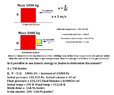
The discussion centers on the application of Newton's laws in conjunction with adiabatic processes, specifically analyzing two scenarios involving gas compression and kinetic energy. Participants highlight critical errors in the original calculations, such as incorrect values for cross-sectional area and misunderstandings of kinetic energy's dependence on time. The original question posed was, "Given a fixed force applied to a mass, what effect would the introduction of a gas compression component make?" The consensus indicates that the work done differs between scenarios due to the additional compression work required in the adiabatic process.
PREREQUISITES
- Understanding of Newton's laws of motion
- Familiarity with adiabatic processes in thermodynamics
- Knowledge of kinetic energy calculations and dependencies
- Basic principles of force, mass, and acceleration
NEXT STEPS
- Study the principles of adiabatic processes in thermodynamics
- Learn about the relationship between force, mass, and acceleration in dynamic systems
- Explore the concept of energy conservation in mechanical systems
- Investigate the effects of gas compression on kinetic energy and system dynamics
USEFUL FOR
Students of physics, engineers working with thermodynamic systems, and anyone interested in the application of Newton's laws to real-world scenarios involving gas dynamics.