Mixture problem. How to solve for C?

  • Thread starter Thread starter Jeff12341234
  • Start date Start date
  • Tags Tags
    Mixture
Join the discussion
Registration is free. Start your own thread to ask a follow-up.
3 replies · 2K views · last reply
Jeff12341234
Messages
179
Reaction score
0
I need to solve for C. I know it's probably simple but i don't remember how to. This is what I have so far:
Handwritten solution to a tank mixing problem: dA/dt = Rin - Rout = 3·4 - 5·A/100, leading to dA/dt + A/20 = 12, integrating factor μ = e^(t/20), and A(t) = 240 + Ce^(-t/20) with the constant of integration noted as forgotten.
 
Physics news on Phys.org
Because the volume flow rate entering is different from the volume flow rate leaving, you need to write down two differential equations, rather than 1:

Volume Input - Volume Output = accumulation for the volume of fluid in the tank

Chemical X Input - chemical X Output = accumulation for chemical X in the tank

If V(t) is the volume of fluid in the tank at time t, fin is the volumetric flow rate of fluid in, and f_out is the volumetric flow rate of fluid out, what is the differential equation for V?

If C(t) is the concentration of chemical X within the tank at time t, and C_in is the concentration of chemical X in the feed to the tank, what is the differential equation for the rate of change of total chemical X in the tank?

The next step is to multiply the differential equation for V by C, and subtract the resulting relationship from the mass balance on chemical X.
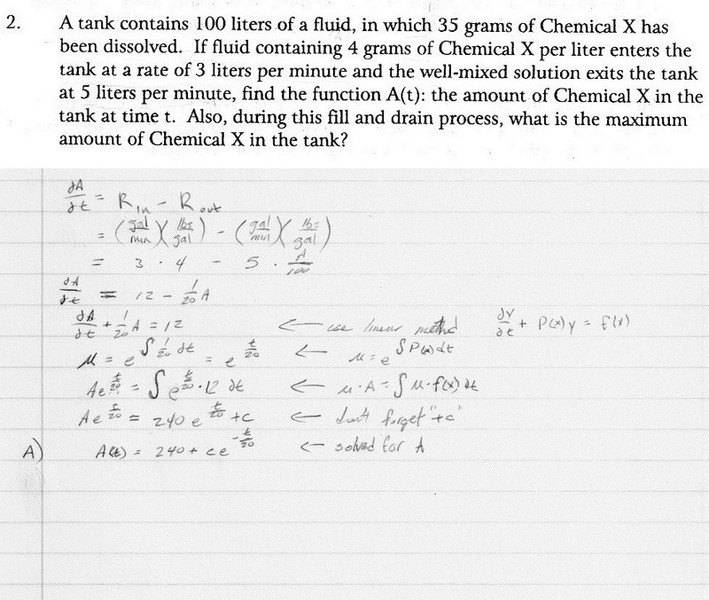
 
I don't follow.. The way I did it is the way the professor instructed us and the steps match the steps in his example. To solve for C, I now realize from an example in the book that A(0)=35. With that information, I can solve for C.

Textbook page showing Example 5, Mixture of Two Salt Solutions, with the initial-value problem dA/dt + A/100 = 6, A(0) = 50, its solution A(t) = 600 - 550e^(-t/100), and a note about the 300 gallon tank.
 
OK. I see what you did, and, of course, it is right. But, here's my alternate version to consider:

[tex]\frac{dV}{dt}=f_{in}-f_{out}[/tex]
[tex]\frac{d(VC)}{dt}=f_{in}C_{in}-f_{out}C[/tex]
Multiply the first equation by C and subtract it from the second equation:

[tex]V\frac{dC}{dt}=f_{in}(C_{in}-C)[/tex]

where [itex]V=V_0+(f_{in}-f_{out})t[/itex]
So,

[tex]\frac{dC}{(C_{in}-C)}=f_{in}\frac{dt}{V_0+(f_{in}-f_{out})t}[/tex]