Mixture problem. How to solve for C?

  • Thread starter Thread starter Jeff12341234
  • Start date Start date
  • Tags Tags
    Mixture
Join the discussion
Ask a follow-up here, or get your own question answered by working scientists, mathematicians and engineers — people, not an autocomplete.
Real named experts · corrections over time · the nuance an AI answer skips
3 replies · 2K views
Jeff12341234
Messages
179
Reaction score
0
I need to solve for C. I know it's probably simple but i don't remember how to. This is what I have so far:
FgCaDxf.jpg
 
Physics news on Phys.org
Because the volume flow rate entering is different from the volume flow rate leaving, you need to write down two differential equations, rather than 1:

Volume Input - Volume Output = accumulation for the volume of fluid in the tank

Chemical X Input - chemical X Output = accumulation for chemical X in the tank

If V(t) is the volume of fluid in the tank at time t, fin is the volumetric flow rate of fluid in, and f_out is the volumetric flow rate of fluid out, what is the differential equation for V?

If C(t) is the concentration of chemical X within the tank at time t, and C_in is the concentration of chemical X in the feed to the tank, what is the differential equation for the rate of change of total chemical X in the tank?

The next step is to multiply the differential equation for V by C, and subtract the resulting relationship from the mass balance on chemical X.
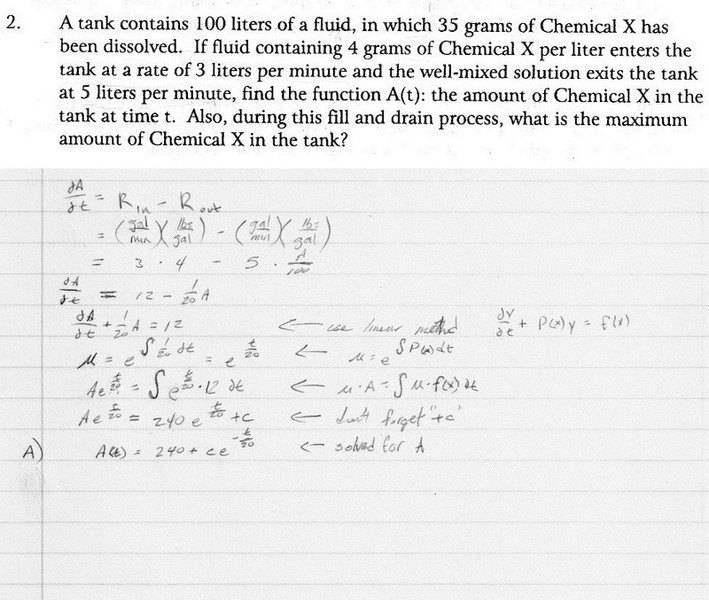
 
I don't follow.. The way I did it is the way the professor instructed us and the steps match the steps in his example. To solve for C, I now realize from an example in the book that A(0)=35. With that information, I can solve for C.

WYp5JqT.png
 
OK. I see what you did, and, of course, it is right. But, here's my alternate version to consider:

[tex]\frac{dV}{dt}=f_{in}-f_{out}[/tex]
[tex]\frac{d(VC)}{dt}=f_{in}C_{in}-f_{out}C[/tex]
Multiply the first equation by C and subtract it from the second equation:

[tex]V\frac{dC}{dt}=f_{in}(C_{in}-C)[/tex]

where [itex]V=V_0+(f_{in}-f_{out})t[/itex]
So,

[tex]\frac{dC}{(C_{in}-C)}=f_{in}\frac{dt}{V_0+(f_{in}-f_{out})t}[/tex]