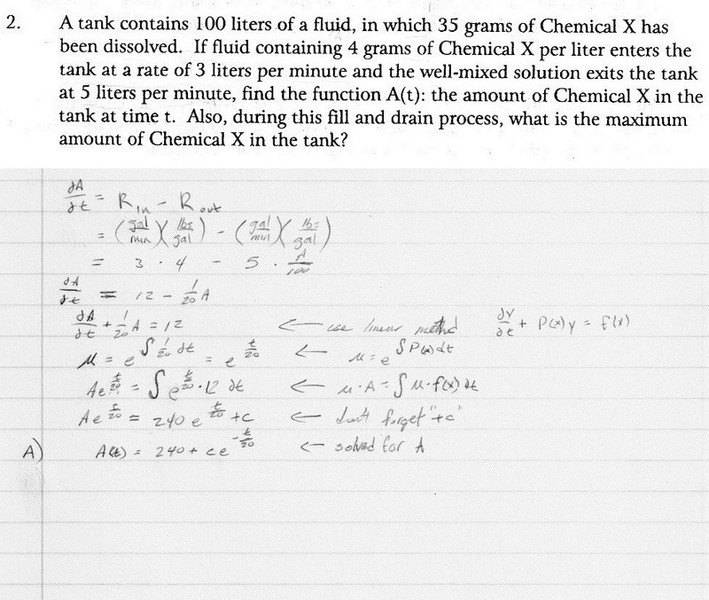
Diff. Eq. Mixture problem. Did most of the work, Need to solve for C

  • Thread starter Thread starter Jeff12341234
  • Start date Start date
  • Tags Tags
    Mixture Work
Click For Summary

Homework Help Overview

The discussion revolves around a differential equation related to a mixture problem, specifically focusing on determining the concentration of a chemical in a solution over time. Participants are exploring the implications of initial conditions and the changing volume of the solution as time progresses.

Discussion Character

  • Mixed

Approaches and Questions Raised

  • Participants discuss the correct formulation of concentration based on the volume of solution and the rate of flow in and out of the tank. There are attempts to clarify the relationship between concentration and volume over time, with various expressions proposed for concentration.

Discussion Status

The conversation is ongoing, with participants providing feedback on each other's reasoning and calculations. Some participants express confusion regarding the results they obtain, while others offer insights and corrections. There is a recognition of differing answers and a suggestion to verify results using external resources.

Contextual Notes

Participants are grappling with the implications of changing volume in the context of the problem, and there are references to specific rates of flow and concentration that are under scrutiny. The discussion reflects a learning process with varying interpretations of the mathematical relationships involved.

Jeff12341234
Messages
179
Reaction score
0
I need to solve for C. I know it's probably simple but i don't remember how to. This is what I have so far:
FgCaDxf.jpg
 
Physics news on Phys.org


Use the initial conditions given.

Also, your solution's incorrect.

You only have 100L of solution at one point in time, so at only one point in time will the concentration leaving the tank be A/100. There's a net change in volume as time passes.


Mangoes said:
Use the initial conditions given.

Also, your solution's incorrect.

You only have 100L of solution at one point in time, so at only one point in time will the concentration leaving the tank be A/100. There's a net change in volume as time passes.

so what should it be instead of A/100?? A/35?


The rate out will be the the concentration times the rate at which the fluid flows out per minute.

You already know the fluid flows out at 5L/min, but your concentration's wrong.

It's correct that the concentration will depend on the amount A of chemical X, but the concentration also depends on the total volume of the solution. Five grams in 1 L is much more concentrated than five grams in 100L.

You just need to write the concentration in a way that's dependent on time since your volume also depends on time.
 
Last edited:


so it will be A/(100+5t)?

or maybe A/(100-2t) <--- -2t came from Rate in rate out
 
Last edited:


No, but you're getting closer.

V(t) = 5t + 100 would imply that the volume is increasing with time. It's not.

Look at the net change in volume.


Close, but you need to consider the rate into the tank as well.


A/(100-2t)? <--- -2t came from Rate in - rate out


A/(100 - 2t) is correct, but don't forget to multiply it by 5 representing the liters/min to get the total rate out.
 
  • #10


Right. Thanks
 
  • #11


I get a non-real result now when I try to solve for c. Where did I go wrong?

OVhz36N.jpg
 
  • #12


That shouldn't be giving you a non-real solution. It looks fine to me.
 
  • #13


no, it doesn't work out.. :/
 
  • #14


Oh, I read it wrong. It should be 50-t, not t-50.
 
  • #15


are you saying it should be A*(t-50)^(-5/2)=-8(50-t)^(-3/2)+c ?
How do you figure??
 
  • #16


The integral of 5/(100-2t) is (-5/2)ln(50-t).
 
  • #17


I get a different answer:

GesMlaO.jpg


Is there another source we can check?
 
  • #18


That's strange that it's giving you that answer. I checked by doing it by hand, as well as wolfram alpha and I get (-5/2)ln(50-t).
 
  • #19


do you have a wolfram alpha link? I want to try it.
 
  • #21


wolfram says: (-5*Log[-2*(-50 + x)])/2
 
  • #22


tkumM93.png


That's not the answer I got, nor is it the answer you got...
 
Last edited:

Similar threads

  • · Replies 2 ·
Replies
2
Views
1K
  • · Replies 3 ·
Replies
3
Views
2K
  • · Replies 24 ·
Replies
24
Views
4K
  • · Replies 3 ·
Replies
3
Views
2K
  • · Replies 0 ·
Replies
0
Views
1K
Replies
22
Views
2K
Replies
5
Views
2K
  • · Replies 9 ·
Replies
9
Views
1K
Replies
18
Views
4K
Replies
4
Views
2K