Modeling projectile motion as subject to a constant accelera

Click For Summary

Discussion Overview

The discussion revolves around the modeling of projectile motion, specifically addressing the forces acting on a projectile after it is launched. Participants explore the implications of different forces and accelerations involved in the motion, questioning the assumptions made in standard equations of motion.

Discussion Character

  • Exploratory
  • Debate/contested
  • Conceptual clarification

Main Points Raised

  • One participant presents a model of projectile motion using the equation $$x_f=x_i+v_it+\frac12at^2$$ and questions why the acceleration is taken as ##a=mg## instead of ##a=mg+\frac Fm##, suggesting there may be a missing element in the understanding of forces.
  • Several participants seek clarification on the meaning of the force ##F##, with one asserting that after the projectile leaves the cannon, the only force acting on it is gravity.
  • There is a discussion about the terminology used, with one participant clarifying that the "projectile" refers to the cannon and the "ball" refers to the object being launched.
  • Another participant confirms that while the ball is inside the cannon, a horizontal force acts on it, but this force ceases once the ball exits the cannon, leading to a consideration of the initial conditions for projectile motion.

Areas of Agreement / Disagreement

Participants generally agree that after the projectile leaves the cannon, only gravity acts on it. However, there is disagreement regarding the interpretation of the force ##F## and its relevance to the motion after launch, indicating multiple competing views on the modeling of projectile motion.

Contextual Notes

The discussion highlights assumptions about forces acting on the projectile and the conditions under which the standard equations of motion apply. There is an unresolved aspect regarding the role of the force ##F## and its implications for the acceleration of the projectile.

Anama Skout
Messages
53
Reaction score
13
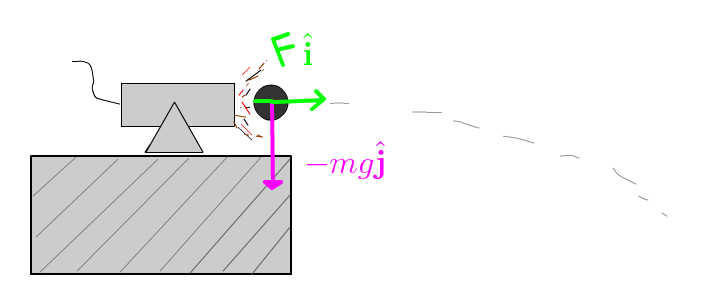
Consider the following diagram of a projectile motion (##\hat{\bf i}## and ##\hat{\bf j}## are the unit vectors of the ##x## and ##y##-axis respectively)
ixzHD.jpg


We know that $$F=ma.\tag1$$ This can be rearranged to $$a=\frac Fm.\tag2$$ So there are actually two accelerations, one with magnitude ##mg## and another with magnitude ##\frac Fm##. However when we model that projectile motion using the equation $$x_f=x_i+v_it+\frac12at^2,\tag3$$ we put ##a=mg## and not ##a=mg+\frac Fm##. Why is this the case? What am I missing?
 
Physics news on Phys.org
What is this F?
After the projectile leaves the cannon there is no force on it besides gravity.
 
nasu said:
What is this F?
After the projectile leaves the cannon there is no force on it besides gravity.
##F## is the force that the projectile exerted on the ball.
 
So you have a projectile and a ball? Isn't the ball the projectile, the moving object?
 
nasu said:
So you have a projectile and a ball? Isn't the ball the projectile, the moving object?
Hmm sorry (english isn't my mother language) I meant by the projectile the canon, the thing that projects, and the ball the thing that was projected, the moving object.
 
Oh, OK.:)
As long as the ball is inside the cannon there is indeed a horizontal force on it. Once the ball is out of the cannon, this force does not act anymore.
When we study projectile motion, we consider as initial state (with initial velocity) some position outside the cannon, where there is no more force exerted by cannon on the ball.
 
  • Like
Likes   Reactions: Anama Skout

Similar threads

  • · Replies 8 ·
Replies
8
Views
6K
  • · Replies 6 ·
Replies
6
Views
2K
  • · Replies 1 ·
Replies
1
Views
2K
  • · Replies 2 ·
Replies
2
Views
2K
Replies
7
Views
1K
  • · Replies 7 ·
Replies
7
Views
7K
  • · Replies 1 ·
Replies
1
Views
2K
  • · Replies 21 ·
Replies
21
Views
2K
  • · Replies 1 ·
Replies
1
Views
2K
Replies
24
Views
3K