Discussion Overview
The discussion revolves around the behavior of moist air in relation to its density compared to dry air, particularly in a controlled environment like a room. Participants explore whether moist air tends to rise or settle at the bottom, considering factors such as temperature, humidity, and airflow dynamics.
Discussion Character
- Exploratory
- Technical explanation
- Debate/contested
- Conceptual clarification
Main Points Raised
- Some participants assert that humid air is less dense than dry air, countering the initial assumption that moist air is heavier due to its water content.
- There is a discussion about the implications of humidity on air density and how this affects the vertical distribution of humidity in a room.
- One participant questions whether humidity at the ceiling would be higher than at the floor, suggesting that temperature uniformity plays a role in this distribution.
- Concerns are raised about the subtlety of airflow differences caused by humidity compared to temperature differences, with some participants suggesting that these differences may not be easily felt.
- Participants discuss the complexities of heat and humidity interactions, noting that hot air can hold more moisture than cold air, which complicates the understanding of air movement.
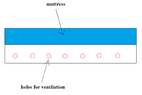
- One participant proposes a hypothetical scenario involving a mattress to illustrate how heat and humidity might interact within a confined space, prompting further exploration of air movement dynamics.
- Some participants challenge assumptions about heat and moisture distribution under a mattress, suggesting that the insulating properties of bedding materials could affect air behavior.
Areas of Agreement / Disagreement
Participants express differing views on the density of moist air compared to dry air, with some asserting that humid air is less dense while others maintain that it is heavier. The discussion remains unresolved regarding the specific dynamics of humidity distribution in a room and how it interacts with temperature.
Contextual Notes
Participants highlight that the behavior of air in a room can be influenced by various factors, including temperature gradients, the presence of heat sources, and the physical properties of materials involved. There is acknowledgment of the complexity of measuring and observing these effects in practice.