Moment of inertia (disk with off center hole)

Click For Summary

Homework Help Overview

The discussion revolves around calculating the moment of inertia (MoI) for a disk that has a circular hole off-center. The original poster is seeking guidance on how to approach the problem, particularly in relation to the effects of the hole on the MoI calculation.

Discussion Character

  • Exploratory, Assumption checking, Mathematical reasoning

Approaches and Questions Raised

  • The original poster considers subtracting the MoI of the hole from that of the disk but is unsure how to account for the hole's off-center position. They express a need for a more direct approach to relate this to a mass rotating around a center point.

Discussion Status

Some participants have offered guidance on using the parallel axis theorem to find the MoI about an axis not through the center of mass. However, the original poster raises concerns about needing the mass of the missing hole, which complicates their calculations. There is an ongoing exploration of how to determine the necessary mass and density to proceed with the problem.

Contextual Notes

The original poster only knows the mass of the disk with the hole and lacks information about the mass of the hole itself. This limitation is affecting their ability to apply the formulas they have. Additionally, they mention needing to know the mass of the disk as if the hole were filled in.

Imperitor
Messages
19
Reaction score
0
I have a disk with some thickness to it and I need its moment of inertia.
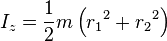
So this is the formula with r1=0
37f7b2c6aaaf32e1972af5e228064928.png


Now there is a "circular hole of diameter 'd' at a distance of 'r' from the geometric center of the disk." So I'm thinking that I should subtract the MoI of the hole from the disk. Here is a picture if you need it.

http://img99.imageshack.us/img99/782/50817033.jpg

I could use the same MoI equation as I did for the disk on the hole but that doesn't account for the hole being off centered. Any ideas??

I need to eventually equate this to a small mass rotating around a center point, so if there is a more direct approach please tell me. Thanks in advance for the help.
 
Last edited by a moderator:
Physics news on Phys.org
Welcome to PF!

Hi Imperitor ! Welcome to PF! :smile:
Imperitor said:
I could use the same MoI equation as I did for the disk

That's right! :smile:

And then use the parallel axis theorem to find the moment of inertia about an axis not through the centre of mass. :wink:
 
Thanks. I really should have known that...

I'm really enjoying this forum. It's a great resource for an engineering student.
 
Wait a minute... hit another snag. To use that theorem I need to know what the mass of the missing hole is. I only know the mass of the disk as is (with the hole in it). Also the first formula I gave could only be used if I knew what the mass of the disk was with the hole filled in. This is driving me nuts. I can't even start working on the question I'm doing without getting this MoI.
 
just got up… :zzz:
Imperitor said:
Wait a minute... hit another snag. To use that theorem I need to know what the mass of the missing hole is. I only know the mass of the disk as is (with the hole in it). Also the first formula I gave could only be used if I knew what the mass of the disk was with the hole filled in. This is driving me nuts. I can't even start working on the question I'm doing without getting this MoI.

Easy-peasy …

divide the given mass by the area, to give you the density :wink:

then multiply by each area separately! :smile:
 
  • Like
Likes   Reactions: harmyder

Similar threads

Replies
11
Views
4K
  • · Replies 13 ·
Replies
13
Views
3K
  • · Replies 9 ·
Replies
9
Views
7K
  • · Replies 2 ·
Replies
2
Views
5K
  • · Replies 27 ·
Replies
27
Views
6K
Replies
13
Views
4K
  • · Replies 19 ·
Replies
19
Views
5K
Replies
2
Views
4K
Replies
8
Views
14K
  • · Replies 45 ·
2
Replies
45
Views
4K