SUMMARY
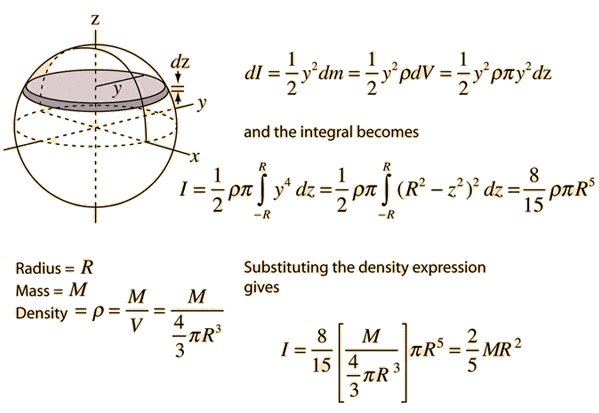
This discussion focuses on the derivation of the moment of inertia (MoI) of solid and hollow spheres, referencing HyperPhysics. The volume element is defined as dV=πy²dz, while the surface area is incorrectly assumed as dA=2πydz. The participants clarify that for surface area calculations, the arc length must be considered, not just the vertical distance. The correct moment of inertia for a solid sphere is derived using integration, yielding the formula 2/5 MR², while the moment of inertia for a hollow sphere is 2/3 MR².
PREREQUISITES
- Understanding of calculus, specifically integration techniques.
- Familiarity with the concepts of moment of inertia and its physical significance.
- Knowledge of geometric properties of spheres and circles.
- Experience with differential elements in volume and surface area calculations.
NEXT STEPS
- Study the derivation of the moment of inertia for various geometric shapes, focusing on solid and hollow spheres.
- Learn about the application of integration in physics, particularly in calculating volumes and surface areas.
- Explore the differences between volume and surface area integrals in calculus.
- Investigate coordinate geometry methods for calculating moments of inertia.
USEFUL FOR
Physics students, mechanical engineers, and anyone interested in understanding the principles of rotational dynamics and moment of inertia calculations.

 )
)