Moments problem -- One point load is given on a table

newbie1127
Messages
13
Reaction score
5
Homework Statement
hi everyone,
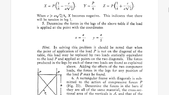
i am trying to solve this question where one point load is given on a table at coordinates
x = a/4 & y=a/5 , where a is the distance between adjacent legs of the table.
Relevant Equations
M = F.d
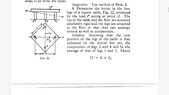
I have tried solving this by splitting the load into two parallel coplaner loads as the Hint below the question suggests but while i was computing the values i realized that, i'll have 4 variables with only 3 equations.
two forces and the two distances to forces from their respective axes.

i've concluded that i have to make an assumption to solve this question. if someone could advice me on a better way or tell me if i am right.

Thanks.

reference :- Images attached
Image 1) The figure of the table

Image 2) The Question and the Hint mentioned above
 

Attachments
  • Screenshot from 2022-04-24 16-09-49.png
    Screenshot from 2022-04-24 16-09-49.png
    22.4 KB · Views: 171
  • Screenshot from 2022-04-24 16-10-02.png
    Screenshot from 2022-04-24 16-10-02.png
    39.4 KB · Views: 177
Physics news on Phys.org
newbie1127 said:
I have tried solving this by splitting the load into two parallel coplaner loads as the Hint below the question suggests but while i was computing the values i realized that, i'll have 4 variables with only 3 equations.
two forces and the two distances to forces from their respective axes.

i've concluded that i have to make an assumption to solve this question. if someone could advice me on a better way or tell me if i am right.
Have you done any work that could be exposed?
 
Lnewqban said:
Have you done any work that could be exposed?
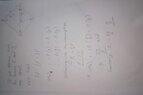
I've done this but I feel like I took a shortcut with that assumption maybe it wasn't meant to be solved like this?
 

Attachments

  • IMG_20220424_183110.jpg
    IMG_20220424_183110.jpg
    24.2 KB · Views: 160
  • Like
Likes   Reactions: Lnewqban
newbie1127 said:
I've done this but I feel like I took a shortcut with that assumption maybe it wasn't meant to be solved like this?
Having more variables than equations is a common problem to all the statically indetermined structures, like our four-legs square table (it only needs three legs to be perfectly stable).
This chapter and its examples try to show the many ways to go around that difficulty.

Your approach and results may be correct, but I believe that problem 5 is meant to be a continuation of problem 4.

If that is correct, you could simply input the given value of e=a/4 into the previously found equations for loads of X and Z shown in the solution of problem 4.
By doing that, you obtain the percentage of load P that should be allocated to legs 1 and 3 (X and Z respectively).

Problem 4 had a symmetrical distribution of loads for legs 2 and 4 (25% of P each).
The new problem is to determine how the loads have been re-distributed respect to the x axis, as the same load P has been relocated off that axis in the amount y=a/5.

By doing a summation of moments respect to an imaginary horizontal axis parallel to the x-axis and in the plane of the load P, you can find the needed additional equation for obtaining the percentage of load P/2 that should be allocated to legs 2 and 4 (Y2 and Y4 respectively).
 
  • Like
Likes   Reactions: newbie1127
Lnewqban said:
Having more variables than equations is a common problem to all the statically indetermined structures, like our four-legs square table (it only needs three legs to be perfectly stable).
This chapter and its examples try to show the many ways to go around that difficulty.

Your approach and results may be correct, but I believe that problem 5 is meant to be a continuation of problem 4.

If that is correct, you could simply input the given value of e=a/4 into the previously found equations for loads of X and Z shown in the solution of problem 4.
By doing that, you obtain the percentage of load P that should be allocated to legs 1 and 3 (X and Z respectively).

Problem 4 had a symmetrical distribution of loads for legs 2 and 4 (25% of P each).
The new problem is to determine how the loads have been re-distributed respect to the x axis, as the same load P has been relocated off that axis in the amount y=a/5.

By doing a summation of moments respect to an imaginary horizontal axis parallel to the x-axis and in the plane of the load P, you can find the needed additional equation for obtaining the percentage of load P/2 that should be allocated to legs 2 and 4 (Y2 and Y4 respectively).
I solved the problem using both mine and your method to see what the values would be but arrived at the same answer for all the legs. Although, your method was much shorter and easier.

After solving it, I do understand why that is, I feel like I was too concerned about splitting the load into two loads.

Anyways, thanks for the detailed help. I appreciate it.
 
  • Like
Likes   Reactions: Lnewqban

Similar threads

  • · Replies 3 ·
Replies
3
Views
2K