Momentum transport in gases in 2d

Click For Summary
SUMMARY

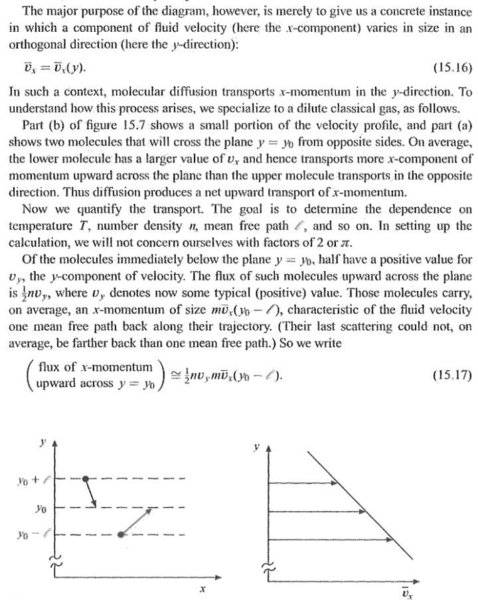
The discussion focuses on the momentum transport of gas molecules in a two-dimensional space, specifically addressing the assumption that half of the molecules move in the positive y-direction while the other half move in the negative direction. This assumption is based on the premise that the overall gas mass remains static, leading to an average speed of zero. The conversation highlights the need for clarity on this assumption and explores the implications of analyzing gas behavior under different conditions, such as an upward accelerating gas mass, as seen in rocket dynamics.

PREREQUISITES
  • Understanding of basic gas dynamics
  • Familiarity with momentum transport concepts
  • Knowledge of two-dimensional vector analysis
  • Basic principles of thermodynamics
NEXT STEPS
  • Research "Momentum transport in two-dimensional gas dynamics"
  • Explore "Tensor analysis in fluid mechanics"
  • Study "Gas behavior under acceleration in rocket science"
  • Investigate "Statistical mechanics and gas motion"
USEFUL FOR

Students and researchers in physics, particularly those studying fluid dynamics, gas behavior, and momentum transport in two-dimensional systems.
Mohankpvk
Messages
102
Reaction score
3
I was trying to understand the momentum transport between gas molecules in 2d.In the image below, it is stated that half of the molecules move up(positive velocity in y direction) and half negative.But the author didnt explain why he assumed it.
IMG_20180914_172950.jpeg
 

Attachments

  • IMG_20180914_172950.jpeg
    IMG_20180914_172950.jpeg
    52.3 KB · Views: 670
Physics news on Phys.org
Because the whole gas mass is assumed to be static, not moving up, down, left, right.

You could do a different analysis for an upward accelerating gas mass, such as on a rocket, but the answers would change.
 
  • Like
Likes   Reactions: Mohankpvk
anorlunda said:
Because the whole gas mass is assumed to be static, not moving up, down, left, right.

You could do a different analysis for an upward accelerating gas mass, such as on a rocket, but the answers would change.
But why half if the gas is static?Please explain.I referred a few books for momentum transport but all of them used tensors.Is there any book(or other source) in which transport is explained only in 2d?
 
Mohankpvk said:
But why half if the gas is static?

No, all the particles are moving, some + some -, the average speed of all is zero.
 
  • Like
Likes   Reactions: Mohankpvk

Similar threads

  • · Replies 3 ·
Replies
3
Views
4K
  • · Replies 12 ·
Replies
12
Views
2K
  • · Replies 2 ·
Replies
2
Views
3K
  • · Replies 6 ·
Replies
6
Views
2K
  • · Replies 16 ·
Replies
16
Views
3K
  • · Replies 30 ·
2
Replies
30
Views
2K
  • · Replies 13 ·
Replies
13
Views
3K
Replies
6
Views
2K
  • · Replies 1 ·
Replies
1
Views
2K
  • · Replies 2 ·
Replies
2
Views
3K