Motion of 3 Bodies Dynamics - Acclerations

  • Thread starter Thread starter al_9591
  • Start date Start date
  • Tags Tags
    bodies Motion
Click For Summary

Homework Help Overview

The discussion revolves around the dynamics of a system involving three masses (m1, m2, m3) connected in a frictionless environment, focusing on determining their accelerations after the system is released from rest.

Discussion Character

  • Exploratory, Conceptual clarification, Mathematical reasoning

Approaches and Questions Raised

  • Participants discuss free body diagrams (FBDs) for each mass, questioning the correctness of the equations derived. There is an exploration of using conservation of linear momentum to relate the accelerations of the masses.

Discussion Status

Some participants have provided feedback on the FBDs and suggested methods for finding the accelerations. There is an ongoing exploration of different approaches, including the use of momentum conservation and differentiation of equations relating the masses.

Contextual Notes

Participants are considering the implications of frictionless surfaces and the role of normal forces in their equations. There is a question regarding the inclusion of certain forces in the equations for mass m1.

al_9591
Messages
12
Reaction score
0
Dynamics. Motion of 3 bodies

Homework Statement


Initially the system of masses is held
motionless. All surfaces, and pulley are frictionless.
At the instant after the system of objects is released,
find the accelerations of m1, m2 and m3.
Data:
m1, m2 and m3
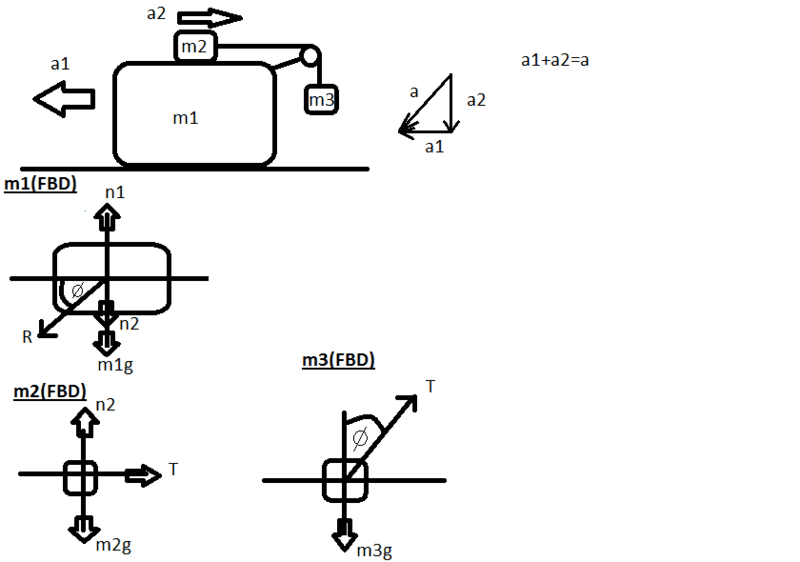
attachment.php?attachmentid=29777&stc=1&d=1289461082.png

Homework Equations


F=ma

The Attempt at a Solution


EQUATIONS
FBD(free body diagram) of m1
X: Rcos(theta)=a1m1
Y: n1=n2+m1g
FBD of m2
X: T=(a2-a1)m2
Y: n2=m2g
FBD of m3
X: Tsin(theta)=a1
Y: Tcos(theta)-m3g=a2

This is what I have done so far are my equations correct?
Should I include the force n2 (normal 2) in the equation for the Y axis for mass 1?
 

Attachments

  • Physics4.png
    Physics4.png
    11.4 KB · Views: 575
Last edited:
Physics news on Phys.org
Your FBD for m3 is incorrect. The tension will not be at an angle theta. It'll be straight up.
Yes, you should include n2 in the Y axis equation for m1.

To find the acceleration of the block m1 you can use conservation of linear momentum.

Find acclerations of m2, m3; write out the equation for colm(m1,m2) and differentiate it wrt time. This gives you the relation between accelerations of m1 and m2, from which you can find out the acceleration of m1.
 
@chaoseverlasting
Can you explain how to find acceleration of mass m1 from conservation of linear momentum?
 
As the surfaces are frictionless, the net force on the horizontal axis is zero. From the conservation of linear momentum you have, m1v1=m2v2.

Differentiating this equation you get m1a1=m2a2.

Now, you can find a2 from the second equation relating m3 and m2. Plugging that value into this equation gives you a1.
 
Oh Ic...thanks
 
Hi, when you say second equation do you refer to the equation: T-m3g=a2?
Thank you for answering my question
 

Similar threads

Replies
25
Views
4K
  • · Replies 34 ·
2
Replies
34
Views
4K
  • · Replies 97 ·
4
Replies
97
Views
17K
Replies
3
Views
2K
  • · Replies 2 ·
Replies
2
Views
2K
  • · Replies 6 ·
Replies
6
Views
3K
  • · Replies 4 ·
Replies
4
Views
3K
  • · Replies 1 ·
Replies
1
Views
7K
  • · Replies 4 ·
Replies
4
Views
4K
  • · Replies 25 ·
Replies
25
Views
2K