Rotational Dynamics Pulley Problem Help needed

Click For Summary

Homework Help Overview

The discussion revolves around a pulley system involving three masses (m1, m2, m3) and the need to determine their accelerations while ensuring no slipping occurs between the disk and the rope. The problem is situated within the context of rotational dynamics and Newton's laws of motion.

Discussion Character

  • Exploratory, Assumption checking, Conceptual clarification

Approaches and Questions Raised

  • The original poster attempts to establish equations based on assumed accelerations and tensions in the system. They question the correctness of their assumptions regarding the direction of these accelerations and the angular acceleration of the disk.

Discussion Status

Participants are engaged in clarifying the original poster's assumptions and providing feedback on the equations presented. There is a focus on understanding the implications of directionality in the chosen variables, with some participants suggesting that the choice of positive direction is flexible as long as consistency is maintained throughout the equations.

Contextual Notes

There is mention of a typo in the equations, which has been acknowledged by the original poster. The discussion also highlights the importance of correctly identifying the direction of accelerations and angular acceleration, which remains a point of inquiry.

Sahil Kukreja
Messages
65
Reaction score
15
1.) Homework Statement
A Pulley System is shown below
Find the accelerations of m1, m2 and m3 (such that there is no slipping between the disk and the rope.)
Assume the threads to be massless.
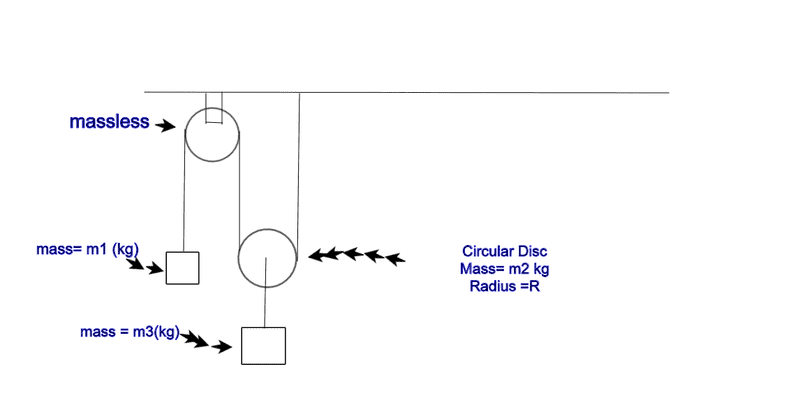
Drawing.png

Homework Equations


The Relevant equations i think are Newtons 2nd law of motion for translation of m1 and m3

And Rotational as well as Translational equations for m2.
Also Torque about Fixed Axis Of Rotation can be written for m2.

The Attempt at a Solution


[/B]I have attempted the problem like this :-

assumed m1 to go up with acceleration a1,
assumed m2 and m3 both to go up with acceleration a2.
assumed α to be the angular acceleration of the disk anti clockwise.
assumed tensions T1,T2,T3.
T1 is not equal to T2 as the disk has mass.
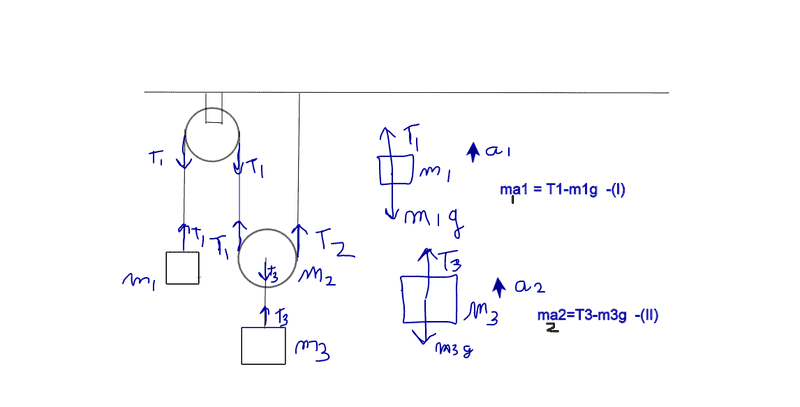
Drawing_1.png


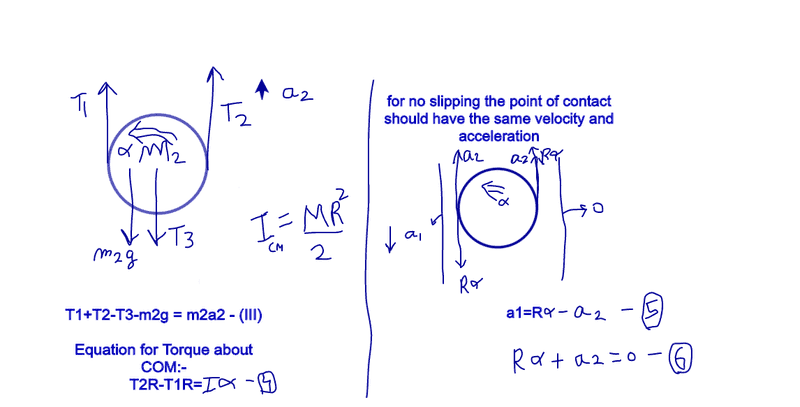
The other equations are :-
Drawing_1.png
The Variable are a1, a2 , T1, T2 , T3, α
6 equations and 6 variables, so it can be solved.

My Question is that are these equations correct and how do i know that my assumed accelerations are in the correct direction??

Please Reply! Thanks! :smile:
 
Physics news on Phys.org
In equation (II) there is a handwritten subscript 2 that should be 3.
All else looks good. Are you stuck, or just wanted a progress check?
 
  • Like
Likes   Reactions: Sahil Kukreja and bznm
Will the answer depend on the direction of angular acceleration or it will come out to be same?
 
haruspex said:
In equation (II) there is a handwritten subscript 2 that should be 3.
All else looks good. Are you stuck, or just wanted a progress check?

thanks, yes that's a typo.
I wanted to know if my direction of accelerations and angular acceleration are correct or not?
 
Sahil Kukreja said:
thanks, yes that's a typo.
I wanted to know if my direction of accelerations and angular acceleration are correct or not?
I cannot tell since you have not posted your solution of the equations.
The directions you choose for the variables at the start is immaterial. All you do there is choose which direction is positive for that variable. If it turns out that the accekeration is in that direction you will get a positive answer. If it is the other way you will get a negative answer.
There are generally three approaches:
- In the "naive" approach, you make a genuine guess at which way each object will accelerate and pick the positive directions accordingly;
- in what one might call the Cartesian approach, you stick to a convention like up is positive and right is positive. But in general some accelerations could be at an angle, so you then have to break it into components.
- Assign the positive directions at random.
Or you could use a hybrid.
Whichever you choose, the important thing is to be consistent through the equations.
 

Similar threads

  • · Replies 17 ·
Replies
17
Views
3K
  • · Replies 34 ·
2
Replies
34
Views
4K
  • · Replies 5 ·
Replies
5
Views
2K
Replies
25
Views
4K
  • · Replies 97 ·
4
Replies
97
Views
17K
  • · Replies 10 ·
Replies
10
Views
3K
  • · Replies 5 ·
Replies
5
Views
5K
  • · Replies 5 ·
Replies
5
Views
3K
  • · Replies 3 ·
Replies
3
Views
2K
  • · Replies 2 ·
Replies
2
Views
2K