Moving a loop within a changing magnetic field

Click For Summary

Discussion Overview

The discussion revolves around the calculation of electromotive force (emf) generated when a loop of wire is moved within a changing magnetic field. Participants explore the implications of Lenz's law, the nature of magnetic flux, and the mathematical treatment of the problem, including the effects of acceleration on the loop's motion. The scope includes theoretical reasoning and mathematical derivations related to electromagnetism.

Discussion Character

  • Exploratory
  • Technical explanation
  • Mathematical reasoning
  • Debate/contested

Main Points Raised

  • Some participants assert that the time derivative of the area swept by the loop relates to the velocity of the loop when calculating emf using Lenz's law.
  • Others argue that if the magnetic field is homogeneous, moving the loop does not generate current, although it creates a potential difference across the loop.
  • A participant points out a contradiction in the original problem statement regarding the area of the loop being treated as both constant and a function of time.
  • Mathematical expressions for magnetic flux and emf are derived, with some participants questioning the assumptions made in the original solution regarding the magnetic field's uniformity.
  • Discussions include the need for accurate initial conditions and the implications of the loop's shape and motion on the calculations of emf.
  • Participants express uncertainty about the correctness of the original solution and suggest that the problem may have been poorly formulated or presented in the source material.

Areas of Agreement / Disagreement

Participants generally do not reach a consensus, as multiple competing views remain regarding the interpretation of the problem, the assumptions made, and the correctness of the mathematical treatment of the situation.

Contextual Notes

There are unresolved issues regarding the assumptions about the magnetic field's behavior and the treatment of the loop's area over time. Some calculations appear to contradict the stated conditions of the problem, leading to confusion about the correct approach to finding the emf.

Who May Find This Useful

This discussion may be of interest to students and educators in physics, particularly those engaged in electromagnetism, as well as participants in physics competitions who are exploring complex problems involving magnetic fields and moving conductors.

avcireis
Messages
22
Reaction score
0
Hello,

Short description: In my country's physics olympics, if a loop of wire is moved in a changing magnetic field, the time derivative of the area (while calculating emf with lenz law) is the velocity of the loop (as if we're taking the time derivative of the AREA SWEPT).

This has became an axiom for me right now. I do the questions based on this and they are correct, so no problem practically. I am just wondering why.

Here's an example question and its solution if I wasn't clear enough.
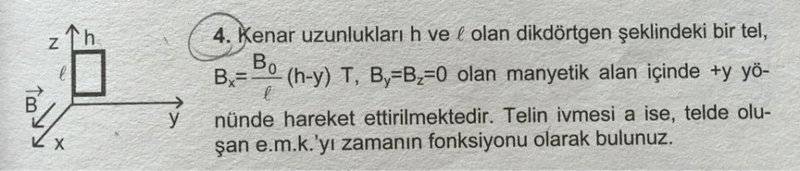
IMG_1473932504.770759.jpg


The loop is moving with acceleration a in the magnetic field defined. Find emf as a function of time
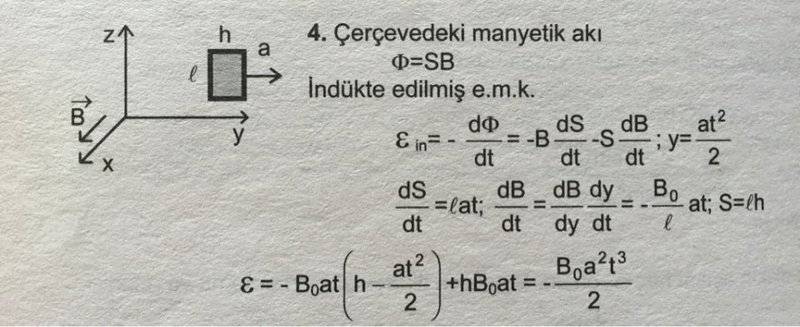
IMG_1473932623.914336.jpg


What I'm talking about happens in the beginning of the third line of equations.

Thank you
 
Physics news on Phys.org
If the magnetic field is homogeneous in space, then moving the loop does not do anything (well it creates a potential difference between the upper and the lower side, but no current in the loop).

A time-dependent or position-dependent magnetic field matters, of course, as it changes the flux through the area.

For a rectangular coil, you can separately calculate the equilibrium voltage on both sides. The difference between the two values is then the EMF. In your case it will be proportional to the length of the wires and to their distance. The product of both is the area.
This also works for more complex shapes, you can approximate them with many squares for example.
 
Let me disagree. As the loop moves to the right the magnetic flux changes. However, the OP shows a contradiction: it states the loop area S=l*h (a constant, O.K.), but in another place makes S a function of time (wrong).
 
Hmm, good point. Confusing.

@avcireis: Can you translate the problem statement as accurate as possible?
 
Sure,
Question: A rectangular loop of wire with side lengths h and l is moved in the y+ direction in a magnetic field Bx=B/l (h-y), By=0, Bz=0. If the loops acceleration is a, find the emf generated as a function of time.

Solution's first line: Flux through the loop

Solution's other line: Generated emf
 
Ok, let's do the math. Obviously they want you to calculate the electromotive force,
$$\frac{1}{c} \dot{\Phi}(t)=-\int_{\partial A} \mathrm{d} \vec{r} \cdot (\vec{E}+\frac{\vec{v}}{c} \times \vec{B}).$$
The magnetic field is
$$\vec{B}=\begin{pmatrix} B_0 (h-y)/l \\ 0\\0 \end{pmatrix}.$$
The rectangular loop defines the surface seems to be in the ##yz## plane and given by
$$\vec{r}(\eta,\zeta) = \begin{pmatrix} 0 \\ \eta + a t^2/2 \\ \zeta \end{pmatrix} \quad \text{with} \quad \eta \in [0,h], \quad \zeta \in [0,l].$$
The surface element is
$$\mathrm{d}^2 \vec{f} = \partial_{\eta} \vec{r} \times \partial_{\zeta} \vec{r} \mathrm{d} \eta \mathrm{d} \zeta=\mathrm{d} \eta \mathrm{d} \zeta \vec{e}_y \times \vec{e}_z= \mathrm{d} \eta \mathrm{d} \zeta\vec{e}_x.$$
The magnetic flux is thus
$$\Phi:=\int_F \mathrm{d}^2 \vec{f} \cdot \vec{B}= \int_{0}^{h} \mathrm{d} \eta \int_0^l \mathrm{d} \zeta B_0 (h-\eta-a t^2/2)/l = B_0 \left [\left (h-\frac{a t^2}{2} \right) h - \frac{h^2}{2} \right ].$$
So I get
$$\mathcal{E}=-\dot{\Phi}/c=\frac{B_0 h a t }{c},$$
but that's far from the solution. I also don't understand, why they simply write ##\Phi=BS## although you need an integral, because the ##B## field depends on ##y##. Something seems to be wrong either with the solution or my understanding of the question.
 
I agree with your answer vanhees (Edit: oops), and the solution in the book doesn't make sense.

The formula for dS/dt would suggest that the loop expands, e. g. the left edge stays constant. But that is in contradiction to S=lh used later.
The multiplication with B would only work if B was constant in space, or if they take the average B. We know it is not constant in space and I don't see any averaging process. dB/dt seems to get evaluated at the right edge of the loop.
 
Last edited:
Well, I guessed from the to pictures that the entire loop moves with constant acceleration in ##y## direction. Of course the calculation changes. It's all the same as in my previous posting but
$$\vec{r}(\eta,\zeta)=\begin{pmatrix} 0 \\ \eta \\ \zeta \end{pmatrix}, \quad \eta \in (0,at^2/2), \quad \zeta \in (0,l).$$
Then the integral for the flux becomes
$$\Phi=B_0 \int_0^{a t^2/2} \mathrm{d} \eta (h-\eta)=B_0 [h a t^2/2-a^2 t^4/8].$$
Then the EMF becomes
$$\mathcal{E}=-\frac{B_0}{c} (h a t-a^2 t^3/2),$$
which is a bit closer to the given result but not quite the same. The reason is that in the solution they didn't correctly evaluate the flux, because they tacitly assumed that the field is just to be substituted with ##B=B_0 (h-at^2/2)/l##, which however is obviously wrong.
 
Last edited:
I'd go for vanhees's first answer.

Let us assume that at time t = 0 the left hand side of the loop is at y = y0 and moving with velocity (0, u, 0). We shouldn't, imo, have to assume these initial conditions; they should be given in the question.

The loop is translating in the y-direction without change of shape. Given the diagram it would surely be perverse to assume anything else.

The emf in a moving straight conductor of length l is ##(\textbf{v}\times \textbf{B}).\textbf{l}##,

So emf in left hand side = ##Blv = \frac{B_0}{l} (h-y_{0} -ut-\frac{1}{2}at^2).l.(u+at)## in anticlockwise sense around loop
And emf in right hand side = ##\frac{B_0}{l} (h-y_{0} -ut-\frac{1}{2}at^2-h).l.(u+at)## in clockwise sense around loop

The net emf is therefore ##B_0h(u+at)## anticlockwise.

I first used ##\frac{d\Phi}{dt}## , evaluating ##\Phi## at time t by integration over the loop. The answer was (of course) the same.
 
Last edited:
  • Like
Likes   Reactions: vanhees71
  • #10
Sure, that's just the correct use of Faraday's Law for moving surfaces/boundaries. In my calculation in I assumed ##u=0## in #6. It's a nice check of the validity of Faraday's law for this situation :-)).
 
  • #11
That makes sense, vanhee's first answer. I'm going to ask my tutor about this. It seemed like an error to me as well. It might be, since these questions I'm talking about were back in 1990's and the national science olympiads were not funded that much back then, so they weren't as professional.
I'll give an update, thanks to all.
 
  • #12
I see it also as a straightforward (but satisfying) use of the magnetic part of the Lorentz force.

Another sniffy remark about the question… What's that 'T' doing at the end of the expression for Bx? Presumably it stands for tesla. Does that mean that B0 is to be regarded as a pure number without units? Weird.
 
  • #13
@Philip Wood, it's true. T just stands for the unit Tesla.
 
  • #14
Did you get the point I was making about its being wrong to put the unit there at all?

Incidentally - here's a tiny nitpick - In the SI, when a unit is named after a person (e.g. Coulomb, Hertz, Tesla) the unit, written in full is all in lower case (coulomb, hertz, tesla). The abbreviated unit is upper case, or if two letters, the first is upper case (C, Hz, T). Just trying to be helpful!
 
Last edited:
  • #15
My tutor also approved vanhee's solution and said that the book I'm using is notoriously known for its mistakes. Thank you to everyone!
 

Similar threads

  • · Replies 16 ·
Replies
16
Views
3K
  • · Replies 5 ·
Replies
5
Views
1K
  • · Replies 5 ·
Replies
5
Views
2K
  • · Replies 1 ·
Replies
1
Views
2K
  • · Replies 2 ·
Replies
2
Views
2K
  • · Replies 3 ·
Replies
3
Views
2K
  • · Replies 5 ·
Replies
5
Views
2K
  • · Replies 14 ·
Replies
14
Views
2K
  • · Replies 2 ·
Replies
2
Views
16K
  • · Replies 9 ·
Replies
9
Views
4K