MPPT algorithms, perturb and observe algorithm etc

Click For Summary
The discussion centers on the classification of MPPT algorithms, specifically the relationship between the "hill climbing method" and the "perturb and observe" (P&O) algorithm. It is noted that hill climbing techniques, including P&O and incremental conductance, are often considered synonymous, yet some sources differentiate them based on their operational mechanics. The P&O algorithm adjusts the operating voltage of the PV array, while hill climbing modifies the duty cycle of the power converter. Ultimately, both methods aim to regulate voltage through duty cycle adjustments, raising questions about whether the distinction is merely semantic. The conversation highlights the need for clarity in terminology within the context of solar photovoltaic systems.
PainterGuy
Messages
938
Reaction score
73
Hi,

I had thought that "hill climbing method" is a general terminology to refer to methods such as perturb and observe and incremental conductance. The same is also said here, "The hill climbing based techniques are so named because of the shape of the power-voltage (P-V) curve. This technique is sub-categorized in three types: Perturb & Observe Algorithm (P&O), Modified Adaptive P & O Method, Incremental Conductance Algorithm (INC)". [Reference #1, page #91: https://www.academia.edu/5691750/Hi..._point_in_Solar_Photovoltaic_Systems-A_Review]

But at many places they are considered two different methods, for example, "Perturbation and observation (P&O) and hill climbing methods are widely applied in the MPPT controllers due to their simplicity and easy implementation [2-3]. P&O method involves a perturbation in the operating voltage of the PV array, while hill climbing strategy introduces a perturbation in the duty ratio of the power converter [2] and is more attractive duty to the simplified control structure [4][Reference #2, page #804: https://www.researchgate.net/publication/224321861_Comparison_of_PO_and_hill_climbing_MPPT_methods_for_grid-connected_PV_converter]

Reference #2, page #805, also lists a flow diagram. Near the end it makes a distinction between perturb and observe algorithm and hill climbing by saying "For P&O MPPT Vref(k)=Vref(k+1)+Vstep*slope" and "For hill climbing MPPT D(k)=Dref(k-1)+Dstep*slope". I understand the hill climbing and how duty cycle is used to change the input voltage of panel to operate it at maximum power point. P&O changes the Vref instead of duty cycle but it can only change the Vref through duty cycle. For both methods, at the end od day, it's the duty cycle which regulates the voltage. So, does the difference only lie in the wording, or is there more to it? Could you please help me with this? Thank you.
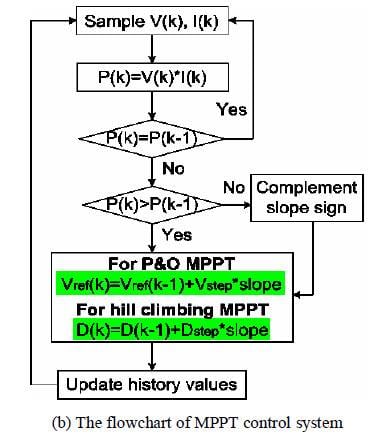
?temp_hash=ad2bf9ac8d7e572ae3cd4c79a5a67fcf.jpg


Reference #11: https://drive.google.com/open?id=1JQ4wQkA-M9PwBmRS6xHLhTBLZv3Dk7ou
Reference #2: https://drive.google.com/open?id=1qthgR8rW572jaaAjmvDFRvnkqtd10mZk
 

Attachments

  • p_&_o_hill.jpg
    p_&_o_hill.jpg
    28.3 KB · Views: 785
  • ?temp_hash=ad2bf9ac8d7e572ae3cd4c79a5a67fcf.jpg
    ?temp_hash=ad2bf9ac8d7e572ae3cd4c79a5a67fcf.jpg
    28.3 KB · Views: 753
Engineering news on Phys.org
PS:
https://www.google.com/search?q="Both+perturb+and+observe%2C+and+incremental+conductance%2C+are+examples+of+"hill+climbing"+methods+that+can+find+the+local+maximum+of+the+power+curve"&oq="Both+perturb+and+observe%2C+and+incremental+conductance%2C+are+examples+of+"hill+climbing"+methods+that+can+find+the+local+maximum+of+the+power+curve"

It includes results from Wikipedia and US solar institute.
 
Opening a Google drive file from a stranger is a security risk. You may not try any answers until you change that.
 
anorlunda said:
Opening a Google drive file from a stranger is a security risk. You may not try any answers until you change that.

Thank you!

But I have more than 450 posts under my belt! :) Anyway, those Google drive files are PDFs and they are okay to open. Also, even an .exe file from Google drive doesn't open directly, you need to select download first.

Those Google drive files are the same as those Reference #1 and Reference #2 URLs in my post.

Finally, I have now attached the same files.

Best wishes,
PG
 

Attachments

PainterGuy said:
But I have more than 450 posts under my belt! :) Anyway, those Google drive files are PDFs
Don't take it personally. Each of us has a policy regarding risks on the Internet. Many PF members (me included) object to PDF files. Partially because on many of our platforms you must download the PDF before you can view it. There are also plenty of risks with PDF.

https://security.stackexchange.com/questions/72037/what-are-the-security-risks-associated-with-pdf-files#72071 said:
One PDF-specific risk is that Adobe and third-party reader extensions are supported: your PDF viewer may have extra modules loaded, or may require them to open certain documents. Examples include:

  • Adobe LiveCycle Rights Management ES4
  • https://stackoverflow.com/questions/6692676/is-there-a-way-to-set-a-time-limit-on-a-pdf for which there are commercial products
Both of these endeavour to constrain digital document use. At best, such features increase the attack surface, and at worst may deny you access to some of your files, report on your activity or otherwise take liberties with your privacy, documents, computer or network. (Sound familiar? Seems analogous to a browser and web page that needs Flash or a similar proprietary plugin.)

See also this question which covers PDF phone-home capability. Javascript, embedded multi-media (including, but not limited to Flash) and Xobjects (external streams) are at least some of the ways to achieve that.

Some less-obvious risks associated with, but not entirely specific to PDFs:

  • PDFs can http://blogs.adobe.com/insidepdf/2010/11/pdf-file-attachments.html, though not all readers support this, and those that do don't always visually indicate their presence. These can be any type of file, including another PDF. An encrypted PDF (commonly RC4 or AES) is identifiable as a PDF (only the data streams are encrypted, rather than the file as a whole), the presence of attachments is not evident in this case. Behaviour is restricted on some platforms at least, see Adobe's KB 331371 and KB 328671. (I consider this is a potential risk because it comes as a surprise to many people, and it may be used for stealth transfer.)
  • Misplaced faith in native "security features" such as no-copy, no-print, no-edit. These are effectively discretionary controls, at the discretion of the viewer software itself.
  • The structure/layout of the PDF format is quite loose, and PDF lends itself to use and abuse as a chameleon or polyglot format (PDF), see Corkami's examples here:http://code.google.com/p/corkami/wiki/mix?show=content . This show files which are simultaneously PDF, native binary executable, .jar and .html by using similar "slack" in those formats.
  • Metadata may leak information about the document origins or history. http://blogs.adobe.com/security/2009/12/how_to_properly_redact_pdf_fil.html is also problem.
  • Support for rich content (multimedia via Flash, embedded fonts) and browser integration facilitate attacks on client-side software components beyond the reader/viewer itself
...One PDF-specific risk is that Adobe and third-party reader extensions are supported: your PDF viewer may have extra modules loaded, or may require them to open certain documents. Examples include:

  • Adobe LiveCycle Rights Management ES4
  • https://stackoverflow.com/questions/6692676/is-there-a-way-to-set-a-time-limit-on-a-pdf for which there are commercial products
Both of these endeavour to constrain digital document use. At best, such features increase the attack surface, and at worst may deny you access to some of your files, report on your activity or otherwise take liberties with your privacy, documents, computer or network. (Sound familiar? Seems analogous to a browser and web page that needs Flash or a similar proprietary plugin.)

See also this question which covers PDF phone-home capability. Javascript, embedded multi-media (including, but not limited to Flash) and Xobjects (external streams) are at least some of the ways to achieve that.

Some less-obvious risks associated with, but not entirely specific to PDFs:
  • PDFs can http://blogs.adobe.com/insidepdf/2010/11/pdf-file-attachments.html, though not all readers support this, and those that do don't always visually indicate their presence. These can be any type of file, including another PDF. An encrypted PDF (commonly RC4 or AES) is identifiable as a PDF (only the data streams are encrypted, rather than the file as a whole), the presence of attachments is not evident in this case. Behaviour is restricted on some platforms at least, see Adobe's KB 331371 and KB 328671. (I consider this is a potential risk because it comes as a surprise to many people, and it may be used for stealth transfer.)
  • Misplaced faith in native "security features" such as no-copy, no-print, no-edit. These are effectively discretionary controls, at the discretion of the viewer software itself.
  • The structure/layout of the PDF format is quite loose, and PDF lends itself to use and abuse as a chameleon or polyglot format (PDF), see Corkami's examples here:http://code.google.com/p/corkami/wiki/mix?show=content . This show files which are simultaneously PDF, native binary executable, .jar and .html by using similar "slack" in those formats.
  • Metadata may leak information about the document origins or history. http://blogs.adobe.com/security/2009/12/how_to_properly_redact_pdf_fil.html is also problem.
  • Support for rich content (multimedia via Flash, embedded fonts) and browser integration facilitate attacks on client-side software components beyond the reader/viewer itself
In summary:
  • PDFs are feature rich, and the implementation potentially complex, both of which contribute to an increased attack surface
  • support is multi-platform and since it continues to be the de-facto document format, approaching ubiquitous, making it a popular target
  • PDFs provide a vector for attack payloads (Javascript, multi-media, attachments etc) both by design, and by accident
The result of the above (combined with the near legendary bloat of the canonical PDF reader) can been seen in the CVE statistics for Acrobat/Reader.
 
anorlunda said:
Don't take it personally. Each of us has a policy regarding risks on the Internet. Many PF members (me included) object to PDF files. Partially because on many of our platforms you must download the PDF before you can view it. There are also plenty of risks with PDF.

Thank you! No problem. I didn't take it personally. :)

Actually I included those Google drive PDFs for the same URL documents was that sometimes sources get deleted over time and in such a case a thread might become almost useless to someone who stumble onto it. Also if I attach PDFs here on PF then first you need to download those files fully which I believe is more risky compared to opening a PDF on Google drive.
 
I would say "hill climbing" is as far as I understand, the overall method, of which perturb and observe is one of.
 
  • Like
Likes PainterGuy
essenmein said:
I would say "hill climbing" is as far as I understand, the overall method, of which perturb and observe is one of.

Thank you.

I have also looked many places and it looks like perturb and observe is one of hill climbing methods.
 

Similar threads

  • · Replies 2 ·
Replies
2
Views
2K
  • · Replies 1 ·
Replies
1
Views
1K
  • · Replies 1 ·
Replies
1
Views
1K
  • · Replies 5 ·
Replies
5
Views
3K
  • · Replies 1 ·
Replies
1
Views
3K
  • · Replies 19 ·
Replies
19
Views
5K
  • · Replies 48 ·
2
Replies
48
Views
12K
  • · Replies 73 ·
3
Replies
73
Views
8K
  • · Replies 50 ·
2
Replies
50
Views
10K
  • · Replies 15 ·
Replies
15
Views
5K