Multiplication Maps on Algebras .... Further questions ....

  • Context: Undergrad 
  • Thread starter Thread starter Math Amateur
  • Start date Start date
  • Tags Tags
    Multiplication
Click For Summary
SUMMARY

The discussion focuses on Lemma 1.24 from Matej Bresar's "Introduction to Noncommutative Algebra," specifically regarding central simple algebras. Participants clarify that a central simple algebra, denoted as ##A##, is indeed unital, meaning there exists an identity element ##1_A##. The proof of Lemma 1.24 requires that if ##b_n \ne 0##, it does not imply that all preceding ##b_i## are zero, and the condition ##n \gt 1## is essential to avoid contradictions in linear independence. These insights are crucial for understanding the implications of the lemma in the context of finite dimensional division algebras.

PREREQUISITES
  • Understanding of central simple algebras
  • Familiarity with linear independence in algebra
  • Knowledge of the structure of finite dimensional division algebras
  • Basic concepts of algebraic proofs and lemmas
NEXT STEPS
  • Study the properties of central simple algebras in depth
  • Explore the implications of linear independence in algebraic structures
  • Review the proof techniques used in noncommutative algebra
  • Examine additional lemmas and theorems in Bresar's book for broader context
USEFUL FOR

Mathematicians, algebraists, and graduate students focusing on noncommutative algebra, particularly those studying finite dimensional division algebras and their properties.

Math Amateur
Gold Member
MHB
Messages
3,920
Reaction score
48
I am reading Matej Bresar's book, "Introduction to Noncommutative Algebra" and am currently focussed on Chapter 1: Finite Dimensional Division Algebras ... ...

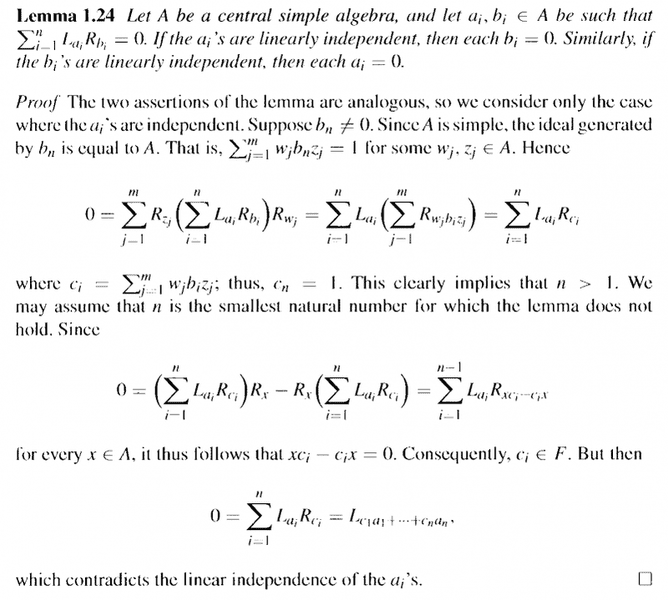
I need some further help with the statement and proof of Lemma 1.24 ...

Lemma 1.24 reads as follows:
?temp_hash=092a942624b9c0487a3dfca35ccaad07.png

My further questions regarding Bresar's statement and proof of Lemma 1.24 are as follows:Question 1

In the statement of Lemma 1.24 we read the following:

" ... ... Let ##A## be a central simple algebra. ... ... "I am assuming that since ##A## is central, it is unital ... that is there exists ##1_A \in A## such that ##x.1 = 1.x = 1## for all ##x \in A## ... ... is that correct ... ?
Question 2

In the proof of Lemma 1.24 we read the following:

" ... ... Suppose ##b_n \ne 0##. ... ... "I am assuming that that the assumption ##b_n \ne 0## implies that we are also assuming

that ##b_1 = b_2 = \ ... \ ... \ = b_{n-1} = 0## ... ...

Is that correct?

Question 3

In the proof of Lemma 1.24 we read the following:

" ... ...where ##c_i = \sum_{ j = 1 }^m w_j b_i z_j## ; thus ##c_n = 1## for some ##w_j, z_j \in A## ... ...

This clearly implies that ##n \gt 1##. ... ... "My question is ... why/how exactly must ##n \gt 1## ... ?

Further ... and even more puzzling ... what is the relevance to the proof of the statements that ##c_n = 1## and ##n \gt 1## ... ?

Why do we need these findings to establish that all the ##b_i = 0## ... ?

Hope someone can help ...

Peter

===========================================================*** NOTE ***

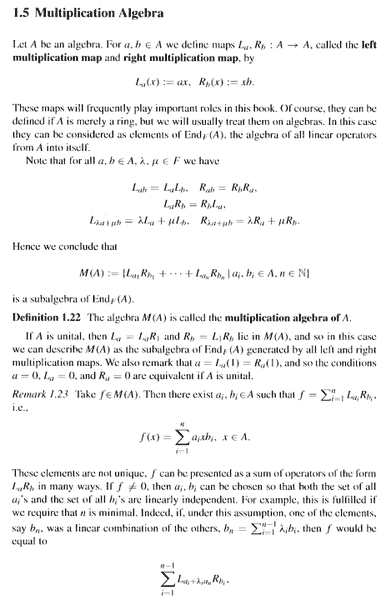
So that readers of the above post will be able to understand the context and notation of the post ... I am providing Bresar's first two pages on Multiplication Algebras ... ... as follows:
?temp_hash=092a942624b9c0487a3dfca35ccaad07.png

?temp_hash=092a942624b9c0487a3dfca35ccaad07.png
 

Attachments

  • Bresar - Lemma 1.24 ... ....png
    Bresar - Lemma 1.24 ... ....png
    85.9 KB · Views: 965
  • Bresar - 1 - Section 1.5 Multiplication Algebra - PART 1 ... ....png
    Bresar - 1 - Section 1.5 Multiplication Algebra - PART 1 ... ....png
    27.6 KB · Views: 586
  • Bresar - 2 - Section 1.5 Multiplication Algebra - PART 2 ... ....png
    Bresar - 2 - Section 1.5 Multiplication Algebra - PART 2 ... ....png
    29.5 KB · Views: 571
Last edited:
Physics news on Phys.org
Math Amateur said:
Question 1

In the statement of Lemma 1.24 we read the following:

" ... ... Let ##A## be a central simple algebra. ... ... "I am assuming that since ##A## is central, it is unital ... that is there exists ##1_A \in A## such that ##x.1 = 1.x = 1## for all ##x \in A## ... ... is that correct ... ?
Central means the center ## C(A) ## of ##A## is equal to the corresponding scalar domain, i.e. a field or a division ring at least. Since the center is part of the algebra, the field ##\mathbb{F} =C(A) ## is contained in the algebra. Then ##1_\mathbb{F} \in A##. So ##1_\mathbb{F}=1_A##, because it does what a one has to do: ##1_\mathbb{F}\cdot a = a## and there cannot be two different ones: ##1=1\,\cdot\,1'= 1'##.
Question 2

In the proof of Lemma 1.24 we read the following:

" ... ... Suppose ##b_n \ne 0##. ... ... "I am assuming that that the assumption ##b_n \ne 0## implies that we are also assuming

that ##b_1 = b_2 = \ ... \ ... \ = b_{n-1} = 0## ... ...

Is that correct?
No. We only assume at least one ##b_i \neq 0## to derive a contradiction. So without loss of generality, we assume it to be ##b_n##, for otherwise we would simply change the numbering. We don't bother ## b_1, \ldots ,b_{n-1}##. They may be equal to zero or not. Only the case in which all are zero is ruled out, for then we would have nothing to show: the ##a_i## would be linear independent.
Question 3

In the proof of Lemma 1.24 we read the following:

" ... ...where ##c_i = \sum_{ j = 1 }^m w_j b_i z_j## ; thus ##c_n = 1## for some ##w_j, z_j \in A## ... ...

This clearly implies that ##n \gt 1##. ... ... "My question is ... why/how exactly must ##n \gt 1## ... ?
If ##n=1## then ##\left( \sum_{i=1}^n L_{a_i}R_{c_i} \right)(x) = (L_{a_1}R_{c_1})(x)=a_1 \cdot x \cdot c_1=a_1 \cdot x=0## for all ##x \in A##, because ##c_n=c_1=1##. Especially ##a_1\cdot 1_\mathbb{F} = a_1 = 0##, but the ##a_i## are linear independent, so they cannot equal ##0##.
Further ... and even more puzzling ... what is the relevance to the proof of the statements that ##c_n = 1## and ##n \gt 1## ... ?
It is important for the sum in ##0=\sum_{i=1}^{n-1} L_{a_i}R_{xc_i-c_i x}## being a real sum and not only trivially fulfilled.
Why do we need these findings to establish that all the ##b_i = 0## ... ?
They are used to show all ##c_i \in \mathbb{F}##. Then ##c_1a_1+\ldots c_na_n## is not only an equation in ##A## but a linear one with coefficients in ##\mathbb{F}##. Now if ##0=L_{c_1a_1+\ldots c_na_n}## then ##0=L_{c_1a_1+\ldots c_na_n}(1_\mathbb{F})=(c_1a_1+\ldots c_na_n)\cdot 1_\mathbb{F}=c_1a_1+\ldots c_na_n## and the ##a_i## are linear dependent over ##\mathbb{F}##, because at least ##c_n \neq 0## and we have our contradiction.
 
  • Like
Likes   Reactions: Math Amateur
Thanks fresh_42 ...

That post was INCREDIBLY helpful!

Peter
 

Similar threads

  • · Replies 2 ·
Replies
2
Views
2K
Replies
2
Views
2K
  • · Replies 11 ·
Replies
11
Views
2K
  • · Replies 6 ·
Replies
6
Views
2K
  • · Replies 14 ·
Replies
14
Views
2K
  • · Replies 3 ·
Replies
3
Views
2K
  • · Replies 4 ·
Replies
4
Views
2K
  • · Replies 2 ·
Replies
2
Views
2K
  • · Replies 2 ·
Replies
2
Views
2K
Replies
3
Views
2K