Multivariable Analysis ....the derivative & the differential

Click For Summary
SUMMARY

The discussion centers on the distinction between the derivative and the differential as presented in Hugo D. Junghenn's "A Course in Real Analysis," specifically in Chapter 9 on differentiation in ##\mathbb{R}^n##. The derivative, denoted as ##f'(a)##, is identified as a vector, while the differential, represented as ##df_a \in \mathscr{L}(\mathbb{R}^n, \mathbb{R})##, is defined as a linear transformation. The two concepts cannot be equated, as they represent different mathematical objects: the derivative is a vector and the differential is a linear map. The relationship between them is clarified through the components of the Jacobian matrix, which are identical for both representations.

PREREQUISITES
  • Understanding of vector calculus and linear transformations
  • Familiarity with the concepts of derivatives and differentials in multivariable calculus
  • Knowledge of Jacobian matrices and their role in linear approximations
  • Basic comprehension of mathematical notation in real analysis
NEXT STEPS
  • Study the concept of Jacobian matrices in detail
  • Explore the applications of linear transformations in multivariable calculus
  • Review the definitions and properties of total derivatives
  • Investigate the differences in terminology across various mathematical texts
USEFUL FOR

Students and professionals in mathematics, particularly those studying real analysis, multivariable calculus, or anyone seeking to clarify the distinctions between derivatives and differentials in mathematical contexts.

Math Amateur
Gold Member
MHB
Messages
3,920
Reaction score
48
I am reading Hugo D. Junghenn's book: "A Course in Real Analysis" ...

I am currently focused on Chapter 9: "Differentiation on ##\mathbb{R}^n##" ... ...

I need some help with another aspect of Definition 9.1.3 ...

Definition 9.1.3 and the relevant accompanying text read as follows:
Junghenn - 1 -  Definition 9.1.3   ... PART 1 ... .png

Junghenn - 2 -  Definition 9.1.3   ... PART 2 ... .png

In the above text from Junghenn we read the following:

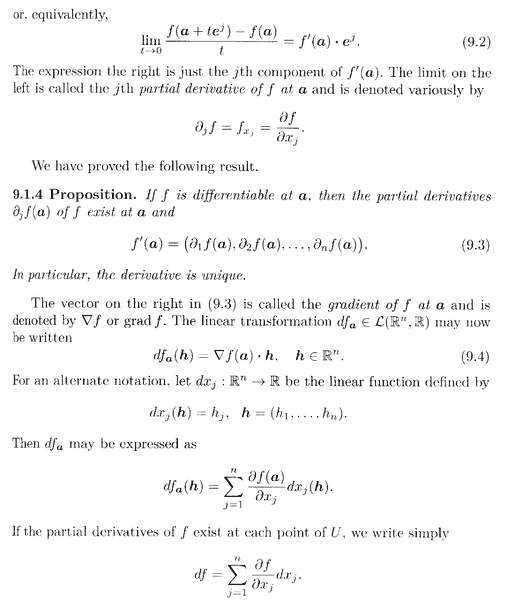
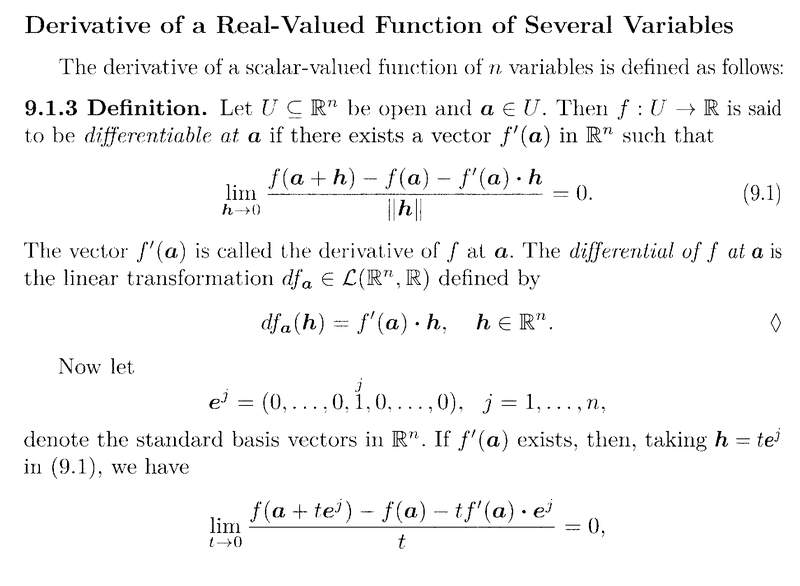
" ... ... The vector ##f'(a)## is called the derivative of ##f## at ##a##. The differential of ##f## at ##a## is the linear transformation ## df_a \in \mathscr{L} ( \mathbb{R}^n, \mathbb{R} )## defined by

##df_a(h) = f'(a) \cdot h, \ \ \ \ \ \ (h \in \mathbb{R}^n )## ... ... ... "My question is as follows:Is the derivative essentially equivalent to the differential ... can we write ##df_a = f'(a)## ... if if we can't ... then why not?

... ... indeed, what is the exact difference between the derivative and the differential ...(I know I have asked a general question like this before ... but this is now in the specific context of Junghenn ...)

Hope someone can help to clarify the above ...

Peter=============================================================================

In another post it was pointed out to me that the terms total derivative and differential are sometimes used for the same concept ... but this author seems to employ both the term derivative (and Junghenn seems to be defining a total derivative for a scalar function) and differential ...

It may also be that the derivative is ##f'(a)## and the differential is ##df_a(h) = f'(a) \cdot h## ... but then Junghenn states that the differential is ##df_a## ... and hence not ##df_a(h)## ...

Maybe I am making too much of the difference between ##df_a## and ##df_a(h)## ... ...

But my apologies to mathwonk and others if I have misunderstood their posts ...

Peter
 

Attachments

  • Junghenn - 1 -  Definition 9.1.3   ... PART 1 ... .png
    Junghenn - 1 - Definition 9.1.3 ... PART 1 ... .png
    33.8 KB · Views: 1,124
  • Junghenn - 2 -  Definition 9.1.3   ... PART 2 ... .png
    Junghenn - 2 - Definition 9.1.3 ... PART 2 ... .png
    24.4 KB · Views: 588
Last edited:
Physics news on Phys.org
Math Amateur said:
Is the derivative essentially equivalent to the differential ... can we write ##df_a = f'(a)## ... if if we can't ... then why not?

... ... indeed, what is the exact difference between the derivative and the differential ...
This particular author has chosen to call the derivative the vector in ##\mathbb R^n## that is labelled ##f'(\mathbf a)##, whereas he calls the differential the linear transformation ##df_a\in\mathscr L(\mathbb R^n,\mathbb R)##. So one is a vector and the other is a linear map.

The relationship between the two is that the components of the Jacobian matrix of the linear map ##df_a## are the same as those of the vector ##f'(\mathbf a)##.

We can't write ##df_a=f'(\mathbf a)## because they are different types of objects.

Bear in mind that the use of these terms is not universal and will vary between authors, so swapping from one book to another can cause confusion. There will very likely be inconsistencies.
 
  • Like
Likes   Reactions: Math Amateur
andrewkirk said:
This particular author has chosen to call the derivative the vector in ##\mathbb R^n## that is labelled ##f'(\mathbf a)##, whereas he calls the differential the linear transformation ##df_a\in\mathscr L(\mathbb R^n,\mathbb R)##. So one is a vector and the other is a linear map.

The relationship between the two is that the components of the Jacobian matrix of the linear map ##df_a## are the same as those of the vector ##f'(\mathbf a)##.

We can't write ##df_a=f'(\mathbf a)## because they are different types of objects.

Bear in mind that the use of these terms is not universal and will vary between authors, so swapping from one book to another can cause confusion. There will very likely be inconsistencies.
Thanks Andrew ...

Reflecting on what you have written...

Thanks again...

Peter
 
andrewkirk said:
We can't write ##df_a=f'(\mathbf a)## because they are different types of objects.
One additional remark. As for any vector ##v## there is a unique linear mapping ##w \rightarrow \langle w,v \rangle = \sum w_iv_i## and vice versa. This duality establishes a one-to-one correspondence (matrix - linear function) between the two, which is especially in physics important to distinguish - not so much in mathematics (IMO) as usually the context makes clear which one is meant.

The confusion normally arises when the differential, resp. derivative is called a linear map. Take for example ##f(x)=x^3\,.## We are used to write ##f\,'(x)=3x^2## and no linear map is in sight, so where is it? The difference lies in ##a##. We better should have written ## f\,'(a)=3a^2## because the derivative takes place at a certain point, a location where the differential is evaluated, where ##f\,'## represents a linear approximation to ##f##. Here we have ##f\,'(a)=\left. \dfrac{d}{dx}\right|_{x=a} x^3 =3x^2|_{x=a}=3a^2## as the derivative and ##df_a = D_af \, : \, (\,w \longmapsto 3a^2\cdot w\,)## which is a linear transformation (in ##w##). Although our vector here has only one component, and the Jacobi matrix is a ##(1\times 1)-##matrix, everything said has still to be right, because we simply have ##n=1\,.##

This means
andrewkirk said:
This particular author has chosen to call the derivative the vector in ##\mathbb R^n## that is labelled ##f'(\mathbf a)##,...
##(3a^2)_{1\leq i \leq 1}## is the derivative and vector ##f\,'(a)## here ...
... whereas he calls the differential the linear transformation ##df_a\in\mathscr L(\mathbb R^n,\mathbb R)##. So one is a vector and the other is a linear map.
... and ##df_a = \text{ times }3a^2## is the differential and linear transformation.
The only difference here is a tiny multiplication dot.
 
Last edited:
  • Like
Likes   Reactions: Math Amateur

Similar threads

Replies
2
Views
1K
  • · Replies 2 ·
Replies
2
Views
1K
  • · Replies 5 ·
Replies
5
Views
2K
Replies
2
Views
2K
  • · Replies 6 ·
Replies
6
Views
2K
  • · Replies 4 ·
Replies
4
Views
2K
Replies
1
Views
1K
  • · Replies 8 ·
Replies
8
Views
2K
  • · Replies 1 ·
Replies
1
Views
2K
Replies
11
Views
2K