sss1
- 50
- 2
- Homework Statement
- Image
- Relevant Equations
- NA
I just wanted to know if my solution to part (b) is correct. Here's what I did:
I took the partial derivative with respect to x and y, which gave me
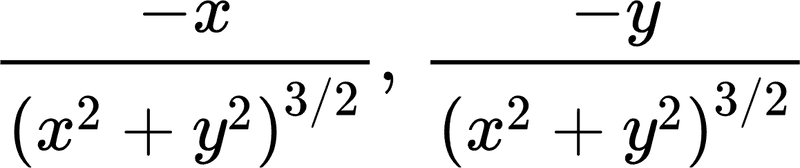 respectively.
Then I computed the partial derivatives at (-3,4) which gave me 3/125 for partial derivative wrt x and -4/125 for partial derivative wrt y
Then since directional derivative requires a direction, I just chose an arbitrary one, uhat=(a,b)
since u is a unit vector that means sqrt(a^2+b^2)=1, or a^2+b^2=1.
I then solved for a, which is the plus minus of sqrt(1-b^2).
I just chose to use the positive answer here instead.
So the directional derivative is 3sqrt(1-b^2)/125-4b/125
To maximise this I took the derivative, which is -3b/125sqrt(1-b^2)-4/125
I set it to 0 and solved for b, which gave me -4/5.
So there is a local maximum for the directional derivative at b=-4/5 (I evaluated the second derivative and it was positive).
So that means on both sides of b=-4/5 the directional derivative decreases.
Subsituting b=-0.8 into my formula for a, a=sqrt(1-b^2), gives me a=0.6
So the directional derivative should be a maximum in the direction given by the unit vector (0.6, -0.8, 0) with magnitude 0.6(3/125)-0.8(-4/125) which is 0.04?
Although I didn't try the negative answer for a, a=-sqrt(1-b^2), I believe that this will yield a smaller answer because if a is negative, then a negative number times a positive number (3/125) will decrease the answer overall? Is my logic correct?
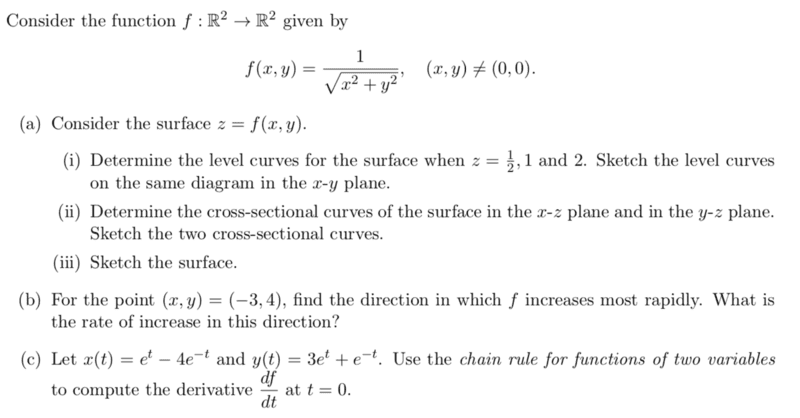
I took the partial derivative with respect to x and y, which gave me
Then I computed the partial derivatives at (-3,4) which gave me 3/125 for partial derivative wrt x and -4/125 for partial derivative wrt y
Then since directional derivative requires a direction, I just chose an arbitrary one, uhat=(a,b)
since u is a unit vector that means sqrt(a^2+b^2)=1, or a^2+b^2=1.
I then solved for a, which is the plus minus of sqrt(1-b^2).
I just chose to use the positive answer here instead.
So the directional derivative is 3sqrt(1-b^2)/125-4b/125
To maximise this I took the derivative, which is -3b/125sqrt(1-b^2)-4/125
I set it to 0 and solved for b, which gave me -4/5.
So there is a local maximum for the directional derivative at b=-4/5 (I evaluated the second derivative and it was positive).
So that means on both sides of b=-4/5 the directional derivative decreases.
Subsituting b=-0.8 into my formula for a, a=sqrt(1-b^2), gives me a=0.6
So the directional derivative should be a maximum in the direction given by the unit vector (0.6, -0.8, 0) with magnitude 0.6(3/125)-0.8(-4/125) which is 0.04?
Although I didn't try the negative answer for a, a=-sqrt(1-b^2), I believe that this will yield a smaller answer because if a is negative, then a negative number times a positive number (3/125) will decrease the answer overall? Is my logic correct?
Last edited by a moderator: