Must even functions have even number of nodes?

  • Context: Undergrad 
  • Thread starter Thread starter Happiness
  • Start date Start date
  • Tags Tags
    even Functions Nodes
Click For Summary

Discussion Overview

The discussion revolves around the properties of even functions, particularly in relation to the number of nodes they possess. Participants explore the implications of symmetry in wave functions, the definition of nodes, and the conditions under which these functions satisfy the Schrödinger equation. The scope includes theoretical considerations and mathematical reasoning.

Discussion Character

  • Exploratory
  • Technical explanation
  • Debate/contested
  • Mathematical reasoning

Main Points Raised

  • Some participants question why even functions must have an even number of nodes, citing examples like ##y=\sin^2x##, which is even but has an odd number of nodes in certain intervals.
  • Others argue that a function must intersect the f=0 axis an even number of times if it goes to 0 at ##\pm\infty##, suggesting a contradiction with the example of ##y=\sin^2x##.
  • Clarifications are made regarding the definition of a node as a point where the wave function changes sign.
  • Some participants propose that wave functions that do not change sign after touching the x-axis may be physically unacceptable, referencing the Schrödinger equation.
  • A later reply introduces a hand-wavy proof regarding the behavior of even functions near ##x=0## and their implications for the number of nodes.
  • Concerns are raised about potential mistakes in the mathematical reasoning presented, particularly regarding limits and the behavior of functions at ##x=0##.
  • One participant simplifies the analysis by stating that if a function is even, the total number of nodes must be even, depending on whether there is a node at ##x=0##.
  • Disagreement arises over the interpretation of nodes and the implications for the validity of certain wave functions.
  • Some participants conclude that a specific textbook may have overlooked important conditions regarding symmetric potentials.

Areas of Agreement / Disagreement

Participants express multiple competing views regarding the relationship between even functions and the number of nodes. The discussion remains unresolved, with no consensus reached on the implications of the examples provided or the definitions used.

Contextual Notes

Limitations include assumptions about the behavior of wave functions at infinity, the definition of nodes, and the conditions under which the Schrödinger equation is satisfied. The discussion also highlights the complexity of analyzing functions near critical points like ##x=0##.

Happiness
Messages
686
Reaction score
30
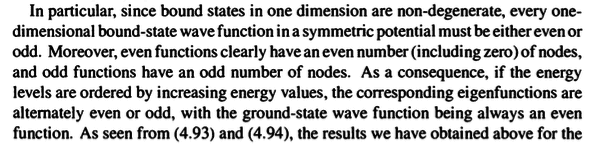
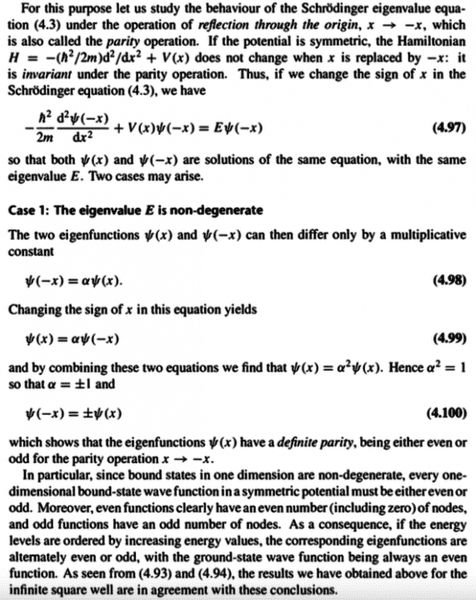
The following text considers the possible wave functions when the potential is symmetric about ##x=0##.
Screen Shot 2015-12-10 at 5.03.57 am.png


Why must even functions have an even number of nodes?
##y=sin^2x## is even but always have an odd number of nodes in any interval centred about ##x=0##.

The part preceding the above text:
Screen Shot 2015-12-10 at 5.05.24 am.png
 
Physics news on Phys.org
Happiness said:
Why must even functions have an even number of nodes?
Function has to go to 0 at ##\pm\infty## so it has to intersect the f=0 axis an even number of times.
## y=sin^2x## is even but always have an odd number of nodes in any interval centered about ##x=0.##
I don't see that.
 
BvU said:
I don't see that.

##y=sin^2x## has a node at ##x=0##. So the number of nodes is always 1, 3, 5, ...
 
What is meant by node here is a point where the wave function changes sign.
 
  • Like
Likes   Reactions: Demystifier and Happiness
DrClaude said:
What is meant by node here is a point where the wave function changes sign.

Is there a reason why wave functions that do not change sign after touching the ##x##-axis are physically unacceptable?
 
  • Like
Likes   Reactions: BvU
I find "the points in space where at which a wave function goes through zero are called its nodes"
(Eugen Merzbacher, Quantum mechanics 2nd ed ).​
 
Happiness said:
Is there a reason why wave functions that do not change sign after touching the ##x##-axis are physically unacceptable?
Good question. All I can come up with is that in that case the wave function is zero and the second derivative is positive. Can't satisfy the Schroedinger equation...
 
  • Like
Likes   Reactions: Happiness
It's not that an even function must have an even number of nodes, but that one satisfying the Schrödinger equation, with a non-infinite potential, must have an even number of nodes.

First of all, if [itex]\psi(x)[/itex] is even, then that means that the only way it can have an odd number of nodes is if [itex]\psi(0) = 0[/itex]

Here's a hand-wavy proof. Near [itex]x=0[/itex], assume that [itex]\psi(x) = A x^n +[/itex] terms that are higher-order in [itex]x[/itex]. Now, take two derivatives:

[itex]\psi''(x) = n (n-1) A x^{n-2} +[/itex] higher-order terms.

By Schrödinger's equation, for an energy eigenstate,

[itex]\psi''(x) = -\frac{2m}{\hbar^2} (E-V(x)) \psi(x) = -\frac{2m}{\hbar^2} (E-V(x)) A x^n +[/itex] higher order terms.

So we have:
[itex]n (n-1) A x^{n-2} = -\frac{2m}{\hbar^2} (E-V(x)) A x^n +[/itex] higher order terms.

Divide through by [itex]A x^{n-2}[/itex] to get:

[itex]n (n-1) = -\frac{2m}{\hbar^2} (E-V(x)) x^2 +[/itex] higher order terms.

Now, if [itex]V[/itex] is finite at [itex]x=0[/itex], then the right-side is zero at [itex]x=0[/itex]. So the left side must be zero, also. This implies that:

[itex]n=0[/itex] or [itex]n=1[/itex]

That means that near [itex]x=0[/itex], [itex]\psi(x)[/itex] either behaves like a constant [itex]A[/itex], or it behaves linearly, like [itex]Ax[/itex]. The first choice implies that [itex]\psi(0)[/itex] is nonzero. The second choice implies that [itex]\psi[/itex] is odd near [itex]x=0[/itex].
 
  • Like
Likes   Reactions: Demystifier, Happiness and BvU
BvU said:
Good question. All I can come up with is that in that case the wave function is zero and the second derivative is positive. Can't satisfy the Schroedinger equation...

But for ##y=sin^4x##, ##y## is zero and its second derivative is also zero at ##x=0##.
 
  • #10
stevendaryl said:
So we have:
[itex]n (n-1) A x^{n-2} = -\frac{2m}{\hbar^2} (E-V(x)) A x^n +[/itex] higher order terms.

Divide through by [itex]A x^{n-2}[/itex] to get:

Is there a mistake here?

If we substitute ##x=0##, we can get LHS ##= 0 =## RHS without having ##n = 0## or ##n = 1##.
 
  • #11
Happiness said:
Is there a mistake here?

If we substitute ##x=0##, we can get LHS ##= 0 =## RHS without having ##n = 0## or ##n = 1##.

You have two functions of [itex]x[/itex] that are equal: [itex]f(x) = g(x)[/itex], where [itex]f(x) = n(n-1) A x^{n-2} +[/itex] higher order terms, and [itex]g(x) = -\frac{2m}{\hbar^2} (E - V(x)) A x^n +[/itex] higher-order terms. If the functions are equal, then [itex]f(x)/(A x^{n-2}) = g(x)/(A x^{n-2})[/itex], as functions of [itex]x[/itex]. This means that:

[itex]n(n-1) +[/itex] higher-order terms = [itex](E - V(x)) x^2 +[/itex] higher-order terms

The equality must be true for every value of [itex]x[/itex] (in the region of convergence of the power series, anyway). So in particular, it must be true in the limit as [itex]x \rightarrow 0[/itex]. So we must have:

[itex]lim_{x \rightarrow 0}[/itex] of [itex]n(n-1) +[/itex] higher-order terms = [itex]lim_{x \rightarrow 0}[/itex] of [itex](E - V(x)) x^2 +[/itex] higher-order terms

The left-hand limit is [itex]n (n-1)[/itex]. The right-hand limit is 0. So [itex]n(n-1) = 0[/itex].
 
  • #12
stevendaryl said:
You have two functions of [itex]x[/itex] that are equal: [itex]f(x) = g(x)[/itex], where [itex]f(x) = n(n-1) A x^{n-2} +[/itex] higher order terms, and [itex]g(x) = -\frac{2m}{\hbar^2} (E - V(x)) A x^n +[/itex] higher-order terms. If the functions are equal, then [itex]f(x)/(A x^{n-2}) = g(x)/(A x^{n-2})[/itex], as functions of [itex]x[/itex]. This means that:

[itex]n(n-1) +[/itex] higher-order terms = [itex](E - V(x)) x^2 +[/itex] higher-order terms

The equality must be true for every value of [itex]x[/itex] (in the region of convergence of the power series, anyway). So in particular, it must be true in the limit as [itex]x \rightarrow 0[/itex]. So we must have:

[itex]lim_{x \rightarrow 0}[/itex] of [itex]n(n-1) +[/itex] higher-order terms = [itex]lim_{x \rightarrow 0}[/itex] of [itex](E - V(x)) x^2 +[/itex] higher-order terms

The left-hand limit is [itex]n (n-1)[/itex]. The right-hand limit is 0. So [itex]n(n-1) = 0[/itex].

Let [itex]f(x) = n(n-1) A x^{n-2} +[/itex] higher-order terms, and [itex]g(x) = -\frac{2m}{\hbar^2} (E - V(x)) A x^n +[/itex] higher-order terms.

But [itex]lim_{x \rightarrow 0}[/itex] [itex]f(x) = 0[/itex], and [itex]lim_{x \rightarrow 0}[/itex] [itex]g(x) = 0[/itex], without having [itex]n(n-1) = 0[/itex],

and [itex]lim_{x \rightarrow 0}[/itex] [itex]\frac{f(x)}{A x^{n-2}} = \infty[/itex], and [itex]lim_{x \rightarrow 0}[/itex] [itex]\frac{g(x)}{A x^{n-2}} = \infty[/itex], without having [itex]n(n-1) = 0[/itex].
 
  • #13
Happiness said:
Let [itex]f(x) = n(n-1) A x^{n-2} +[/itex] higher-order terms, and [itex]g(x) = -\frac{2m}{\hbar^2} (E - V(x)) A x^n +[/itex] higher-order terms.

But [itex]lim_{x \rightarrow 0}[/itex] of [itex]f(x) = 0[/itex], and [itex]lim_{x \rightarrow 0}[/itex] of [itex]g(x) = 0[/itex], without having [itex]n(n-1) = 0[/itex]

and [itex]lim_{x \rightarrow 0}[/itex] of [itex]f(x))/(A x^{n-2}) = \infty[/itex], and [itex]lim_{x \rightarrow 0}[/itex] of [itex]g(x))/(A x^{n-2}) = \infty[/itex], without having [itex]n(n-1) = 0[/itex]
[itex]lim_{x \rightarrow 0}[/itex] of [itex]f(x))/(A x^{n-2})[/itex] is equal to [itex]n(n-1)[/itex], not infinity.

Let's try the example with [itex]n=0[/itex]. Then we have
[itex]f(x) = n (n-1) A/x^2[/itex]
[itex]g(x) = -\frac{2m}{\hbar^2} (E - V(x)) A[/itex]

If [itex]n(n-1) \neq 0[/itex], then the left side blows up at [itex]x=0[/itex]. The right side does not. So they can't be equal. They can only be equal if [itex]n(n-1) = 0[/itex].
 
Last edited:
  • Like
Likes   Reactions: Happiness
  • #14
I think you all over-complicate. Here is a very simple analysis:

Let ##f(x)## be a function defined for real numbers ##x##. Let ##N_+## be number of nodes with ##x>0## and let ##N_-## be number of nodes with ##x<0##. If ##f(x)## is even, then ##N_+=N_-##, so the total number of nodes at all points ##x\neq 0## is ##2N_+##, which is even. Thus we have the following result:
If there is no node at ##x=0##, then the total number of nodes is ##2N_+##, which is even.
If there is a node at ##x=0##, then the total number of nodes is ##2N_+ +1##, which is odd.
Q.E.D.

Of course, the assumption is that the number of nodes is finite. The infinity is neither even nor odd. In particular, the number of nodes in ##\sin x## is neither even nor odd.
 
Last edited:
  • #15
But that does not eliminate the case where there is a node at ##x=0##, whose elimination is what is required.
 
  • #16
Happiness said:
But that does not eliminate the case where there is a node at ##x=0##, whose elimination is what is required.
You are right, and all I can conclude from that is that the book is wrong. By the way, which book was that?
 
  • #17
Demystifier said:
You are right, and all I can conclude from that is that the book is wrong. By the way, which book was that?

It's Quantum Mechanics by B H Bransden and C J Joachain, 2nd edition, page 160.

The book is not wrong (though it forgets to mention that the symmetric potential must be finite at ##x=0##). The proof is given by stevendaryl.
 
  • #18
Happiness said:
The book is not wrong (though it forgets to mention that the symmetric potential must be finite at ##x=0##). The proof is given by stevendaryl.
You are right. I overlooked the fact that the node is defined not merely by ##f=0##, but by a change of sign. That excludes ##x^2## behavior near ##x=0##, which I overlooked.

Anyway, with this insight, his analysis around ##x=0## can be much simplified:
The function at ##x=0## either changes the sign or does not change the sign. If it does, then it is not even. If it doesn't, then it is not the node. Q.E.D.
 
  • #19
Demystifier said:
You are right. I overlooked the fact that the node is defined not merely by ##f=0##, but by a change of sign. That excludes ##x^2## behavior near ##x=0##, which I overlooked.

A node does not need a change of sign.

Even if you do accept that definition, it does not solve the problem because although it does make the statement correct by itself, it does not imply the following statement. For eigenfunctions to be alternately even and odd, we must show that even solutions can only have even number of zeros.
 
  • #20
Happiness said:
A node does not need a change of sign.
Then how do you define the node?

Happiness said:
Even if you do accept that definition, it does not solve the problem because although it does make the statement correct by itself, it does not imply the following statement. For eigenfunctions to be alternately even and odd, we must show that even solutions only have even number of zeros.
If ##x=0## is excluded, then I have shown that the number of zeros of even function is even (provided that their number is finite).
 
  • #21
Demystifier said:
I think you all over-complicate. Here is a very simple analysis:

Let ##f(x)## be a function defined for real numbers ##x##. Let ##N_+## be number of nodes with ##x>0## and let ##N_-## be number of nodes with ##x<0##. If ##f(x)## is even, then ##N_+=N_-##, so the total number of nodes at all points ##x\neq 0## is ##2N_+##, which is even. Thus we have the following result:
If there is no node at ##x=0##, then the total number of nodes is ##2N_+##, which is even.
If there is a node at ##x=0##, then the total number of nodes is ##2N_+ +1##, which is odd.
Q.E.D.

That's not the QED. The question was: if the function is even (meaning [itex]\psi(x) = \psi(-x)[/itex]), then why must it have an even number of nodes. Your analysis shows that the question can be restated as:

If [itex]\psi(x)[/itex] is even, then how do we know that it doesn't have a node at [itex]x=0[/itex]?​

A counter-example might be something like: [itex]\psi(x) = (A x^2 - B x^4) e^{-\lambda x^2}[/itex]. That's even, but it has an odd number of nodes, at [itex]x=0[/itex] and [itex]x = \pm \sqrt{\frac{A}{B}}[/itex]. My claim is that such a function can't satisfy the Schrödinger equation (unless the potential goes to infinity at [itex]x=0[/itex]).
 
  • Like
Likes   Reactions: BvU and Demystifier
  • #22
stevendaryl said:
My claim is that such a function can't satisfy the Schrödinger equation (unless the potential goes to infinity at x=0).
You are right!
 

Similar threads

Replies
3
Views
3K
  • · Replies 6 ·
Replies
6
Views
2K
  • · Replies 2 ·
Replies
2
Views
1K
  • · Replies 10 ·
Replies
10
Views
2K
  • · Replies 1 ·
Replies
1
Views
1K
  • · Replies 3 ·
Replies
3
Views
1K
  • · Replies 3 ·
Replies
3
Views
2K
  • · Replies 7 ·
Replies
7
Views
2K
  • · Replies 9 ·
Replies
9
Views
2K
  • · Replies 4 ·
Replies
4
Views
5K