NASA: We're sending humans to Mars

  • Context: NASA 
  • Thread starter Thread starter Greg Bernhardt
  • Start date Start date
  • Tags Tags
    Mars Nasa
Click For Summary

Discussion Overview

The discussion centers around NASA's announcement of plans to send humans to Mars using the Orion space capsule. Participants explore the feasibility, implications, and potential timelines of such a mission, touching on various aspects including budgetary concerns, technological readiness, and the necessity of preliminary steps like establishing a moon base.

Discussion Character

  • Debate/contested
  • Exploratory
  • Technical explanation
  • Conceptual clarification

Main Points Raised

  • Some participants express excitement about the prospect of humans landing on Mars, with personal hopes for witnessing it within their lifetimes.
  • Others raise skepticism regarding the 2030 timeline, citing historical delays in space projects and questioning the scientific value of sending humans to Mars.
  • Concerns are voiced about NASA's budgetary constraints and whether the Mars mission is a strategic move to secure funding.
  • A few participants suggest that establishing a moon base should precede any Mars mission, arguing that it is a necessary step for long-term human space exploration.
  • Some participants propose alternative ideas, such as sending advanced virtual reality equipment to experience Mars remotely instead of manned missions.
  • Technical discussions include the costs associated with sending humans to Mars, including the mass of supplies needed for the journey.
  • There are references to doubts expressed by experts, including those from reputable institutions, about the viability of long-term human habitation on Mars.

Areas of Agreement / Disagreement

Participants exhibit a mix of excitement and skepticism regarding the Mars mission, with no clear consensus on the feasibility of the proposed timeline or the necessity of the mission itself. Multiple competing views remain on the best approach to human space exploration.

Contextual Notes

Participants highlight various assumptions, such as the reliability of current space capsules and the public interest in Mars versus the Moon. There are unresolved questions regarding the engineering challenges of proposed technologies, like a moon-based rail gun.
Messages
19,881
Reaction score
10,890
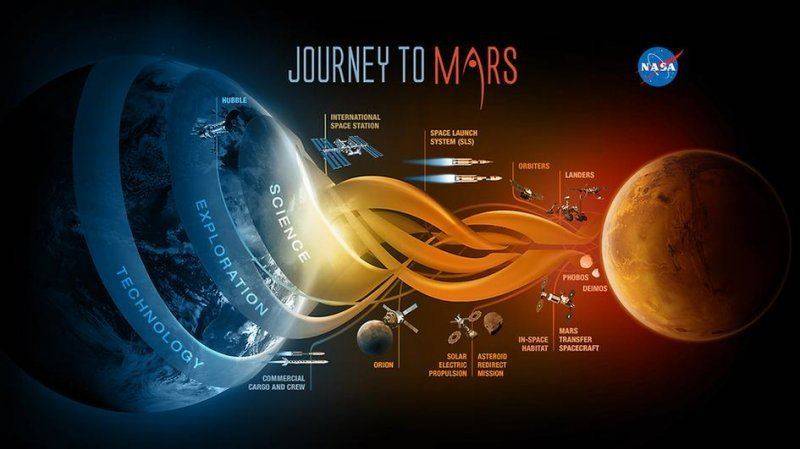
NASA Officially Announce Plans To Put Humans On Mars With Orion Space Capsule
http://www.huffingtonpost.co.uk/2014/12/02/orion-nasa-humans-mars_n_6255740.html

"We're sending humans to Mars! Watch our #JourneytoMars briefing live today at 12pm ET: http://www.nasa.gov/nasatv #Orion "

B33OkExCcAAKD5e.jpg
 
  • Like
Likes   Reactions: OmCheeto
Physics news on Phys.org
I can't wait for the day that this actually happens. My family won't care but I sure will. What a time to be alive :)
 
  • Like
Likes   Reactions: elusiveshame, Peacemaker 501, OmCheeto and 1 other person
  • Like
Likes   Reactions: Monsterboy
I guess we'll see what happens over the coming years. :)
It's be great to see people land on Mars in my lifetime. Preferably before I'm 50.
 
I hate to be a nay-sayer, but it took 22 years to launch the JWST, if it does fly in 2018 as planned, and that's an Earth orbiting satellite with no people on it. The budgetary environment has never been worse at any time in NASA history, it's not clear the scientific value in putting people on Mars in the first place, and there are a huge number of hurdles to get over. I have to think the 2030 timetable is pure wishful thinking, it doesn't even sound the least bit plausible to me. I'd like to be wrong, it would be great to see humans on Mars, but it would be lousy to see dead humans orbiting in the solar system for centuries. In my opinion, the first human on Mars will have to fund the trip themself, and will plan on a one-way trip. It seems like a generally better way to go would be to send advanced virtual reality hardware, and bring the experience of being on Mars back to Earth remotely. I'd rather know the timetable on that.
 
NASA knows "No bucks without Buck Rogers". This whole thing looks like a Gruberesque attempt to improve NASA's dire budgetary situation.
 
  • Like
Likes   Reactions: mheslep
Drakkith said:
I guess we'll see what happens over the coming years. :)
It's be great to see people land on Mars in my lifetime. Preferably before I'm 50.

I was 2 years old when Gagarin became the first Earthing in space.
I would prefer they make it to Mars before I'm 100.

Hmmm... Have you ever seen the 1964 version of "First Men in the Moon". The final scene is of a very old man looking through a telescope at the moon.

2014.12.02.2322.fmitm.nasty.cold.jpg


Perhaps by the time I'm 100, I'll have purchased a telescope, and will find Mars, and make a joke about one of the astronauts having a nasty cold. :)


Ha! It's been a while since I've seen the movie. Watching the trailer, at about t=1:45, you'll see a long tunnel. Just a couple of weeks ago, I was thinking we should first set up a colony on the moon, excavate a really long linear tunnel, and build a rail gun to propel ships to the planets. I wonder if I got the idea from the movie?

Someone get me Elon Musk's phone number! :D
 
Vanadium 50 said:
NASA knows "No bucks without Buck Rogers". This whole thing looks like a Gruberesque attempt to improve NASA's dire budgetary situation.

You're right about this. This whole thing smells of a PR stunt, or a "Look! A squirrel!" kind of misdirection. I wonder when the other shoe is going to drop.
 
  • #10
No matter what they are trying to get from this, I am still hyped. If the schedule works as planned and they launch the mission by the mid-2030's, then I would only be pushing my late 30's to early 40's. A perfect age for me to join this project ;)
 
  • Like
Likes   Reactions: Monsterboy, Greg Bernhardt and OmCheeto
  • #11
Call me a skeptic, sounds like a pipe dream without even a pipe.
 
  • #12
To put men on Mars by 2030 probably is a pipe dream but that doesn't mean that developing continued funding for a new generation of human carrying capsules isn't required right now if we are going to make it before ~2060. We presently don't have reliable capsules, even for Moon landings, IMHO and that includes the Apollo capsules which don't lend themselves to simple upgrading.

For some reason going back to the Moon doesn't generate the public hoopla like going to Mars does. Perhaps it's that jaded "been there, done that" viewpoint. So I think it was smart of NASA to bill it as a Mars device that maybe, just maybe, will be required to return humans to the Moon say in 3-4 years as a "qualifying test". That would be wise on several levels.
 
  • #13
enorbet said:
To put men on Mars by 2030 probably is a pipe dream but that doesn't mean that developing continued funding for a new generation of human carrying capsules isn't required right now if we are going to make it before ~2060. We presently don't have reliable capsules, even for Moon landings, IMHO and that includes the Apollo capsules which don't lend themselves to simple upgrading.

I think I see the reason a Mars mission has been bandied about this week. The first test flight of the new Orion spacecraft is set to launch tomorrow morning (Dec. 4, 2014 @ 0705 EST):

http://www.wired.com/2014/12/nasa-orion- spacecraft -test-flight/

For some reason going back to the Moon doesn't generate the public hoopla like going to Mars does. Perhaps it's that jaded "been there, done that" viewpoint. So I think it was smart of NASA to bill it as a Mars device that maybe, just maybe, will be required to return humans to the Moon say in 3-4 years as a "qualifying test". That would be wise on several levels.

Orion is intended to be the manned craft which follows the Space Shuttle, to allow the US a way back into space flight without relying on Russian rockets:

http://en.wikipedia.org/wiki/Orion_( spacecraft )
 
  • #14
Ken G said:
... I have to think the 2030 timetable is pure wishful thinking, it doesn't even sound the least bit plausible to me.
I couldn't agree more, sadly.
 
  • #15
I'll take a manned Mars mission seriously when we have an established moon base. It makes no sense without that first step.
 
  • Like
Likes   Reactions: Monsterboy
  • #16
What's the rate at the moment? $/kg to Earth orbit? ~3k? And how much mass/person (food, water, oxygen) for how long? To Mars?
 
  • #18
It sounds like we have some agreement then. Back to the moon. :)

I just did some preliminary calculations on my moon based rail gun.
A 550 MW solar array* would generate enough power in 100 minutes to propel a Greyhound bus to Mars in only 12 weeks.

I'm currently ignoring the engineering problems involved with boring a tunnel from one side of the moon to the other. (3500 kilometers!)
I'll leave that to Christopher Nolan. :rolleyes:

Speaking of Christophers, Chris Hadfield appears to have some reservations. But he's a Canuck. What the heck do they know?

On the other hand, isn't MIT a reputable institution?
Hadfield isn't the only one doubting this project. Doubters at MIT have calculated that "living on Mars" will last only about 68 days before the colonists die.
[ref]

oo)*I'm currently bashing a bunch of people on FB, regarding the world's largest solar farm, which has an output of 550 MW.
 
  • #19
OmCheeto said:
On the other hand, isn't MIT a reputable institution?

You'd think so, but apparently they employ some shady professors like Jonathan Gruber, who, although he maintains a lucrative consulting practice, his clients never heard of.
 
  • Like
Likes   Reactions: mheslep
  • #20
I think Ceres would be a better place to go, expected to have a thick mantel that is largely water ice. Nearly 1000 km diameter.
Humans could tunnel into the ice and make an underground habitat, safe from vacuum, radiation, space debris.
More interesting place than Mars. Dawn spacecraft is following Ceres along its orbit, gradually catching up with solar powered ion thrusters.
If successful should arrive at Ceres spring 2015, i.e. in a few months.

I favor robotic space exploration over human, as a general rule, but if humans are to colonize any time soon, don't bother with Moon or Mars, make it somewhere nice and icy.
http://neo.jpl.nasa.gov/orbits/fulltraj.jpg
You can see on the full trajectory map that the craft is now within 0.007409 AU of Ceres. the two dots are barely separable on the map. Here are some images from the craft's perspective.
http://dawn.jpl.nasa.gov/mission/live_shots.asp
I guess 0.007 AU is around a million km.
 
Last edited by a moderator:
  • Like
Likes   Reactions: OmCheeto
  • #21
For context to post #20 on previous page:
marcus said:
I think Ceres would be a better place to go, expected to have a thick mantel that is largely water ice. Nearly 1000 km diameter.
Humans could tunnel into the ice and make an underground habitat, safe from vacuum, radiation, space debris.
More interesting place than Mars. Dawn spacecraft is following Ceres along its orbit, gradually catching up with solar powered ion thrusters.
If successful should arrive at Ceres spring 2015, i.e. in a few months.

I favor robotic space exploration over human, as a general rule, but if humans are to colonize any time soon, don't bother with Moon or Mars, make it somewhere nice and icy.
http://neo.jpl.nasa.gov/orbits/fulltraj.jpg
You can see on the full trajectory map that the craft is now within 0.007409 AU of Ceres. the two dots are barely separable on the map. Here are some images from the craft's perspective.
http://dawn.jpl.nasa.gov/mission/live_shots.asp
I guess 0.007 AU is around a million km.
Here's a "current events" quote from http://dawnblog.jpl.nasa.gov/2014/11/28/dawn-journal-november-28/
==quote Dawn blog 28 November==
...
...If the spacecraft stopped thrusting just when Ceres captured it, it would continue looping around the massive body in a high, elliptical orbit, but its mission is to scrutinize the mysterious world. Our goal is not to be in just any arbitrary orbit but rather in the particular orbits that have been chosen to provide the best scientific return for the probe’s camera and other sensors. So it won’t stop but instead will continue maneuvering to RC3. Ever graceful, Dawn will gently thrust to counter its orbital momentum, keeping it from swinging up to the highest altitude it would otherwise attain. On March 18, nearly two weeks after it is captured by Ceres’ gravity, Dawn will arc to the crest of its orbit. Like a ball thrown high that slows to a momentary stop before falling back, Dawn’s orbital ascent will end at an altitude of 47,000 miles (75,000 kilometers), and Ceres’ relentless pull (aided by the constant, gentle thrust) will win out. As it begins descending toward its gravitational master, it will continue working with Ceres. Rather than resist the fall, the spacecraft will thrust to accelerate itself, quickening the trip down to RC3. There is more to the specification of the orbit than the altitude. One of the other attributes is the orientation of the orbit in space. (Imagine an orbit as a ring around Ceres, but that ring can be tipped and tilted in many ways.) To provide a view of the entire surface as Ceres rotates underneath it, Dawn needs to be in a polar orbit, flying over the north pole as it travels from the nightside to the dayside, moving south as it passes over the equator, sailing back to the unilluminated side when it reaches the south pole, and then heading north above terrain in the dark of night. To accomplish the earlier part of its new approach trajectory, however, Dawn will stay over lower latitudes, very high above the mysterious surface but not far from the equator. Therefore, as it races toward RC3, it will orient its ion engine not only to shorten the time to reach that orbital altitude but also to tip the plane of its orbit so that it encircles the poles (and tilts the plane to be at a particular orientation relative to the sun). Then, finally, as it gets closer still, it will turn to use that famously efficient glowing beam of xenon ions against Ceres’ gravity, acting as a brake rather than an accelerator. By April 23, this first act of a beautiful new celestial ballet will conclude. Dawn will be in the originally intended orbit around Ceres, ready for its next act: the intensive observations of RC3 we described in February. - See more at: http://dawnblog.jpl.nasa.gov/2014/11/28/dawn-journal-november-28/#sthash.HacYSU7c.dpuf
==endquote==
RC3 is their name for the intended orbit around Ceres, which is polar (so that over time it can survey the whole surface) and within about 13,000 km or 8000 miles of surface.
So capture is early March 2015 and detailed observation (if all goes as planned) begins in April 2015.
 
Last edited by a moderator:
  • Like
Likes   Reactions: Monsterboy
  • #22
could someone please explain why we don't create a huge (miles long) pipe tube, electromagnetic launcher the components would be nice and light easy to assemble and the acceleration wouldn't kill off the astronauts while giving them a pretty good exit speed towards mars.(yes its in space not on earth)
 
Last edited:
  • #23
Vanadium 50 said:
NASA knows "No bucks without Buck Rogers".
Er...yeah, I knew what you meant. ;)

But I agree -- I'm not holding my breath.
 
  • #24
dragoneyes001 said:
could someone please explain why we don't create a huge (miles long) pipe tube, electromagnetic launcher the components would be nice and light easy to assemble and the acceleration wouldn't kill off the astronauts while giving them a pretty good exit speed towards mars.(yes its in space not on earth)
If it were "nice and light", and you tried to launch a heavy space ship, you'd end up launching the launcher.
Unless you launched counter weights in the opposite direction. That would work.

But my moon launcher is 2,160 miles in length( = the equatorial diameter of the moon).
At 3 g's, it only accelerates the craft to a speed of 14,300 meters/sec. ( = 32,000 mph)
The launch takes about 8 minutes.
And as I stated earlier, the trip to Mars would only take 12 weeks at that speed. (best case)
I have no idea how they'd slow down once they got there.

A 12 mile long launcher in space, with a 3g force launch acceleration, would only achieve a velocity of 1,100 m/sec, and extend the travel time to 3 years.
Hmmm... The ISS orbits the Earth at 7,800 m/sec.

This is starting to look like a homework problem.
 
  • Like
Likes   Reactions: dragoneyes001
  • #25
up the G's to 5 which is plenty within keep em alive.(probably a bit sick after a few miles of it but definitely alive)
also i did expect a couple engines on the outside of the tube to counter the initial backwards push as the ship got moving. the rest should be smaller thrusters.

or let's merge our ideas forget burrowing through the moon make the rail go the entire circumference of the moon with the end straightened out in the direction of the Earth to add a slingshot on top of the rail speed.

no need to slow down that much at Mars let the primary ship slowly reduce its speed in orbit around Mars while smaller craft peal off to land.
 
Last edited:
  • #26
dragoneyes001 said:
up the G's to 5 which is plenty within keep em alive.(probably a bit sick after a few miles of it but definitely alive)
also i did expect a couple engines on the outside of the tube to counter the initial backwards push as the ship got moving. the rest should be smaller thrusters.

or let's merge our ideas forget burrowing through the moon make the rail go the entire circumference of the moon with the end straightened out in the direction of the Earth to add a slingshot on top of the rail speed.

no need to slow down that much at Mars let the primary ship slowly reduce its speed in orbit around Mars while smaller craft peal off to land.
Your last name isn't "Wells" is it. You think very much like someone I met on another science forum about a decade ago. Quite the mad scientist. I liked him.

I played with "G forces" quite a bit. (spreadsheets have been my best science tool for several years now, since I forgot how to do "real" math)
It didn't seem to have much of an effect.

I also calculated the centripetal force on a Greyhound bus, circling the moon at 14,000 m/s.
It turned out to be 10 times the force of a Greyhound bus on earth. I decided not to go there.

ps. A Greyhound bus has a mass of ≈32,000 kg. I chose this vehicle, as I thought I heard that the astronauts were going to spend the trip in an Apollo capsule sized vehicle. It seemed kind of nightmarish to me. I think someone mentioned "the first murder in space" earlier. I concur.

I also agree with Marcus. Unmanned exploration makes much more sense at the moment. I'm not a big fan of Plato, but his; "The world is just a bunch of shadow puppet shows" statement, strikes me as true. I traveled extensively when younger, but recently, I've discovered that looking at pictures from other peoples trips, is at least as enjoyable.

And as for the "Buck Rodgers" theory?
Bam!
NASA nailed the perfect moment of Amerimbecilangst;
Imbi; "How much did we pay in taxes to get to a comet? Waste of money!"
Voice; "The Europeans did it. It didn't cost you a penny."
Imbi; "What!? Who let them get ahead? Thanks Obama! Grrrrrrrr... Mars!"
 
  • Like
Likes   Reactions: Monsterboy, enorbet and dragoneyes001
  • #27
OmCheeto said:
Speaking of Christophers, Chris Hadfield appears to have some reservations. But he's a Canuck. What the heck do they know?
If you look closely at The Eagle that brought Armstrong to the moon you should see a small sticker that says "Made in Canada".
 
  • #28
OmCheeto said:
I'll leave that to Christopher Nolan.
So Chris Nolan retired from hockey and is now in space - :))
 
  • #30
256bits said:
If you look closely at The Eagle that brought Armstrong to the moon you should see a small sticker that says "Made in Canada".
I did not know that. But I'm old, and forget things. And I was only 10 years old at the time, so I probably didn't care.
But retrospectively, that was pretty amazing that humanity went from zero people in space, to men on the moon, in only 8 years.
 

Similar threads

  • · Replies 183 ·
7
Replies
183
Views
19K
  • · Replies 25 ·
Replies
25
Views
4K
  • · Replies 3 ·
Replies
3
Views
2K
  • · Replies 47 ·
2
Replies
47
Views
9K
  • · Replies 67 ·
3
Replies
67
Views
15K
  • · Replies 10 ·
Replies
10
Views
4K
  • · Replies 52 ·
2
Replies
52
Views
20K
  • · Replies 2 ·
Replies
2
Views
2K
  • · Replies 13 ·
Replies
13
Views
3K
  • · Replies 12 ·
Replies
12
Views
4K