Natural deduction (negated implication)

  • Context: MHB 
  • Thread starter Thread starter Logic1
  • Start date Start date
  • Tags Tags
    implication Natural
Click For Summary
SUMMARY

The proposition ¬(P→Q) is equivalent to (P∧¬Q), as established in the discussion. Participants emphasized the need to prove both directions: ¬(P→Q) implies (P∧¬Q) and (P∧¬Q) implies ¬(P→Q). Key proof techniques discussed include → elimination and ∧ introduction, with a focus on using ¬ elimination to construct sub-proofs. The conversation highlighted the importance of contradiction elimination in logical proofs.

PREREQUISITES
  • Understanding of natural deduction principles
  • Familiarity with logical symbols: ¬, ∧, →, and their meanings
  • Knowledge of proof techniques such as contradiction elimination and sub-proofs
  • Ability to construct truth tables for logical equivalences
NEXT STEPS
  • Study natural deduction proof strategies in detail
  • Learn about contradiction elimination and its applications in proofs
  • Practice constructing truth tables for various logical propositions
  • Explore advanced topics in propositional logic, focusing on equivalences
USEFUL FOR

Students of logic, mathematicians, and anyone interested in mastering natural deduction and propositional logic proofs.

Logic1
Messages
2
Reaction score
0
The proposition ¬(P→Q) is equivalent to ¬P^Q

Does someone maybe have an idea how you can prove (directly) ¬P^Q from ¬(P→Q) by means of natural deduction? I do not manage it.

Thanks in advance!
 
Physics news on Phys.org
I would disagree with the problem. It's true that $\lnot(p\to q) \equiv (p\land\lnot q),$ but it is not true that $\lnot(p\to q)\equiv(\lnot p \land q)$. (A quick truth table will tell you this.) So you need to prove $\lnot(p\to q) \implies (p\land\lnot q)$ and you need to prove $(p\land\lnot q) \implies \lnot(p\to q)$.

Let's take the first one: $\lnot(p\to q) \implies (p\land\lnot q)$. What logical symbols $(\lnot, \land, \lor, \to, \equiv)$ are present/absent in the conclusion versus the premise? Well, we see that there's a $\to$ in the premise, but not in the conclusion, and there's a $\land$ in the conclusion that's not in the premise. So we might well need $\to$ elimination, as well as $\land$ introduction. You see how that can help you structure your proof?
 
Thank Ackbach!

I made a typing error I think. I meant ¬(p→q)⟹(p∧¬q) of course.

To apply the ∧-introduction, I need to get P and ¬Q. But I do not see yet which steps I can start with to make the →-elimination possible (it's clearly not applicable immediately).
 
Logic said:
Thank Ackbach!

I made a typing error I think. I meant ¬(p→q)⟹(p∧¬q) of course.

To apply the ∧-introduction, I need to get P and ¬Q. But I do not see yet which steps I can start with to make the →-elimination possible (it's clearly not applicable immediately).

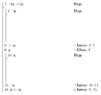
Right, exactly. I would think about using $\lnot$ elimination. It's a powerful method, because you can construct sub-proofs by assuming anything you want. Don't forget contradiction elimination, where you can conclude anything you want from a contradiction. That's an important proof technique in subproofs. What outline do you have?
 
Here's what I mean by outline, and this is what I would recommend for you to do. Basically, you're going to use $\land$ intro as the main organizing principle.

View attachment 7751
 

Attachments

  • Logic Problem 2018-02-09 Outline.png
    Logic Problem 2018-02-09 Outline.png
    3.3 KB · Views: 169
Ackbach said:
Here's what I mean by outline, and this is what I would recommend for you to do. Basically, you're going to use $\land$ intro as the main organizing principle.

Is step 2 hypothesis for contradiction??
 
solakis said:
Is step 2 hypothesis for contradiction??

Yep, that's right!
 
Ackbach said:
Yep, that's right!

Then on the 6th step we should have ~~P and not on the 8th step
 
solakis said:
Then on the 6th step we should have ~~P and not on the 8th step

Well, that just depends on how many steps it takes you to get a contradiction. No doubt you are more efficient at it than I am.
 

Similar threads

  • · Replies 22 ·
Replies
22
Views
3K
  • · Replies 5 ·
Replies
5
Views
2K
  • · Replies 4 ·
Replies
4
Views
2K
  • · Replies 1 ·
Replies
1
Views
2K
  • · Replies 4 ·
Replies
4
Views
3K
Replies
9
Views
1K
  • · Replies 4 ·
Replies
4
Views
745
  • · Replies 16 ·
Replies
16
Views
3K
  • · Replies 10 ·
Replies
10
Views
1K
  • · Replies 3 ·
Replies
3
Views
2K