Discussion Overview
The discussion revolves around calculating the natural frequency of a column that is clamped at the bottom and hinged at the top, with specific attention to its boundary conditions and material properties. The scope includes theoretical exploration and mathematical reasoning related to oscillation modes and frequency equations.
Discussion Character
- Exploratory
- Technical explanation
- Mathematical reasoning
Main Points Raised
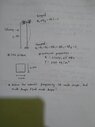
- One participant describes the column's boundary conditions and requests guidance on calculating its natural frequency.
- Another participant notes that multiple modes and frequencies of oscillation will exist and inquires about the column's cross-sectional shape.
- A participant provides a specific equation for natural frequency but expresses confusion regarding the parameter k, which is dependent on boundary conditions and mode shapes.
- There is a suggestion to investigate relevant texts to find the appropriate equations for the problem.
- A participant shares a link to a paper that discusses boundary condition fixity, specifically for the clamped-hinged configuration.
Areas of Agreement / Disagreement
Participants generally agree on the complexity of the problem and the need for further investigation into boundary conditions and relevant equations. However, there is no consensus on the specific value of the parameter k for the clamped-hinged column.
Contextual Notes
Participants have noted limitations in the available literature regarding the parameter k and the clarity of units in the equations presented. The discussion does not resolve these issues.
Who May Find This Useful
Individuals interested in structural engineering, vibration analysis, and those dealing with boundary condition effects in oscillatory systems may find this discussion relevant.