Need Help w/ Some Rotational Physics

  • Thread starter Thread starter r34racer01
  • Start date Start date
  • Tags Tags
    Physics Rotational
Click For Summary

Homework Help Overview

The discussion revolves around concepts in rotational physics, specifically focusing on angular momentum, kinetic energy, and the conservation laws applicable to rotating systems. Participants explore scenarios involving a student on a stool, a boy jumping onto a merry-go-round, and the behavior of a gyroscope.

Discussion Character

  • Mixed

Approaches and Questions Raised

  • Participants examine the relationship between angular velocity and kinetic energy, questioning whether kinetic energy increases when a student pulls her arms in. They also discuss the conservation of linear and angular momentum in the context of a boy jumping onto a merry-go-round.
  • Some participants seek clarification on the direction of angular momentum and precession in gyroscopic motion, expressing confusion about the underlying concepts.

Discussion Status

There is an active exchange of ideas, with participants questioning assumptions about conservation laws and the effects of changing moment of inertia on kinetic energy. Some guidance has been offered regarding the need to consider both angular velocity and moment of inertia in calculations, but no consensus has been reached on the specific outcomes.

Contextual Notes

Participants are working under the constraints of a homework assignment, which may limit the information available for discussion. The complexity of the problems and the need for visual aids have also been noted as factors contributing to confusion.

r34racer01
Messages
62
Reaction score
0
A student sits on a freely turning stool and rotates with constant angular velocity w1. She pulls her arms in towards her body, and her angular velocity increases to w2.
In doing this her kinetic energy: increases, stays the same or decreases

I thought that since KE = 1/2Iw^2 that would mean an increase in w would be an increse in KE, but I hear otherwise, can someone clarify this for me?
----------------------------------------------------------------------------------------

A boy of mass m = 50 kg running with speed v = 1 m/s jumps onto the outer edge of a merry-go-round of mass M = 100 kg and radius R = 2 m, as shown in the picture above. The merry-go-round is initially at rest, and can rotate about a frictionless pivot at its center. You may assume that the inital velocity of the boy is tangent to the edge of the merry-go round.

Which of the following quantities are conserved throughout this problem for the system consisting of the boy and the merry-go-round?

only kinetic energy
kinetic energy and angular momentum
only linear momentum
linear momentum and angular momentum
only angular momentum

I think linear & angular momentum are conserved because they are both conserved whether the collision is elastic or inelastic right?
----------------------------------------------------------------------------------------
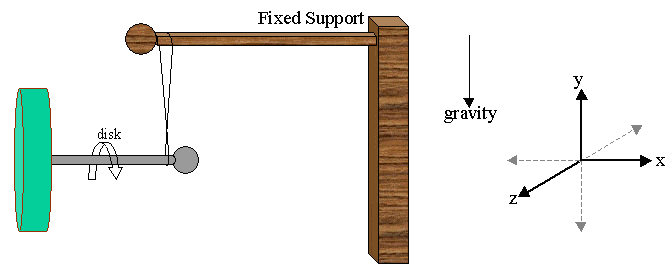
showmepl-3.gif


A gyroscope is turning such that in the picture the top of the wheel is coming out of the page and the bottom of the wheel is going into the page (the wheel is rotating in the sense of the curved arrow). The bar (which is attached to the center of mass of the wheel and of negligible mass) is being held up by a piece of string wrapped around its end.

Which direction does the angular momentum vector of the gyroscope point in?

+x
-x
+zThe direction of rotation (precession) of the gyroscope is:

counterclockwise in the plane of the page (rotating in the direction from the -x axis to the -y axis)
out of the page (rotating in the direction from the -x axis to the z axis)
into the page (rotating in the direction from the -x axis to the -z axis)

I am just completely lost on these 2. Can anyone break this down into simpler words?

Homework Statement


Homework Equations


The Attempt at a Solution

 
Last edited:
Physics news on Phys.org
r34racer01 said:
A student sits on a freely turning stool and rotates with constant angular velocity w1. She pulls her arms in towards her body, and her angular velocity increases to w2.
In doing this her kinetic energy: increases, stays the same or decreases

I thought that since KE = 1/2Iw^2 that would mean an increase in w would be an increse in KE, but I hear otherwise, can someone clarify this for me?
Are you sure that rotational kinetic energy is conserved? Furthermore, are you sure that the moment of inertia remains constant?
r34racer01 said:
A boy of mass m = 50 kg running with speed v = 1 m/s jumps onto the outer edge of a merry-go-round of mass M = 100 kg and radius R = 2 m, as shown in the picture above. The merry-go-round is initially at rest, and can rotate about a frictionless pivot at its center. You may assume that the inital velocity of the boy is tangent to the edge of the merry-go round.

Which of the following quantities are conserved throughout this problem for the system consisting of the boy and the merry-go-round?

only kinetic energy
kinetic energy and angular momentum
only linear momentum
linear momentum and angular momentum
only angular momentum

I think linear & angular momentum are conserved because they are both conserved whether the collision is elastic or inelastic right?
Is the linear momentum really conserved? What is the condition that linear momentum be conserved? Secondly, are there any external torques acting on the system?
r34racer01 said:
A gyroscope is turning such that in the picture the top of the wheel is coming out of the page and the bottom of the wheel is going into the page (the wheel is rotating in the sense of the curved arrow). The bar (which is attached to the center of mass of the wheel and of negligible mass) is being held up by a piece of string wrapped around its end.

Which direction does the angular momentum vector of the gyroscope point in?

+x
-x
+z


The direction of rotation (precession) of the gyroscope is:

counterclockwise in the plane of the page (rotating in the direction from the -x axis to the -y axis)
out of the page (rotating in the direction from the -x axis to the z axis)
into the page (rotating in the direction from the -x axis to the -z axis)

I am just completely lost on these 2. Can anyone break this down into simpler words?
Could you perhaps post the picture?
 
Hootenanny said:
Are you sure that rotational kinetic energy is conserved?
Could you perhaps post the picture?

I've added it to the original post and thanks so far for the help.
 
r34racer01 said:
A student sits on a freely turning stool and rotates with constant angular velocity w1. She pulls her arms in towards her body, and her angular velocity increases to w2.
In doing this her kinetic energy: increases, stays the same or decreases

I thought that since KE = 1/2Iw^2 that would mean an increase in w would be an increse in KE, but I hear otherwise, can someone clarify this for me?

There is the following comparison:
The motion of the hands of the student is like the motion of a celestial body orbiting the sun, on a non-circular trajectory.

As an extreme example, think of a comet with a very elliptical orbit. Look at the part of the trajectory where the comet is moving towards the center of the solar system. Gravity from the Sun is the centripetal force. The centripetal force is increasing the comet's velocity. This shows that close to the Sun the comet has more kinetic energy than when it is far away from the Sun.

The student rotating away on the free turning stool is providing the centripetal force for her arms. To tuck her arms in she provides a surplus of centripetal force. Therefore when her arms are tucked in her kinetic energy must be larger then before.

As you state, the rotational kinetic energy is 1/2*I*w^2
To compare before and after, you have to compare the moment of inertia before and after, plus the angular velocity before and after.

The comparison with the case of ellipse-shaped orbit provides a check. If your computation appears to show that kinetic energy remains the same then you know there must be an error somewhere; correct computation will show that kinetic energy increases when the student tucks in her arms.

It won't catch all mistakes, though. If you make two errors then you may end up with the correct prediction, reached with wrong reasoning. Your initial attempt does indicate you're making two errors.
 

Similar threads

  • · Replies 5 ·
Replies
5
Views
2K
Replies
67
Views
5K
Replies
9
Views
3K
Replies
17
Views
2K
Replies
9
Views
3K
  • · Replies 17 ·
Replies
17
Views
1K
Replies
26
Views
2K
Replies
335
Views
17K
Replies
1
Views
3K
  • · Replies 16 ·
Replies
16
Views
2K