Undergrad Need help with a proof involving points on a quadratic

Click For Summary
The discussion focuses on proving that for three points on a positive definite quadratic curve, the middle point's y-value is never higher than at least one of the other two points. The quadratic equation provided is y = (αx + φ)² + x², which has an absolute minimum. The proof involves analyzing the derivative of the function, indicating that if the middle point is to the left of the minimum, the left point will be higher, and if to the right, the right point will be higher. The conclusion is that the proposed reasoning and analysis of the derivative effectively establish the proof's validity. This proof holds true for any quadratic with a positive coefficient for x².
Jeff.Nevington
Messages
12
Reaction score
1
TL;DR
Given three points on a positive definite quadratic line, I need to prove that the middle point is never higher than at least one of the other two.
Summary: Given three points on a positive definite quadratic line, I need to prove that the middle point is never higher than at least one of the other two.

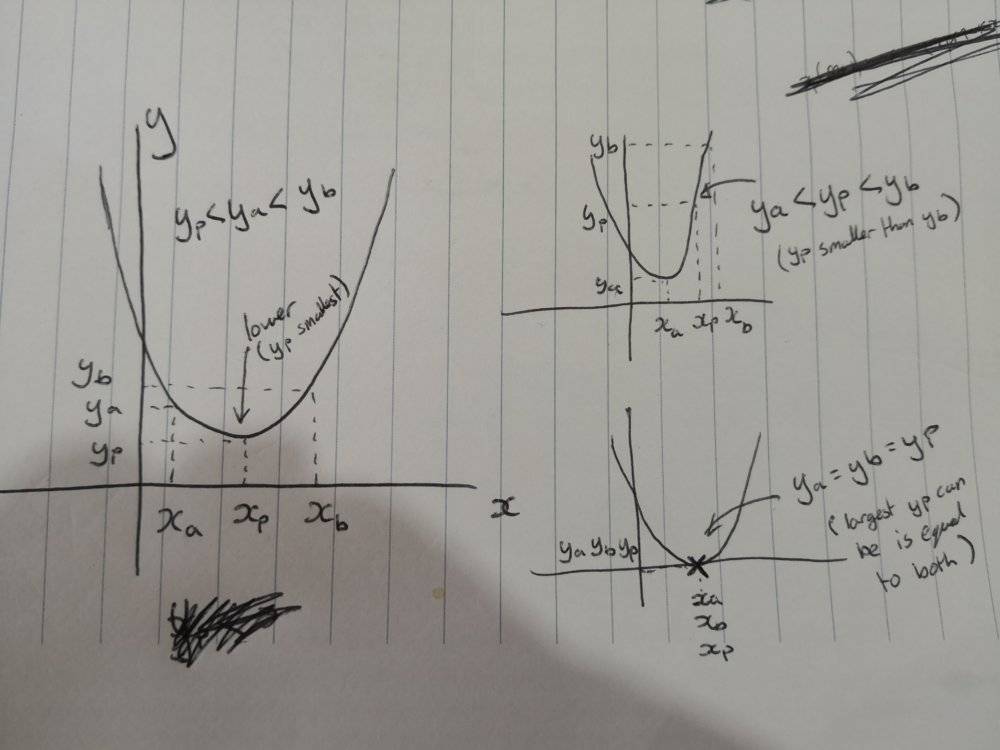
I am struggling to write a proof down for something. It's obvious when looking at it graphically, but I don't know how to write the proof succinctly.

I have a positive definite quadratic equation:

y= (αx + φ)^2+x^2;
where x and y are the axes, and α and φ are real constants (could be positive or negative), so y is always ≥0.

If I choose three values of X: x_a, x_p, x_b, these will correspond to three values of y: y_a, y_p, y_b.
If x_a ≤ x_p ≤ x_b, it is obvious, visually on the curve that y_p ≤ y_a OR y_p ≤ y_b. Unfortunately I need something more robust than "obvious visually". Does anyone know how I would go about writing a mathematical proof for this?
IMG_20191002_095331.jpg
 
Physics news on Phys.org
Your parabola has an absolute minimum (you can find it but you don't need to), its derivative is negative for smaller x-values and positive for larger values. If the middle point is to the left of the absolute minimum, which point is guaranteed to be larger (in y) than the middle point? If the middle point is to the right of the absolute minimum, which point is guaranteed to be larger than the middle point? What if the middle point is at the absolute minimum?
 
  • Like
Likes Jeff.Nevington
mfb said:
Your parabola has an absolute minimum (you can find it but you don't need to), its derivative is negative for smaller x-values and positive for larger values. If the middle point is to the left of the absolute minimum, which point is guaranteed to be larger (in y) than the middle point? If the middle point is to the right of the absolute minimum, which point is guaranteed to be larger than the middle point? What if the middle point is at the absolute minimum?

Thank you, so I can write:

let x_m be the x value at the absolute minimum;
for x_p ≥ x_m and for x ≥ x_p; dy/dx ≥ 0, hence y_b ≥ y_p as x_b ≥ x_p;
for x_p ≤ x_m and for x ≤ x_p; dy/dx ≤ 0, hence y_a ≥ y_p as x_a ≤ x_p;

I think these two cover everything and I don't necessarily need a 3rd statement considering only x_p=x_m?

Does the above qualify as a proof?
 
  • Like
Likes Delta2
Jeff.Nevington said:
Thank you, so I can write:

let x_m be the x value at the absolute minimum;
for x_p ≥ x_m and for x ≥ x_p; dy/dx ≥ 0, hence y_b ≥ y_p as x_b ≥ x_p;
for x_p ≤ x_m and for x ≤ x_p; dy/dx ≤ 0, hence y_a ≥ y_p as x_a ≤ x_p;

I think these two cover everything and I don't necessarily need a 3rd statement considering only x_p=x_m?

Does the above qualify as a proof?
It must be true for any quadratic with positive coefficient of ##x^2##. We can write:

##y = ax^2 + bx + c = a[(x - b/2a)^2 + k]##

For some constant ##k##.

We can see that ## y(x_1) > y(x_2)## iff ##(x_1 - b/2a)^2 > (x_2 - b/2a)^2##.

Now consider the cases where the middle point is greater or less than ##b/2a##.

That, it seems to me, gets at the heart of the matter.
 

Similar threads

  • · Replies 11 ·
Replies
11
Views
2K
  • · Replies 3 ·
Replies
3
Views
1K
  • · Replies 1 ·
Replies
1
Views
3K
  • · Replies 8 ·
Replies
8
Views
2K
  • · Replies 2 ·
Replies
2
Views
8K
Replies
20
Views
4K
  • · Replies 2 ·
Replies
2
Views
2K
  • · Replies 9 ·
Replies
9
Views
2K
  • · Replies 4 ·
Replies
4
Views
3K
  • · Replies 1 ·
Replies
1
Views
2K