Need Help With Geometry Problem (Circles)

  • Thread starter Thread starter Izzhov
  • Start date Start date
  • Tags Tags
    Circles Geometry
Click For Summary
SUMMARY

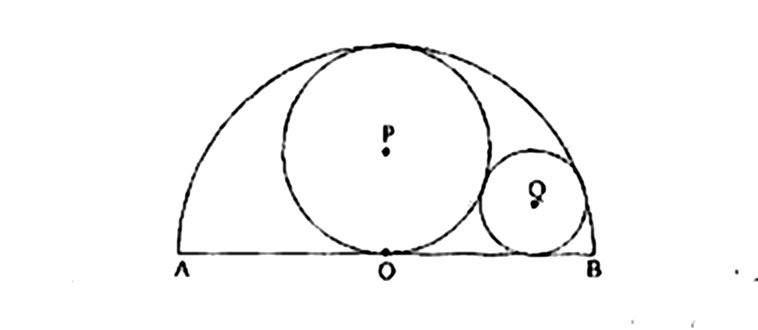
The geometry problem involves determining the radius of circle Q, which is tangent to circle P and a semicircle with center O, where OB is 4. The user initially struggled to establish a system of equations but identified that the distance between circles P and Q equals the sum of their radii. The third condition requires that circle Q be tangent to the semicircle, leading to a quadratic equation in the coordinates of circle Q. Ultimately, the user resolved the problem independently.

PREREQUISITES
  • Understanding of circle geometry and tangents
  • Familiarity with Cartesian coordinate systems
  • Knowledge of quadratic equations
  • Ability to set up systems of equations
NEXT STEPS
  • Study the properties of tangents in circle geometry
  • Learn how to derive equations for circle intersections
  • Explore quadratic equations in two variables
  • Practice solving geometry problems involving multiple circles
USEFUL FOR

Students studying geometry, math educators, and anyone interested in solving complex geometric problems involving circles and tangents.

Izzhov
Messages
120
Reaction score
0
In the diagram below:
math.JPG

AB is the diameter of the semicircle with center O. Circles P and Q are tangent to each other and to the semicircle. If OB=4, find the radius of circle Q.

I haven't been able to make any headway at all with this problem. I tried to find a system of equations with the radius of circle Q equal to x and some other length equal to y, but all I found was that the length of the common external tangent of circles P and Q is [tex]2 \sqrt{2x}[/tex], where x is the radius of circle Q, and I'm not sure how that's useful. Please help.
 
Last edited:
Physics news on Phys.org
Let the origin be (0,0) in a cartesian coordinate system. The point P is then (0,2). Let the point Q be at position (x,y).

To define the position of a circle needs three equations. (There are 3 degrees of freedom, the position (x,y) of the center, and the radius.)

The radius of Q is y, this is one restriction.

The circle Q and P are tangent. This means that the distance from P to Q is equal to the sum of their radii.

The third restriction on the circle centered at Q is that it be tangent to the circle centered at O. This will be a quadratic equation in x and y.
 
CarlB said:
Let the origin be (0,0) in a cartesian coordinate system. The point P is then (0,2). Let the point Q be at position (x,y).

To define the position of a circle needs three equations. (There are 3 degrees of freedom, the position (x,y) of the center, and the radius.)

The radius of Q is y, this is one restriction.

The circle Q and P are tangent. This means that the distance from P to Q is equal to the sum of their radii.

The third restriction on the circle centered at Q is that it be tangent to the circle centered at O. This will be a quadratic equation in x and y.

I'd already figured out the first two restrictions, and I understood that the third restriction would have to do with circle Q being tangent to the semicircle, but I have no idea how to derive an equation from that.

EDIT: Never mind. I figured it out. Thank you.
 
Last edited:

Similar threads

Replies
17
Views
4K
  • · Replies 13 ·
Replies
13
Views
4K
  • · Replies 14 ·
Replies
14
Views
3K
  • · Replies 2 ·
Replies
2
Views
3K
  • · Replies 29 ·
Replies
29
Views
2K
Replies
20
Views
4K
Replies
4
Views
2K
  • · Replies 5 ·
Replies
5
Views
2K
Replies
5
Views
3K
  • · Replies 21 ·
Replies
21
Views
4K