Need help with Newton's Law of Physics

Click For Summary
SUMMARY

The discussion centers on solving a physics problem involving Newton's laws, specifically calculating the acceleration of a mass attached to a spring. The equations used include 2 k * x sin(θ') = 100/g * a and Ma = 2kxsin(angle) - 100. The user initially struggled with precision in calculations, particularly in determining the unstretched length of the spring and maintaining significant digits. Ultimately, the correct acceleration was found to be 7.72 m/s² by using precise values throughout the calculations.

PREREQUISITES
  • Understanding of Newton's laws of motion
  • Familiarity with spring mechanics and Hooke's Law
  • Knowledge of trigonometric functions in physics
  • Ability to perform calculations with significant figures
NEXT STEPS
  • Review the principles of Hooke's Law and its application in spring systems
  • Study the concept of significant figures and their importance in physics calculations
  • Learn how to construct and interpret free body diagrams for dynamic systems
  • Explore advanced topics in oscillatory motion and energy conservation in spring systems
USEFUL FOR

Students studying physics, particularly those focusing on mechanics, as well as educators and tutors assisting with Newtonian physics problems.

alex740rider
Messages
8
Reaction score
0
I've been stuck on part b for several hours now (feels like the whole day).

1. Homework Statement :
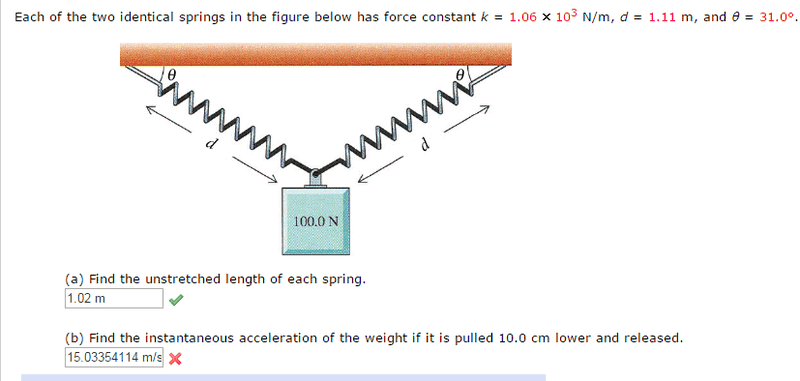
6gQ0sk5.png


2. Homework Equations :
2 k * x sin(θ') = 100/g * a
sum(Fy) = F net
Ma = 2kxsin(angle) - 100
a = (2kxsin(angle) - 100) / (100 / 9.8)
2*kxsin(θ')-100 / 10.2

3. The Attempt at a Solution :

What I've done so far...
x component of d = d cos(θ) = 1.11 cos(31)= 0.95 (.9514557038)

y component of d = d sin(θ) = 1.11 sin(31) = 0.57 (.5716922632)

added 10 cm to y component = 0.67 (.6716922632)

θ' =tan-1( 0.67 / 0.95)

θ' = 35.19° (35.22066645)

d' = sqrt((x component of d)^2 + (New y component of d) ^2 )

d' = sqrt(0.95^2 + 0.67^2) (1.164662377)

d’ = 1.164662377

x= d' - Unstretched length of spring

x = 1.164662377 - 1.02

x = 0.1446623771 m

exact values (for those wondering):
< = 35.22069645

d' = 1.164662377

mg = 100N

m = 100/g

I used 2 k * x sin(θ') = 100/g * a

And plugged in 2*1060*0.1446623771*sin(35.22069645)*9.8/100 and got 17.33356261 m/s^2 ;and it's still incorrect...

I also tried another equation
Ma = 2kxsin(angle) - 100
a = (2kxsin(angle) - 100) / (100 / 9.8)
a = 2*1060*0.1446623771*sin(35.22069645) - 100 / 100/9.8
a = 7.533575457 m/s^2
^(still incorrect)

currently at 71/100 for attempts...

So far, I've slumped 3 tutors on Cheggs, math majors, physics major, you name it. And yes I have tried contacting the teacher for the past few days, no replies back yet. This is starting to be very frustrating.

god bless

p.s.; this is how I got part a:
2*1060*sin(31) = 1091.880719
100/1091.880719 = .0915850956
1.11-.0915850956 = 1.018414904
I rounded it to 1.02 and got it right on webassign (not sure if it made a difference)
 
Last edited:
Physics news on Phys.org
Your first two attempts above are clearly wrong in that you forgot to subtract mg. The last two are much better, but I still get a slightly higher number than the last, by about 4%. You need to be particularly accurate when taking a difference of two numbers that are fairly close together, such as happens when you find the new extension. Try keeping 5 digits throughout.

Usually it's better to keep everything algebraic until the very end, only plugging in numbers then. Sometimes this circumvents those 'small difference' steps, other times it suggests an approximation method that's better. But in the present case, the final algebraic expression is pretty messy
 
  • Like
Likes   Reactions: Student100
haruspex said:
Your first two attempts above are clearly wrong in that you forgot to subtract mg. The last two are much better, but I still get a slightly higher number than the last, by about 4%. You need to be particularly accurate when taking a difference of two numbers that are fairly close together, such as happens when you find the new extension. Try keeping 5 digits throughout.

Usually it's better to keep everything algebraic until the very end, only plugging in numbers then. Sometimes this circumvents those 'small difference' steps, other times it suggests an approximation method that's better. But in the present case, the final algebraic expression is pretty messy
The numbers for the x and y components or the numbers for x in the equation?
 
alex740rider said:
I've been stuck on part b for several hours now (feels like the whole day).

1. Homework Statement :
6gQ0sk5.png


2. Homework Equations :
2 k * x sin(θ') = 100/g * a
sum(Fy) = F net
Ma = 2kxsin(angle) - 100
a = (2kxsin(angle) - 100) / (100 / 9.8)
2*kxsin(θ')-100 / 10.2

3. The Attempt at a Solution :

What I've done so far...
x component of d = d cos(θ) = 1.11 cos(31)= 0.95

y component of d = d sin(θ) = 1.11 sin(31) = 0.57

added 10 cm to y component = 0.67

θ' =tan-1( 0.67 / 0.95)

θ' = 35.19°

d' = sqrt((x component of d)^2 + (New y component of d) ^2 )

d' = sqrt(0.95^2 + 0.67^2)

d’ = 1.162 m

x= d' - Unstretched length of spring

x = 1.162 - 1.02

x = 0.1425 m

mg = 100N

m = 100/g

I agree with your calculations to this point.

I used 2 k * x sin(θ') = 100/g * a

And plugged in 2*1060*.1425*sin(35.19)*9.8/100 and got 17.06 m/s^2 ;and it's still wrong...

As the acceleration on the weight is produced by the net force, you should draw a free body diagram of the weight and the forces acting on it.
another attempt (with more precise numbers) and got 17.33 m/s^2. (no luck)

I also tried
Ma = 2kxsin(angle) - 100
a = (2kxsin(angle) - 100) / (100 / 9.8)
a = 7.2644 m/s^2 (still incorrect)

It's not clear what value of 'angle' is being used here.
another attempt (with more precise numbers) and got a = 7.53 m/s^2 (still no luck)

currently at 71/100 for attempts...

So far, I've slumped 3 tutors on Cheggs, math majors, physics major, you name it. And yes I have tried contacting the teacher for the past few days, no replies back yet. This is starting to be very frustrating.

god bless

You're getting close. Don't give up!
 
  • Like
Likes   Reactions: Student100
alex740rider said:
I've been stuck on part b for several hours now (feels like the whole day).

1. Homework Statement :
6gQ0sk5.png


2. Homework Equations :
2 k * x sin(θ') = 100/g * a
sum(Fy) = F net
Ma = 2kxsin(angle) - 100
a = (2kxsin(angle) - 100) / (100 / 9.8)
2*kxsin(θ')-100 / 10.2

3. The Attempt at a Solution :

What I've done so far...
x component of d = d cos(θ) = 1.11 cos(31)= 0.95

y component of d = d sin(θ) = 1.11 sin(31) = 0.57

added 10 cm to y component = 0.67

θ' =tan-1( 0.67 / 0.95)

θ' = 35.19°

d' = sqrt((x component of d)^2 + (New y component of d) ^2 )

d' = sqrt(0.95^2 + 0.67^2)

d’ = 1.162 m

x= d' - Unstretched length of spring

x = 1.162 - 1.02

x = 0.1425 m

mg = 100N

m = 100/g

I used 2 k * x sin(θ') = 100/g * a

And plugged in 2*1060*.1425*sin(35.19)*9.8/100 and got 17.06 m/s^2 ;and it's still wrong...

another attempt (with more precise numbers) and got 17.33 m/s^2. (no luck)

I also tried
Ma = 2kxsin(angle) - 100
a = (2kxsin(angle) - 100) / (100 / 9.8)
a = 7.2644 m/s^2 (still incorrect)

another attempt (with more precise numbers) and got a = 7.53 m/s^2 (still no luck)

currently at 71/100 for attempts...

So far, I've slumped 3 tutors on Cheggs, math majors, physics major, you name it. And yes I have tried contacting the teacher for the past few days, no replies back yet. This is starting to be very frustrating.

god bless

Your work is kind difficult to follow, the linear restoring force of the spring system is $$\vec{F}=-k\vec{x}$$

In your problem we're concerned about the displacement from equilibrium. Obviously to find the instantaneous acceleration we're going to want to look at $$\sum\vec{F}=m\vec{a}$$
Are you looking at the sum of the forces in the direction of acceleration? What're the forces in the y direction upon release?
 
Student100 said:
Are you looking at the sum of the forces in the direction of acceleration? What're the forces in the y direction upon release?
I have the 2 tension forces upwards and gravity downwards
 
alex740rider said:
The numbers for the x and y components or the numbers for x in the equation?
In respect of keeping at least 5 digits? For everything on the path to finding the new extension (so includes finding the relaxed length).
If you keep five, you would normally have four reliable at the end. But the extensions are only about 10% of the relaxed length, so when you take one of those length differences you lose a digit of precision.
 
haruspex said:
In respect of keeping at least 5 digits? For everything on the path to finding the new extension (so includes finding the relaxed length).
If you keep five, you would normally have four reliable at the end. But the extensions are only about 10% of the relaxed length, so when you take one of those length differences you lose a digit of precision.
also what equation did you use for it to be 4% higher?
 
Keep 4-5 decimals during the calculation steps, including the unstretched length. Calculate x with the more precise value of it. As the lengths are close, you loose one significant digit during subtraction.
 
  • #10
I have updated all the numbers and kept all of the decimals. Can someone tell me what I'm doing wrong or if there's another equation that I can use?
 
  • #11
We do not see your calculations.
 
  • #12
ehild said:
We do not see your calculations.

Looks as though he posted it in the original post:

I also tried another equation
Ma = 2kxsin(angle) - 100
a = (2kxsin(angle) - 100) / (100 / 9.8)
a = 2*1060*0.1446623771*sin(35.22069645) - 100 / 100/9.8
a = 7.533575457 m/s^2
^(still incorrect)
 
  • #13
Student100 said:
Looks as though he posted it in the original post:
The original length is not 1.02 m with 4 digit accuracy.
 
  • #14
alex740rider said:
I have updated all the numbers and kept all of the decimals. Can someone tell me what I'm doing wrong or if there's another equation that I can use?
Did you updated the original length too?
 
  • Like
Likes   Reactions: alex740rider
  • #15
ehild said:
Did you updated the original length too?
2*1060*sin(31) = 1091.880719
100/1091.880719 = .0915850956
1.11-.0915850956=
1.018414904
 
  • #16
ehild said:
Did you updated the original length too?
WOW i guess it did made a difference
 
  • #17
alex740rider said:
WOW i guess it did made a difference
You see at last? Never round down too much during calculations.
 
  • Like
Likes   Reactions: alex740rider
  • #18
Solve it, thanks to ehild! You had to use all the numbers in part a to solve it correctly (instead of just 1.02)
Then plug it back into a = (2kxsin(angle) - 100) / (100 / 9.8)
which you will get 7.7235 m/s^2
Thank you to everyone that tried to help!

Again big shout out to ehild!
 
  • #19
alex740rider said:
Solve it, thanks to ehild! You had to use all the numbers in part a to solve it correctly (instead of just 1.02)
Then plug it back into a = (2kxsin(angle) - 100) / (100 / 9.8)
which you will get 7.7235 m/s^2
That is exactly the same result I got.
You will remember the importance of significant digits forever I hope, :smile: But you need to round off to the desired accuracy at the end. It is 3 digits in this problem, so you have to give the acceleration as 7.72 m/s2.
 
  • #20
alex740rider said:
WOW i guess it did made a difference
I guess you did not read this properly:
haruspex said:
In respect of keeping at least 5 digits? For everything on the path to finding the new extension (so includes finding the relaxed length).
 

Similar threads

  • · Replies 38 ·
2
Replies
38
Views
4K
Replies
10
Views
2K
  • · Replies 4 ·
Replies
4
Views
2K
  • · Replies 22 ·
Replies
22
Views
6K
  • · Replies 3 ·
Replies
3
Views
2K
  • · Replies 6 ·
Replies
6
Views
10K
  • · Replies 5 ·
Replies
5
Views
5K
  • · Replies 1 ·
Replies
1
Views
2K
  • · Replies 4 ·
Replies
4
Views
4K
  • · Replies 2 ·
Replies
2
Views
2K