Where Did My Neglect of High-Order Terms Go Wrong in Integral Sums?

  • Context: High School 
  • Thread starter Thread starter Mike_bb
  • Start date Start date
  • Tags Tags
    Integral Sum Terms
Click For Summary
SUMMARY

The discussion centers on the misunderstanding of high-order terms in integral sums, specifically regarding the neglect of terms like ##dx^2## in the context of Riemann sums. The participants clarify that the notation ##dx## in integrals does not represent infinitesimals but rather a specific notation for integration. The correct approach to evaluating integrals involves using Riemann sums, which divide intervals into equal lengths and estimate areas under curves, rather than neglecting higher-order terms. A recommendation is made to consult more modern resources for a clearer understanding of these concepts.

PREREQUISITES
  • Understanding of Riemann sums and their application in calculus
  • Familiarity with the concept of differentials in calculus
  • Knowledge of integral calculus and its notation
  • Basic understanding of the historical context of calculus texts
NEXT STEPS
  • Study the concept of Riemann sums in detail, including examples and visual aids
  • Learn about the differences between differentials and infinitesimals in calculus
  • Explore modern calculus textbooks that provide updated explanations and illustrations
  • Review the properties of integrals and their applications in various mathematical contexts
USEFUL FOR

Students of calculus, educators teaching integral calculus, and anyone seeking to clarify misconceptions about high-order terms and Riemann sums in mathematical analysis.

Mike_bb
Messages
191
Reaction score
19
Hello.

As is known, we can neglect high-order term in expression ##f(x+dx)-f(x)##. For ##y=x^2##: ##dy=2xdx+dx^2##, ##dy=2xdx##.

I read that infinitesimals have property: ##dx+dx^2=dx##

I tried to neglect high-order terms in integral sum (##dx^2## and ##4dx^2## and so on) and I obtained wrong result in the end.
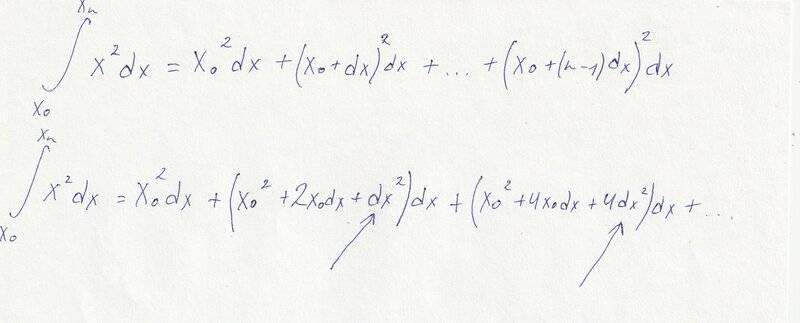
IMG_20220727_0001.jpg


Where is my mistake?

Thanks.
 
Physics news on Phys.org
Mike_bb said:
Hello.

As is known, we can neglect high-order term in expression ##f(x+dx)-f(x)##. For ##y=x^2##: ##dy=2xdx+dx^2##, ##dy=2xdx##.

I read that infinitesimals have property: ##dx+dx^2=dx##

I tried to neglect high-order terms in integral sum (##dx^2## and ##4dx^2## and so on) and I obtained wrong result in the end.

View attachment 304873

Where is my mistake?

Thanks.
I don't really understand what you've done. The ##dx## in an integral isn't an infinitesimal.

In fact, to be precise, there is no such thing as an "infinitesimal" in standard calculus. Although, there is the concept of the "differential" ##dx##.

The ##dx## in the integral is not a differential either, but a notation specific to integration.
 
PeroK said:
I don't really understand what you've done. The ##dx## in an integral isn't an infinitesimal.

In fact, to be precise, there is no such thing as an "infinitesimal" in standard calculus. Although, there is the concept of the "differential" ##dx##.

The ##dx## in the integral is not a differential either, but a notation specific to integration.
I read "A treatise on infinitesimal calculus" Bartholomew Price. Integral sum, for ##2xdx##:

1.jpg
 
  • Informative
Likes   Reactions: PeroK
Okay. Infinitesimal calculus is not something I know anything about, I'm sorry to say!
 
  • Like
Likes   Reactions: Mike_bb
@Mike_bb, what you're doing is evaluating the definite integral using a Riemann sum.
In post 1 you said this:
Mike_bb said:
For ##y = x^2, dy = 2xdx + dx^2, dy = 2xdx##
This doesn't make any sense to me. If the function is defined by the formula ##y = f(x) = x^2##, then by definition, the differential of f (df) or differential of y (dy) is given by ##dy = \frac{df}{dx} dx = 2xdx##. I don't see where you're getting the ##dx^2## term from.

In evaluating the def. integral ##\int_{x_0}^{x_n} x^2 dx##, the author of the book you're working from is using a Riemann sum to evaluate the integral. BTW, from the language used, my guess is that this is a very old textbook (maybe over 100 years old!). I would advise getting something a bit more modern and that uses illustrations.

The author's use of dx in the Riemann sum is not at all the way things are usually done these days. See https://en.wikipedia.org/wiki/Riemann_sum for a more modern explanation.

In the Riemann sum, the interval ##[x_0, x_n}## is divided into subintervals of equal length. This is usually written as ##\Delta x = \frac{x_n - x_0} n## and not as dx.

In each subinterval, an estimate is calculated of the area under the curve, within that subinterval, and then all n subintervals are added to get the total. This is easier to follow from a drawing, several of which are shown with examples in the wiki article I linked to.
 
  • Informative
Likes   Reactions: PeroK

Similar threads

  • · Replies 3 ·
Replies
3
Views
3K
  • · Replies 1 ·
Replies
1
Views
3K
  • · Replies 1 ·
Replies
1
Views
3K
  • · Replies 3 ·
Replies
3
Views
2K
  • · Replies 4 ·
Replies
4
Views
3K
  • · Replies 3 ·
Replies
3
Views
2K
  • · Replies 5 ·
Replies
5
Views
2K
  • · Replies 24 ·
Replies
24
Views
6K
  • · Replies 16 ·
Replies
16
Views
4K
  • · Replies 6 ·
Replies
6
Views
2K