Discussion Overview
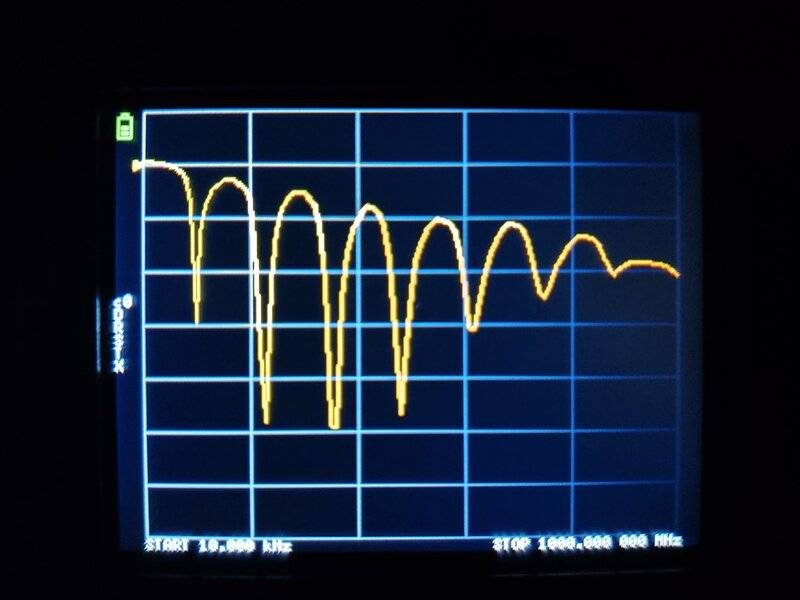
The discussion revolves around the use of a NanoVNA spectrum analyzer to measure the reflection characteristics of a 1 meter long solid copper wire. Participants explore the implications of the measurements taken across a frequency range from 10 kHz to 1 GHz, focusing on the interpretation of the resulting data and the underlying principles of Time Domain Reflectometry (TDR) and frequency domain analysis.
Discussion Character
- Exploratory
- Technical explanation
- Debate/contested
- Mathematical reasoning
Main Points Raised
- One participant describes the high value near zero in the reflection measurement as indicative of an open-circuited transmission line or an end-fed dipole antenna element, suggesting that the reflection characteristics are influenced by the wire length relative to the wavelength.
- Another participant notes that the reflected energy is attenuated at higher frequencies due to radiation from the wire antenna, which affects the depth of nulls in the measurement.
- There is a discussion about the implications of using a frequency sweep as a form of TDR, with some participants arguing that this may confuse the original poster (OP) regarding the nature of the analysis.
- One participant mentions the historical context of swept frequency methods in radar development, referencing Edward Appleton's work in 1924.
- Participants debate the effectiveness of standing wave measurements for determining distance and the necessity of explicit time domain analysis for accurate distance information.
- There is a discussion about the classification of TDR techniques, with some participants suggesting that swept sinewave measurements can be interpreted as TDR plots, while others emphasize the traditional pulse methods.
Areas of Agreement / Disagreement
Participants express differing views on the interpretation of the measurements and the classification of analysis techniques. There is no consensus on whether the frequency domain measurements can be equated to time domain analysis, and the discussion remains unresolved regarding the best approach to analyze the data.
Contextual Notes
Participants highlight various assumptions, such as the treatment of the ground side of the experiment and the potential effects of wire insulation on measurements. The discussion also reflects limitations in interpreting standing wave measurements in terms of distance and impedance changes.
 No handbags at dawn needed.