mirumirai
- 3
- 0
Hi all,
I'm trying to understand the electrical model of a neuron, and I have 2 questions.
I'm a little confused about the time constant in this electrical model of neuron recording:
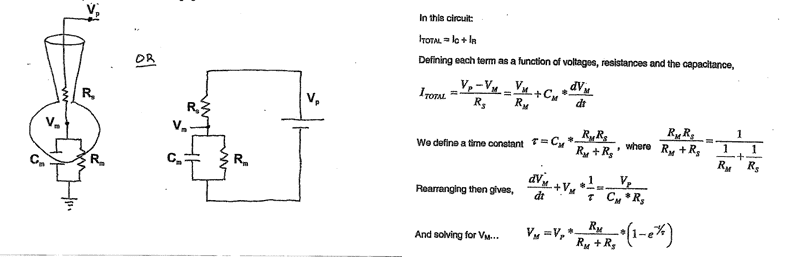
The time constant shown is tau = C*(Rm*Rs)/(Rm+Rs), which implies that the resistors are in parallel. However, to me, it looks like the resistors are in series. I feel like I'm missing something here.
First question: Why is the time constant C*(Rm*Rs)/(Rm+Rs) rather than C*(Rm+Rs)?
To make matters worse, earlier in the lecture this circuit was shown, implying the resistor represented membrane resistance: (ignore the values)
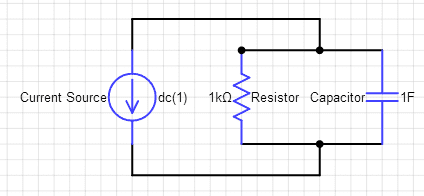
There is a current source here.
In the first picture, the diagram is using a voltage source. The second diagram is the same thing as a series RC circuit with a voltage source, just using a source transformation (I think). I looked up parallel RC circuits (with a voltage source) and found they had very different properties than series RC circuits. Note: The first picture seems to show a voltage clamp, while the second was just a general model. Might or might not change things.
Second Question: How can I reconcile these two diagrams?
What's a correct neuron model?
Thanks.
Edit: Some of the information I was given could be erroneous; i.e. I don't trust the lecture slides.
I'm trying to understand the electrical model of a neuron, and I have 2 questions.
I'm a little confused about the time constant in this electrical model of neuron recording:
The time constant shown is tau = C*(Rm*Rs)/(Rm+Rs), which implies that the resistors are in parallel. However, to me, it looks like the resistors are in series. I feel like I'm missing something here.
First question: Why is the time constant C*(Rm*Rs)/(Rm+Rs) rather than C*(Rm+Rs)?
To make matters worse, earlier in the lecture this circuit was shown, implying the resistor represented membrane resistance: (ignore the values)
There is a current source here.
In the first picture, the diagram is using a voltage source. The second diagram is the same thing as a series RC circuit with a voltage source, just using a source transformation (I think). I looked up parallel RC circuits (with a voltage source) and found they had very different properties than series RC circuits. Note: The first picture seems to show a voltage clamp, while the second was just a general model. Might or might not change things.
Second Question: How can I reconcile these two diagrams?
What's a correct neuron model?
Thanks.
Edit: Some of the information I was given could be erroneous; i.e. I don't trust the lecture slides.
Last edited: