New method of traveling on water

  • Thread starter Thread starter Colin Wilson
  • Start date Start date
  • Tags Tags
    Method Water
Click For Summary
SUMMARY

The discussion centers on a novel concept called Rotating Planing Surfaces (R.P.S.), which utilizes freely rotating disks to enhance lift and reduce drag while traveling on water. The proposed lift-to-drag ratio is anticipated to exceed 5:1, outperforming traditional planing hulls. Key insights include the reduced skin friction due to the unique boundary layer dynamics and the potential for experimental validation using small model boats. Participants emphasize the importance of practical experimentation over theoretical debate, suggesting various testing methods to evaluate the effectiveness of the R.P.S. design.

PREREQUISITES
  • Understanding of fluid dynamics principles, particularly lift and drag.
  • Familiarity with planing hull mechanics and hydrofoil design.
  • Knowledge of boundary layer theory and its implications on surface interaction.
  • Experience with experimental design and model testing in marine applications.
NEXT STEPS
  • Research methods for measuring lift and drag in fluid dynamics experiments.
  • Explore the effects of boundary layer thickness on rotating surfaces.
  • Investigate crowdfunding platforms for marine engineering projects.
  • Learn about the Coanda effect and its applications in fluid mechanics.
USEFUL FOR

Marine engineers, hobbyist boat designers, and researchers interested in innovative watercraft propulsion methods will benefit from this discussion.

Colin Wilson
Messages
12
Reaction score
6
My question concerns what I call R.P.S. (Rotating Planing Surfaces). This version uses freely rotating disks to plane across the surface of the water somewhat similar to wheels on a car going down the road. Specifically what the lift / drag ratio might be and will it be higher than a typical planing hull at about a 5:1 ratio. My explanation of why I expect an improvement goes like this:

Since the disks rotate freely the skin friction is limited to the deflection of the boundary layer into a shallow arc from the front of the planing edge of the disk to the back of the planing edge of the disk. This results in an average differential in velocity between the planing surface of the disk and the water that is much lower than a non-rotating planing surface such as a planing hull or a lifting surface such as a hydrofoil would experience traveling at the same speed.

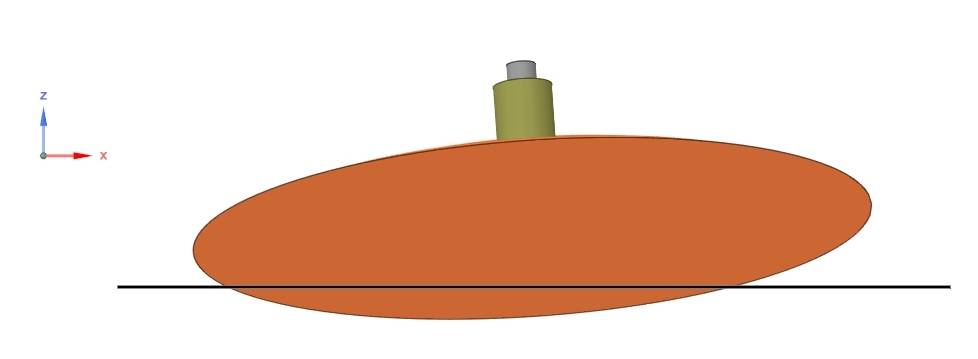
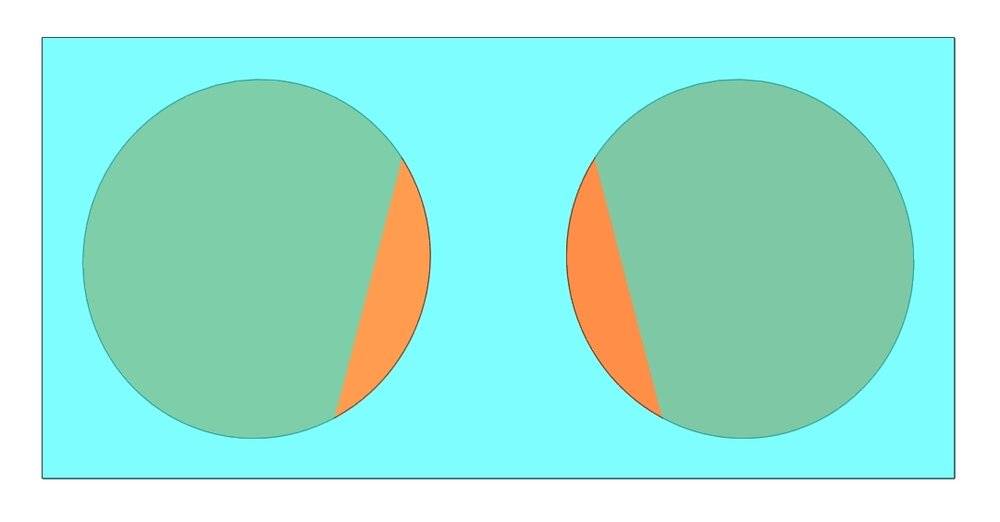
The following illustrations show the disks (attached hull not shown) with about 15% of the bottom surface area submerged. The attack angle of 5 degrees and the deadrise angle of 15 degrees being typical of a planing hull at speed.

Front view
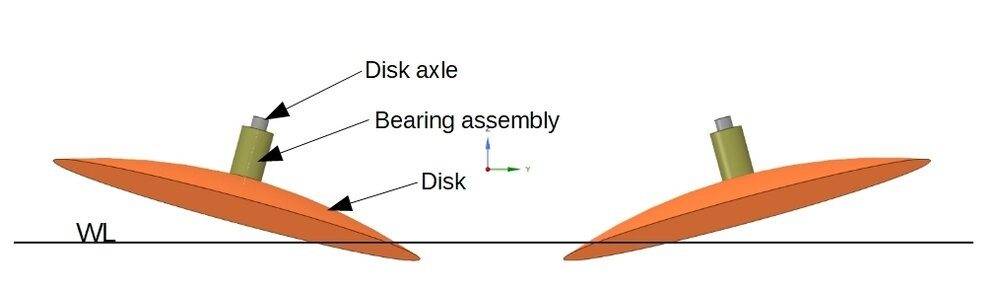
Disks with WL front.jpg


Side view

Disks with WL side.jpg

Bottom view submerged area in orange
Disks with WL bottom.jpg
 
  • Like
Likes   Reactions: OmCheeto and Lnewqban
Engineering news on Phys.org
Take a pair of water skis and add a set of your planing disks. You will quickly find if it works, if there are any control issues, and if you need to try different geometry. This is a case where one experiment is better than 1000 opinions.
 
A hydrofoil flies with its foils submerged so it is not affected by small surface waves. Your design appears to be a hydroplane that skims on the surface, and so is more sensitive to surface waves.

The downward weight of the vessel is still imparted to the water, so the vessel will radiate the same energy as wave pattern, circulation and wake.

You have reduced the whetted area, and reduced the differential fluid velocity, but I wonder how thick the boundary layer will need to be if it is to drive free disk rotation. Without a differential velocity the disk will not spin. Should the disk be rough, dimpled or smooth?
 
  • Like
Likes   Reactions: Lnewqban
Welcome, Colin :cool:

Interesting idea!
I am not sure, but it seems to me that reducing the relative speed would reduce the desired lift also, which would lead to inceasing the induced drag.
 
  • Like
Likes   Reactions: tech99
Thanks for your replies. I've attached a PDF to better explain the concept and (page 4) to answer your replies. I believe I would need test tank like results to be taken seriously (test bed page 3) but I'm retired now with limited resources. I thought of maybe a crowd funding project? Any suggestions.
 

Attachments

  • Like
Likes   Reactions: Lnewqban
Thank you for posting that.
I like that RC boat. :cool:
 
Interesting idea. I agree that an experiment will be the best thing to see how this works. To make a experiment that is not so expensive you can make a small model, and get a small boat that you can drive at a constant speed. Then make a rig where you can pull the model a distance off the side of the boat (so the bow wave does not affect it) and make the disks on the model able be locked. then pull the model with a line and have a fishing scale or something like that to measure the difference in drag force with the disks locked and free rotating.
 
@Colin Wilson
You should also consider powered rotation of the disks.
 
Baluncore said:
@Colin Wilson
You should also consider powered rotation of the disks.
He needs another form of propulsion to get up planing on the wheels anyway so i don't think adding a second mode of propulsion for after it is up on a plane is of any benefit.
 
  • #10
Stormer said:
He needs another form of propulsion to get up planing on the wheels anyway so i don't think adding a second mode of propulsion for after it is up on a plane is of any benefit.
I am not suggesting it as a form of propulsion.
It may provide more lift from the area of disk contact, by breaking or separating coanda effect.
 
  • #11
Baluncore said:
I am not suggesting it as a form of propulsion.
It may provide more lift from the area of disk contact, by breaking or separating coanda effect.
Ok. Then i misunderstood. I thought it was for boundary layer propulsion.
 

Similar threads

  • · Replies 17 ·
Replies
17
Views
5K
Replies
4
Views
2K
  • · Replies 3 ·
Replies
3
Views
2K
  • · Replies 20 ·
Replies
20
Views
3K
  • · Replies 52 ·
2
Replies
52
Views
7K
  • · Replies 21 ·
Replies
21
Views
5K
  • · Replies 1 ·
Replies
1
Views
1K
  • · Replies 2 ·
Replies
2
Views
1K
  • · Replies 4 ·
Replies
4
Views
3K
  • · Replies 1 ·
Replies
1
Views
5K