SUMMARY
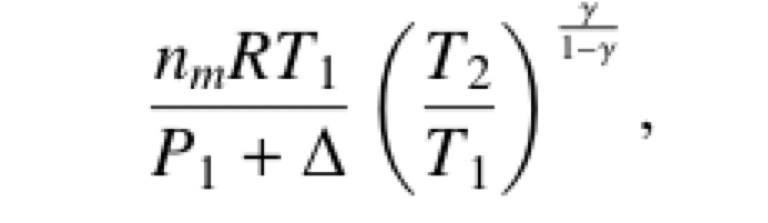
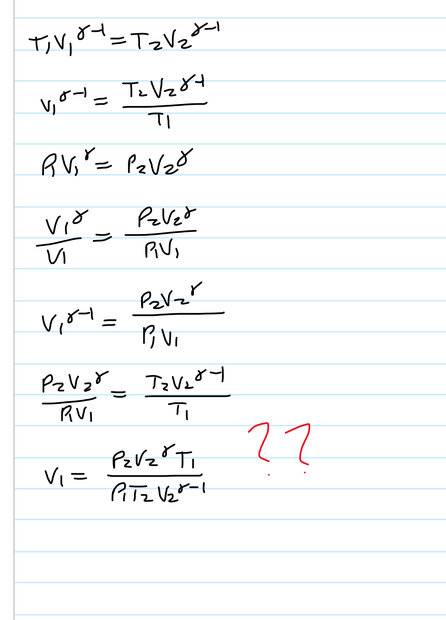
The discussion focuses on the calculation of the new volume of a balloon after adiabatic expansion, specifically addressing the equations governing the process. Participants clarify that the initial conditions involve an increase in ambient temperature at constant pressure, followed by an abrupt drop in external pressure leading to adiabatic expansion. Key equations discussed include ##V_1T_2=V_2T_1## and ##P_1V_2^\gamma=P_fV_f^\gamma##, with emphasis on eliminating variables to derive the final volume equation. The consensus is that the correct relationship is ##(\frac{V_f}{V_1})^{\gamma-1}=(\frac{T_2}{T_1})^\gamma##, which simplifies the problem significantly.
PREREQUISITES
- Understanding of adiabatic processes in thermodynamics
- Familiarity with the ideal gas law and its applications
- Knowledge of the specific heat ratio, denoted as ##\gamma##
- Ability to manipulate algebraic equations involving multiple variables
NEXT STEPS
- Study the derivation of the ideal gas law and its implications in thermodynamic processes
- Learn about the principles of adiabatic expansion and its mathematical representation
- Explore the concept of isobaric processes and their relationship to adiabatic processes
- Investigate the significance of the specific heat ratio ##\gamma## in various gas laws
USEFUL FOR
Students and professionals in physics and engineering, particularly those specializing in thermodynamics and fluid mechanics, will benefit from this discussion. It is also valuable for anyone involved in the study of gas behavior under varying pressure and temperature conditions.