Newbie Asks: ONTO Surjection Help

  • Context: Undergrad 
  • Thread starter Thread starter xfunctionx
  • Start date Start date
  • Tags Tags
    Surjection
Click For Summary
SUMMARY

The discussion centers on demonstrating the surjectivity of a linear map T. To establish that T is surjective, one must show that for every element v in the range, there exists an element w in the domain such that T(w) = v. The key insight provided is that if the vectors (1,1) and (1,2) form a basis for R², then the map is confirmed to be surjective. This method simplifies the process by leveraging the properties of linear maps and their basis representations.

PREREQUISITES
  • Understanding of linear maps and their properties
  • Knowledge of vector spaces and bases
  • Familiarity with the concept of surjectivity in mathematics
  • Basic proficiency in R² vector space
NEXT STEPS
  • Study the properties of linear transformations in depth
  • Learn how to determine bases for vector spaces
  • Explore the concept of injectivity and its relationship with surjectivity
  • Investigate examples of surjective linear maps in various contexts
USEFUL FOR

Mathematics students, educators, and anyone interested in understanding linear algebra concepts, particularly those focusing on linear maps and their properties.

xfunctionx
Messages
9
Reaction score
0
Hi :smile: I'm new on these forums, and not only is this my first post, but this is also my first thread.

The following is not a homework question, but a question I found. However, I have no idea how to do this. I would appreciate it if someone could help me. Please click on the following link :-p
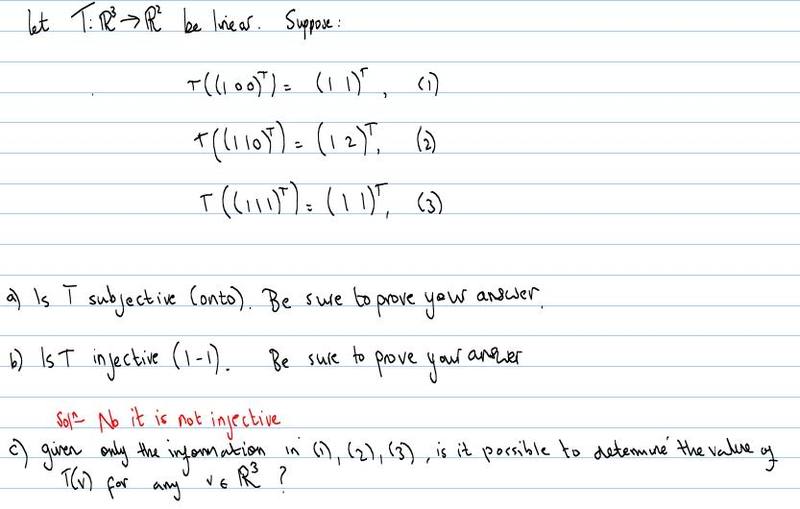
Untitled-2.jpg
 
Physics news on Phys.org
Welcome to the forums! To show in general that a map T is surjective you need to show that for every element in v in the range, there exists an element w in the domain such that T(w) = v. With a linear map, it is a little easier since you can deal with a basis. To show that a linear map is surjective, it is sufficient to show that a basis for the range is in the image set. In the problem you linked to, you can see that (1,1) and (1,2) are in the range. Do those two vectors form a basis for R^2? If so, the map is surjective.
 
eok20 said:
Welcome to the forums! To show in general that a map T is surjective you need to show that for every element in v in the range, there exists an element w in the domain such that T(w) = v. With a linear map, it is a little easier since you can deal with a basis. To show that a linear map is surjective, it is sufficient to show that a basis for the range is in the image set. In the problem you linked to, you can see that (1,1) and (1,2) are in the range. Do those two vectors form a basis for R^2? If so, the map is surjective.

Thank you very much eok20. I think I finally understand :approve:

I really appreciate your help!
 

Similar threads

  • · Replies 10 ·
Replies
10
Views
2K
  • · Replies 10 ·
Replies
10
Views
3K
Replies
1
Views
2K
  • · Replies 7 ·
Replies
7
Views
2K
  • · Replies 10 ·
Replies
10
Views
2K
Replies
1
Views
2K
  • · Replies 5 ·
Replies
5
Views
2K
  • · Replies 12 ·
Replies
12
Views
2K
  • · Replies 1 ·
Replies
1
Views
1K
  • · Replies 21 ·
Replies
21
Views
1K