Discussion Overview
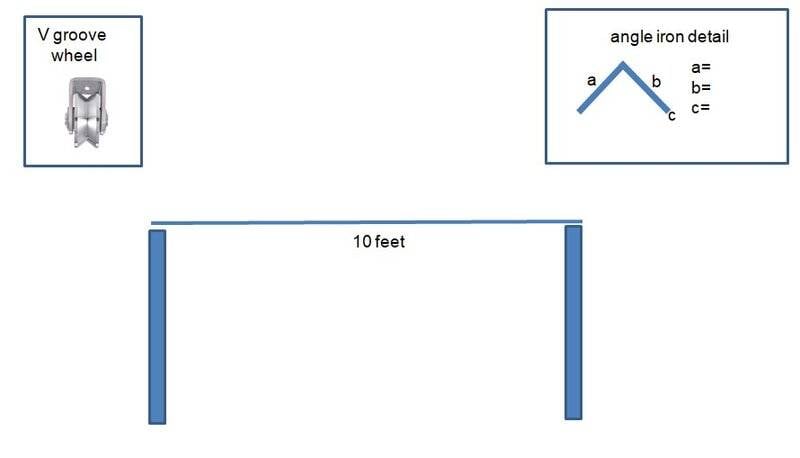
The discussion revolves around the calculation of load-bearing capacities for steel and aluminum angle iron used in a rail system supported over a 10ft span. Participants explore material choices, structural integrity, and safety considerations related to the design and application of the rails.
Discussion Character
- Technical explanation
- Debate/contested
- Mathematical reasoning
Main Points Raised
- Some participants inquire about the necessity of bracing the rails, questioning the safety of a design that relies solely on end supports.
- Concerns are raised regarding potential structural failure and the implications of such a failure, including safety risks and building code compliance.
- Participants suggest consulting engineering tables for quantitative data on load capacities and deflection limits.
- There is a discussion about the importance of beam depth and stiffness in relation to load-bearing capacity, with some suggesting that angle iron may not be sufficient for the proposed design.
- One participant mentions the potential for twisting under load and emphasizes the need for additional bracing to mitigate this effect.
- Participants discuss the orientation of the angle iron and how it affects load capacity and deflection, suggesting that turning the angle onto its edge may improve performance.
- There are inquiries about the ratio of Young's modulus for aluminum and steel, with some speculating on the material properties and failure modes of each.
- One participant provides equations for calculating maximum deflection and stress, highlighting the complexity of determining safe load limits.
- Another participant notes that the question has evolved from load capacity to deflection, indicating a shift in focus within the discussion.
Areas of Agreement / Disagreement
Participants express a range of views on the adequacy of the proposed design and the calculations involved. There is no consensus on the best approach or the safety of the design, with multiple competing perspectives on the structural requirements and material choices.
Contextual Notes
Limitations include the lack of detailed structural context, assumptions about loading conditions, and the complexity of calculating safe load limits and deflection for the proposed materials and configurations.