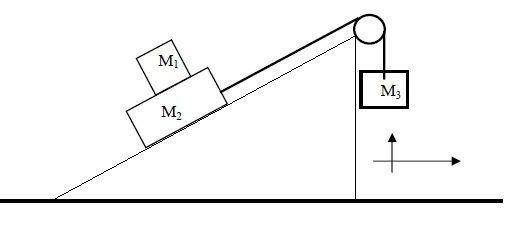
Newton Laws/Dynamics: 3 Masses on an incline

  • Thread starter Thread starter BitterX
  • Start date Start date
  • Tags Tags
    Incline Newton
Click For Summary

Homework Help Overview

The discussion revolves around a dynamics problem involving three masses on an incline, specifically focusing on the acceleration of the system when there is no relative movement between two of the masses, M1 and M2. Participants are exploring the implications of friction and the forces acting on the masses.

Discussion Character

  • Conceptual clarification, Assumption checking, Problem interpretation

Approaches and Questions Raised

  • Participants discuss the role of friction between M1 and M2 and question whether they can be treated as a single body. There are attempts to understand how the coefficient of friction affects the system's acceleration and whether it should be included in the calculations.

Discussion Status

The discussion is ongoing, with participants expressing uncertainty about their reasoning and the implications of the assumptions made regarding friction and relative motion. Some guidance has been offered regarding the treatment of the masses and the forces involved, but no consensus has been reached.

Contextual Notes

There is a noted lack of friction between mass 2 and the incline, which may affect the dynamics of the system. Participants are also considering the grading implications of their answers, indicating a formal homework context.

BitterX
Messages
35
Reaction score
0
Mu1 is the friction coefficient , I'm sure I did it wrong because I got the acceleration isn't dependent on it, and it doesn't make sense.
disregard the axis in the drawing - it's for another question.

Homework Statement


Find an expression for the acceleration of the system when there is no relative movement between M1 and M2
(same acceleration and velocity?)

h.jpg


Homework Equations


ΣF =ma

The Attempt at a Solution


View attachment 1.doc
 
Physics news on Phys.org
If there is no relative movement between M1 and M2 then one can take (M1 + M2) as one body. The coefficient of friction is between the block and the inclined plane. Right?
 
forgot to mention: there's no friction between the incline and the mass 2 only between mass 1 and 2.
I don't think you can look at it as one body mass 1 can slip from mass 2 the friction is the only think that can make them move together (the only force that resist the Earth pull on mass1).

I don't know what the answer is. that's what I'm trying to find out!
 
It was given that there is no relative movement between M1 and M2. Of course there is friction between these two masses. But if these masses are considered as one body then this friction force will be an internal force and can be left out of our consideration.
 
Maybe you are right, then it's reasonable why I haven't got Mu in the answer :/
I don't have the final answer so I'm trying to find out if I'm right... these questions have grades.

My line of thinking is that if Mu will be a large number than m1 could go up along with m2 even if m3 is heavy (and thus the force pulling both of the masses up is greater) but if it would be very little m1 won't "keep up" with m2(if it's going up) .
and so the acceleration has to be dependent on Mu - though I could be wrong.

But thanks, it's really kind of you to help :)
 
It all depends on whether or not it is 'given' that there is no relative motion between M1 and M2.
 

Similar threads

  • · Replies 13 ·
Replies
13
Views
2K
  • · Replies 3 ·
Replies
3
Views
2K
  • · Replies 5 ·
Replies
5
Views
2K
  • · Replies 1 ·
Replies
1
Views
2K
  • · Replies 13 ·
Replies
13
Views
6K
Replies
13
Views
3K
  • · Replies 5 ·
Replies
5
Views
2K
  • · Replies 5 ·
Replies
5
Views
4K
Replies
17
Views
2K
  • · Replies 3 ·
Replies
3
Views
2K