Non-uniform stress distrubution

Click For Summary

Discussion Overview

The discussion revolves around the calculation of non-uniform stress distribution in a rectangular wooden sample subjected to compression. Participants explore methods to determine the shortening of the sample at different heights based on experimental data and assumptions about stress distribution.

Discussion Character

  • Technical explanation
  • Debate/contested
  • Mathematical reasoning

Main Points Raised

  • Hana presents a problem involving a rectangular wooden sample compressed from the top and seeks to understand the shortening at the top based on a triangular stress distribution.
  • One participant proposes a method to calculate strain based on the known deflection at the bottom section and suggests that strain increases proportionally as the width decreases with height.
  • The same participant calculates an average strain for the top section using an average width of 27 mm, leading to a total deflection of 0.643 mm at the top.
  • Another participant questions the use of the average width and identifies an error in the initial calculation, proposing a new method that averages strains at the top and bottom widths to find a more accurate total deflection of 1.768 mm.
  • The second participant acknowledges the error in the first method and clarifies that the correct average width is essential for accurate calculations.

Areas of Agreement / Disagreement

Participants express differing views on the appropriate method for calculating deflection, with one method being challenged and revised. There is no consensus on a single correct approach, as participants explore various calculations and assumptions.

Contextual Notes

The discussion highlights the dependence on the choice of average width for strain calculations and the implications of linear variation of strain across the triangular section. Unresolved mathematical steps and assumptions about stress distribution are noted.

HannaMadd
Messages
3
Reaction score
0
Hi everyone!

I have perhaps a basic question, but I can't dealt with it.
I have a rectangular sample 50x150mm of let's say wood. The sample is compressed from the top over the width of 4mm. I know the shortening of the sample at 70 mm from the bottom (from experimental testing) and I know the force. The shortening is 0.2mm. But I need to know how much the sample shortens at the top, assuming triangle stress distribution. This is a 2D problem. Please, take a look at the sketch.

Thank you for any suggestions!

Hana
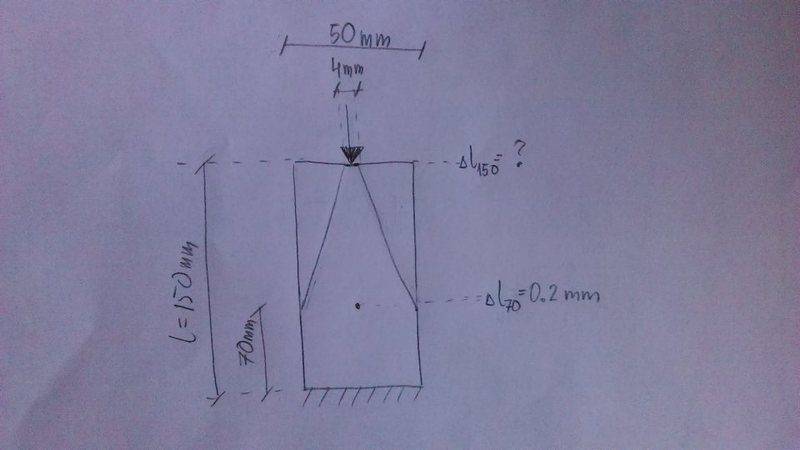
sketch.JPG
 
Engineering news on Phys.org
There may be better methods but this is how I would solve the problem.
(With the assumption that the 150 mm and 70 mm height dimensions shown are before the load was applied and the .2 mm deflection occurred.)

1. Since you know the amount of change in the bottom constant width section you can calculate the amount of strain (mm of compression per mm height of the bottom section) by dividing the .2 mm of deflection by the 70 mm of height of that section.

2. Since the amount of strain under a load is proportional to the load / area of the part x- section; so as long as the thickness of the part is constant the widths of the part are an accurate for determining the ratio of strain; so, as the width of the triangular section decreases with height, the amount of strain increases proportionally.

3 For the type of truncated triangle shown the average width of the this section is 1/2 of the difference between the base width and and top width = (50 + 4) / 2 = 27 mm and this can be used to calculate the top section average strain vs the strain at the width of the base of the triangle with the formula:
average top section strain = (base width / average triangle width) x the base section strain. = (50 / 27) x (.2 / 70) = .0053 mm / mm of height

4. As a result, the top section deflection = .0053 x (150 - 70) = 0.423 mm (rounded to 3 decimal places) and the total deflection at the top of the piece = .2 + .423 = 0.643 mm
 
JBA said:
There may be better methods but this is how I would solve the problem.
(With the assumption that the 150 mm and 70 mm height dimensions shown are before the load was applied and the .2 mm deflection occurred.)

1. Since you know the amount of change in the bottom constant width section you can calculate the amount of strain (mm of compression per mm height of the bottom section) by dividing the .2 mm of deflection by the 70 mm of height of that section.

2. Since the amount of strain under a load is proportional to the load / area of the part x- section; so as long as the thickness of the part is constant the widths of the part are an accurate for determining the ratio of strain; so, as the width of the triangular section decreases with height, the amount of strain increases proportionally.

3 For the type of truncated triangle shown the average width of the this section is 1/2 of the difference between the base width and and top width = (50 + 4) / 2 = 27 mm and this can be used to calculate the top section average strain vs the strain at the width of the base of the triangle with the formula:
average top section strain = (base width / average triangle width) x the base section strain. = (50 / 27) x (.2 / 70) = .0053 mm / mm of height

4. As a result, the top section deflection = .0053 x (150 - 70) = 0.423 mm (rounded to 3 decimal places) and the total deflection at the top of the piece = .2 + .423 = 0.643 mm

Hi JBA! Thank you for your reply.

My only doubt now is the point 3 in your answer. If we take an average width of 27mm, is your solution equivalent to the one in the sketch below?

sketch 2.JPG
 
I'm glad you questioned my above procedure because I began the following calculation to show that it would give the same results as my first post procedure; but it clearly does not support that calculation. After some reviewing of my first procedure using the 27 mm average width I have found that there is an error in my selection of that width for the average strain calculation. The below is an accurate (and more straight forward) method of calculating the deflection for the triangular section and total deflection at the top of the figure. I apologize for misleading you with my erroneous first post procedure.

To describe the process another way:
Strain at 50 mm base width = .2 / 70 = .0029 mm / mm height
Strain at 4 mm top width = (.0029) x (50 /4) = .0363 mm / mm height
Since the strain varies linearly between the top and bottom widths of the triangular section your can average those two values to get the average strain for that complete section = (.0363 +.0029) / 2 = .0196 mm / mm height
Therefore, deflection of the top 80 mm section = .0196 x 80 = 1.568 mm and the total deflection at the top of the figure = .2 + 1.568 = 1.768 mm

PS When the correct average width is used, the first method with a representative rectangle width and equivalent strain value at that width is an accepted equivalent method of calculating total deflection for the varying area of a triangular section such as in your figure, so I am working to find my error in determining the correct representative rectangle width in that first calculation.
 
JBA said:
I'm glad you questioned my above procedure because I began the following calculation to show that it would give the same results as my first post procedure; but it clearly does not support that calculation. After some reviewing of my first procedure using the 27 mm average width I have found that there is an error in my selection of that width for the average strain calculation. The below is an accurate (and more straight forward) method of calculating the deflection for the triangular section and total deflection at the top of the figure. I apologize for misleading you with my erroneous first post procedure.

To describe the process another way:
Strain at 50 mm base width = .2 / 70 = .0029 mm / mm height
Strain at 4 mm top width = (.0029) x (50 /4) = .0363 mm / mm height
Since the strain varies linearly between the top and bottom widths of the triangular section your can average those two values to get the average strain for that complete section = (.0363 +.0029) / 2 = .0196 mm / mm height
Therefore, deflection of the top 80 mm section = .0196 x 80 = 1.568 mm and the total deflection at the top of the figure = .2 + 1.568 = 1.768 mm

PS When the correct average width is used, the first method with a representative rectangle width and equivalent strain value at that width is an accepted equivalent method of calculating total deflection for the varying area of a triangular section such as in your figure, so I am working to find my error in determining the correct representative rectangle width in that first calculation.
Thank you for your explanation. It is more clear now.
 

Similar threads

  • · Replies 6 ·
Replies
6
Views
3K
  • · Replies 7 ·
Replies
7
Views
3K
Replies
2
Views
7K
  • · Replies 17 ·
Replies
17
Views
3K
  • · Replies 5 ·
Replies
5
Views
17K
  • · Replies 17 ·
Replies
17
Views
5K
  • · Replies 15 ·
Replies
15
Views
54K
  • · Replies 21 ·
Replies
21
Views
24K
  • · Replies 11 ·
Replies
11
Views
5K
Replies
7
Views
2K