High School Normal form of the conic section equation

Click For Summary
SUMMARY

The discussion centers on the normal form of the conic section equation, specifically x²+y²+2ax+2by+c=0, which is primarily associated with circles. Participants express confusion regarding the term "normal form" and its applicability to other conic sections, such as hyperbolas represented by the equation xy+F=0. The conversation highlights the differences between various forms of equations, including general, standard, and vertex forms, while also addressing the transformation of hyperbolas and the rotation of axes using specific equations.

PREREQUISITES
  • Understanding of conic sections, particularly circles and hyperbolas.
  • Familiarity with the general equation of a hyperbola: (x-x₀)²/a² - (y-y₀)²/b² = 1.
  • Knowledge of coordinate transformations and rotation of axes.
  • Basic algebraic manipulation of quadratic equations.
NEXT STEPS
  • Research the derivation of the normal form of conic sections and its relation to circles and hyperbolas.
  • Learn about the transformation equations for rotating conic sections, specifically x′=xcos(α)+ysin(α) and y′=ycos(α)-xsin(α).
  • Explore the differences between general, standard, and vertex forms of conic equations.
  • Study the graphical representation of hyperbolas and their transformations in Cartesian coordinates.
USEFUL FOR

Mathematicians, students studying conic sections, educators teaching geometry, and anyone interested in the properties and transformations of conic equations.

PainterGuy
Messages
938
Reaction score
73
TL;DR
Why this equation, x²+y²+2ax+2by+c=0, is called 'normal form of the conic section equation'.
Hi,

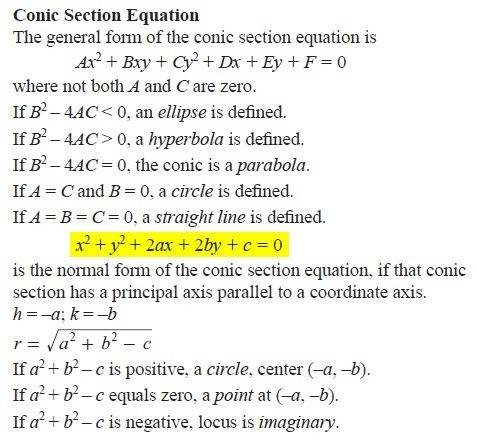
The following is called normal form of the conic section equation:
x²+y²+2ax+2by+c=0

A circle is one of the conic sections when considered as a special of ellipse. I'm confused as to why the the given equation is called "normal form of the conic section equation" when, in my opinion, the equation only describes a circle, a point which could be said to be a special case of circle, imaginary locus or imaginary circle; as I understand it the equation has nothing to do with the conic sections other than the circle which is a special case. Could it represent any other conic section?

The shown below is equation in its context:
?hash=3ec9a72c83dc9a5c9e2ce1c60870a5f9.jpg


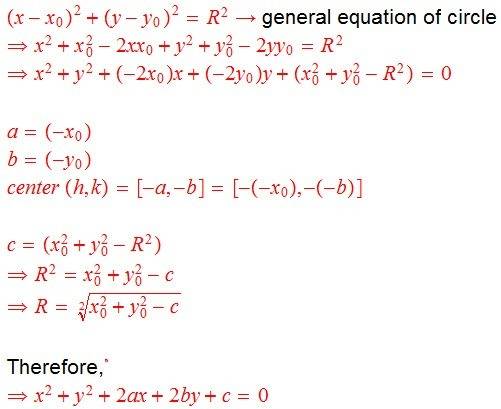
I have tried below to relate the "normal form of the conic section equation" to general equation of a circle with radius R and center at (x₀, y₀).
?hash=3ec9a72c83dc9a5c9e2ce1c60870a5f9.jpg


Thank you for your help and time!
 

Attachments

  • normal_equation_conic.jpg
    normal_equation_conic.jpg
    36.8 KB · Views: 649
  • general_equation_circle.jpg
    general_equation_circle.jpg
    20.5 KB · Views: 682
Mathematics news on Phys.org
I don't know why the term "normal" is used. Your analysis agrees with what is given in the extract. Essentially, it's a circle.
 
  • Like
Likes PainterGuy
A and C both may = 0 as long as B is not. (hyperbola)
 
Thank you!

mathman said:
A and C both may = 0 as long as B is not. (hyperbola)

I'm sorry but I don't follow your point. Could you please elaborate a bit? Thanks.

?hash=d73e364b9a54376f63a4ab55d4b63554.jpg
 

Attachments

  • normal_equation_conic_hyperbola.jpg
    normal_equation_conic_hyperbola.jpg
    34.6 KB · Views: 399
A little more generally, equation forms might be called "general", "standard", or other kinds ("vertex form"). Why then need to use any designation of "normal"? Maybe to know if an equation is general or standard or something else and why, might be good.
 
  • Like
Likes PainterGuy
##xy+F=0## is an equation for a hyperbola.
 
  • Like
Likes PainterGuy
Thank you!

mathman said:
##xy+F=0## is an equation for a hyperbola.

Thanks for pointing this out that xy+F=0 represents a hyperbola but how can one derive "xy+F=0" from this so-called 'normal form of the conic section equation' x²+y²+2ax+2by+c=0? I don't see a way.

By the way, another related question is that how one can convert the general equation of hyperbola, (x-x₀)²/a² - (y-y₀)²/b² = 1, into xy=c or xy+c=0.

symbolipoint said:
A little more generally, equation forms might be called "general", "standard", or other kinds ("vertex form"). Why then need to use any designation of "normal"? Maybe to know if an equation is general or standard or something else and why, might be good.

I'd say that many a time terminology and definitions vary from one source to another and one should not worry oneself with the terminology unless it seems really important. I tried to find the answer about the difference between 'standard form', 'normal form', 'general form', etc. and got confused so left it halfway because it didn't seem much important to me.

Anyway, some of the links given below might be useful.

1: https://pages.mtu.edu/~shene/COURSES/cs3621/NOTES/geometry/simple.html
2: https://elsenaju.eu/Calculator/normal-form-to-vertex-form.htm
3: watch?v=cjXafzJ-gEk (add "https://www.youtube.com/" before "watch")
4: https://arxiv.org/pdf/1702.05789.pdf
5: https://mathbitsnotebook.com/Algebra1/Quadratics/QDVertexForm.html
6: https://www.physicsforums.com/threads/general-form-vs-standard-form-of-a-line.640797/
7: https://www.mathsisfun.com/algebra/quadratic-equation.html
8: https://www.analyzemath.com/quadraticg/quadraticg.htm
9: watch?v=-r4v9J0tn-o (add "https://www.youtube.com/" before "watch")
 
Look at what actual textbooks say for the kinds of or names of the equations' forms.
 
  • Like
Likes PainterGuy
To convert ##xy=c##, set ##x=x'+y'## and ##y=x'-y'## to get ##x'^2-y'^2+c=0##.
 
  • Like
Likes PainterGuy
  • #10
Thank you!

mathman said:
To convert ##xy=c##, set ##x=x'+y'## and ##y=x'-y'## to get ##x'^2-y'^2+c=0##.

xy=c --- equation 1
using x=x′+y′ and y=x′-y′
(x′+y′)(x′-y′)=c
(x′)²-x′y′+y′x′-(y′)²=c
(x′)²-(y′)²=c
letting x′=X, y′=Y
X²-Y²=c --- equation 2

Now let's graph the equations.

Graph #1:
xy=c
⇒y=c/x
let c=2
y=2/x

?hash=fcd193a231171e92ff8264d6a8bab7d1.jpg


Graph #2:
x²-y²+c=0
⇒-y²=-x²-c
⇒y²=x²+c
⇒y=√(x²+c)
let c=2
⇒y=√(x²+2)

?hash=fcd193a231171e92ff8264d6a8bab7d1.jpg


It's clear that both equations represent a hyperbola and one equation is rotated version of another. It's 45 degrees rotation.

These two equations, x=x′+y′ and y=x′-y′, are used to rotate the axes by 45 degrees. But I don't understand where these equations come from. The rotation of axes is given as follows.

?hash=fcd193a231171e92ff8264d6a8bab7d1.jpg


Could you please help me with this? Thank you!
 

Attachments

  • hyperbola_mathman2.jpg
    hyperbola_mathman2.jpg
    13.1 KB · Views: 460
  • hyperbola_mathman.jpg
    hyperbola_mathman.jpg
    20.4 KB · Views: 421
  • rotations_axes.jpg
    rotations_axes.jpg
    16.5 KB · Views: 429
  • #11
Hi,

Could someone please help me with the query from my last post?

The query was "These two equations, x=x′+y′ and y=x′-y′, are used to rotate the axes by 45 degrees. But I don't understand where these equations come from."

Thank you!
 
  • #12
Hi,

In post #10 above I made few mistakes so in this posting I would try to fix them.

The equation of a hyperbola in rectangular coordination is given as:

?hash=b16c846c00d2c40c4db3de006e092243.jpg


where (x₀,y₀) is center and "a" is distance from center to vertex and "b" is vertical distance from vertex to the asymptote, or distance from center to co-vertex. The given equation encapsulates definition of a hyperbola and assumes that the major axis is parallel to x-axis. For example, there cannot be "-1", "2", or "2.2" on the right side of equation. It can only be "1" because that's what the definition, i.e. equation, says.

245425


Also, if the major axis is parallel to y-axis instead, one can interchange x and y in the equation above. Sometimes one can find a conic section, including hyperbola, rotated and in such cases one can use transformation equations involving pure rotation shown below to find the final equation.

x′=xcos(α)+ysin(α)
y′=ycos(α)-xsin(α)

We know from post #10 that hyperbola represented by xy=c is a 45 degrees rotated version.

?hash=b16c846c00d2c40c4db3de006e092243.jpg


These two equations, x=x′+y′ and y=x′-y′, do not actually represent rotation; they are more of a conversion tool from one form to another.

Thank you!
 

Attachments

  • hyperbola_typical.jpg
    hyperbola_typical.jpg
    2.2 KB · Views: 398
  • hyperbola_rotate1.jpg
    hyperbola_rotate1.jpg
    40.7 KB · Views: 395
Last edited:

Similar threads

  • · Replies 18 ·
Replies
18
Views
3K
  • · Replies 5 ·
Replies
5
Views
2K
  • · Replies 1 ·
Replies
1
Views
4K
  • · Replies 3 ·
Replies
3
Views
2K
  • · Replies 3 ·
Replies
3
Views
5K
Replies
4
Views
14K
  • · Replies 1 ·
Replies
1
Views
2K
  • · Replies 1 ·
Replies
1
Views
3K
  • · Replies 6 ·
Replies
6
Views
2K
  • · Replies 2 ·
Replies
2
Views
2K