Normalizing Wavefunction: Hard QM Question)

Click For Summary

Homework Help Overview

The discussion revolves around normalizing a piecewise continuous wavefunction in quantum mechanics, specifically in the context of a potential well problem. Participants are exploring the mathematical formulation and implications of boundary conditions, energy eigenvalues, and normalization techniques.

Discussion Character

  • Exploratory, Conceptual clarification, Mathematical reasoning, Assumption checking

Approaches and Questions Raised

  • Participants discuss various attempts to normalize the wavefunction, questioning the necessity of normalization and the implications of boundary conditions. There are inquiries about the relationship between potential energy and eigenvalues, as well as the methods for determining these values graphically or numerically.

Discussion Status

The discussion is ongoing, with participants providing insights and suggestions regarding normalization and energy eigenvalue determination. Some participants express uncertainty about specific aspects, such as the upper bounds of potential energy and the conditions for bound states. Multiple interpretations and approaches are being explored without a clear consensus.

Contextual Notes

Participants are navigating the complexities of a hybrid problem that combines elements of the infinite square well and potential well scenarios. There are references to specific mathematical relationships and conditions that need to be satisfied for the existence of solutions, as well as the implications of infinite potential in certain regions.

drop_out_kid
Messages
34
Reaction score
2
Homework Statement
For a well left side is infinite potential and right side is finite potential V0 , and the energy is constant and less than V0(also constant). Now get the wave function , get the equation for eigen energy(the energy allowed) and the conditions for no solution
Relevant Equations
$$-\frac{\hbar^2}{2m} \frac{\partial^2}{\partial x^2} \Phi(x)+V(x)\Phi(x)=0$$
1650421835423.png

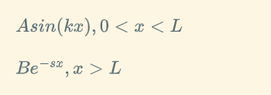
So I have come up with my solution(attempt) which is:

1650421198982.png


where
1650421023842.png


(
$$\psi_ 1 \triangleq Asin(kx),0<x<L$$

$$\psi_ 2 \triangleq Be^{-sx},x>L$$

$$k \triangleq \sqrt{\frac{2mE}{\hbar^2}} $$

$$s \triangleq \sqrt{\frac{2m(V-E)}{\hbar^2}} $$)

But this has a serious problem about boundary: I think I should use that
1650421287866.png


But this is what I get:

1650421761245.png


So:
1. How can I get this normalisation in a easy way?
2. Can I use this for part (b) to solve eigen energy?Thought for hours , assignment is going to due (
 

Attachments

  • 1650420856221.png
    1650420856221.png
    1.6 KB · Views: 137
Physics news on Phys.org
And congratulation to myself, markdown finally worked.
 
Some new progress:

I still didn't find way to normalise this.. Perhaps problem doesn't require it idk, and I am analyze this equation:

$$
\alpha \triangleq\sqrt{E} \ \
\gamma \triangleq\sqrt{\frac{2m}{\hbar^2}}L \ \
tan(\gamma\alpha)=-\sqrt{\frac{\alpha^2}{V-\alpha^2}}\ \ (\gamma,V\ \ are\ \ constant)
$$

1650423224325.png
 
To normalize the piecewise continuous wavefunction, express ##\psi_1(x)## and ##\psi_2(x)## in terms of a single constant, ##A## or ##B##, and then normalize the usual way. The energy eigenvalues will have to be deternined graphically or numerically.
 
kuruman said:
To normalize the piecewise continuous wavefunction, express ##\psi_1(x)## and ##\psi_2(x)## in terms of a single constant, ##A## or ##B##, and then normalize the usual way. The energy eigenvalues will have to be deternined graphically or numerically.
But I can determine the upper bound of V by Tangent function asymptotic line right?
Not sure but I get sth like V<=Pi^2*hbar^2/(8mL)
 
drop_out_kid said:
But I can determine the upper bound of V by Tangent function asymptotic line right?
Not sure but I get sth like V<=Pi^2*hbar^2/(8mL)
What upper bound of V? How do you propose to find the eigenvalues? Have you studied how to find them in the case of the particle in a box and in the case of a square well? This is a hybrid that combines the two methods for finding the eigenvalues.
 
kuruman said:
What upper bound of V? How do you propose to find the eigenvalues? Have you studied how to find them in the case of the particle in a box and in the case of a square well? This is a hybrid that combines the two methods for finding the eigenvalues.
If V is bigger than this , there's no possible energy.(from the two eqs of B/A)
 
drop_out_kid said:
If V is bigger than this , there's no possible energy.(from the two eqs of B/A)
What is "this" that V cannot be bigger than? V is infinite at x = 0 and you already know how to deal with that. It is -U in the region 0 ≤ x ≤ L (the well) and zero for x > L. The two equations give you $$\frac{k\cos(kL)}{-se^{-sL}}=\frac{\sin(kL)}{e^{-sL}}.$$That's what you have to solve numerically for ##E## which is implicit in the definitions for ##k## and ##s##.
 
drop_out_kid said:
If V is bigger than this , there's no possible energy.(from the two eqs of B/A)
Why? The infinite square well has an infinite number of bound eigenstates.
 
  • #10
Regarding normalization: You will always be able to normalize the wave function as long as the norm is finite (which you have already used implicitly to discard the exponentially growing solutions). The issue is instead whether solutions exist for particular energies. To find out you need to use the matching conditions in the way described by @kuruman (also obtainable by dividing one matching condition by the other). To obtain the condition for no bound state solution (there will always be a continuum of scattering states in this problem), you need to find out when the equation thus obtained has no solutions for ##E < V##.
 

Similar threads

Replies
8
Views
1K
  • · Replies 12 ·
Replies
12
Views
1K
  • · Replies 6 ·
Replies
6
Views
1K
  • · Replies 2 ·
Replies
2
Views
2K
Replies
6
Views
2K
  • · Replies 4 ·
Replies
4
Views
1K
  • · Replies 10 ·
Replies
10
Views
2K
  • · Replies 8 ·
Replies
8
Views
1K
  • · Replies 17 ·
Replies
17
Views
2K
  • · Replies 20 ·
Replies
20
Views
3K