Nothing can travel faster than the speed of light

Click For Summary

Discussion Overview

The discussion revolves around the concept of the speed of light and its implications for thought processes. Participants explore whether thoughts can be considered to travel and how they relate to the physical limitations imposed by the speed of light, including the nature of thought as a non-physical entity versus the biological processes involved in thinking.

Discussion Character

  • Exploratory
  • Debate/contested
  • Conceptual clarification

Main Points Raised

  • Some participants assert that thought is not a "thing" and therefore not governed by the speed of light.
  • Others question whether thoughts can be said to travel and, if so, from where they originate.
  • A participant mentions the possibility of imagining speeds faster than light and conducting hypothetical calculations.
  • Some argue that thoughts are ultimately based on nerve impulses and chemical reactions, which are subject to physical limitations.
  • There is a suggestion that while thoughts are not physical objects, the processes involved in thinking are limited by the speed of light, particularly in the context of electronic or photonic AI.
  • Concerns are raised about the feasibility of localizing thoughts within the dimensions of the human brain and timing them accurately.
  • A later reply provides a measurement of the speed of thought, suggesting it is significantly slower than the speed of light.

Areas of Agreement / Disagreement

Participants express differing views on the nature of thought and its relationship to the speed of light. There is no consensus on whether thoughts can be measured in terms of speed or how they relate to physical processes.

Contextual Notes

Some discussions involve assumptions about the nature of thought and its measurement, as well as the definitions of physical versus non-physical entities. The limitations of measuring thought speed and the implications of brain dimensions are also noted.

sAzt71
Messages
3
Reaction score
0
Hello,

I came to this site, with a question in mind.

The speed of light. Nothing travels faster than the speed of light. This is a phrase, most of us are familiar with, to some extent.

The word "Nothing" has two syllables, "No" & "Thing". There is no thing, that can, travel faster than the speed of light ?

To "think", is not a "thing". Therefore, thought, is not governed by the speed or frequency of light.

Our Eyes, receive Photon(s), from a Wave, with the Frequency of light. Do our Minds, receive Thought(s), from a Wave, with the Frequency of ? to think !

Who can gauge the distance, thought has traversed, if at all any.
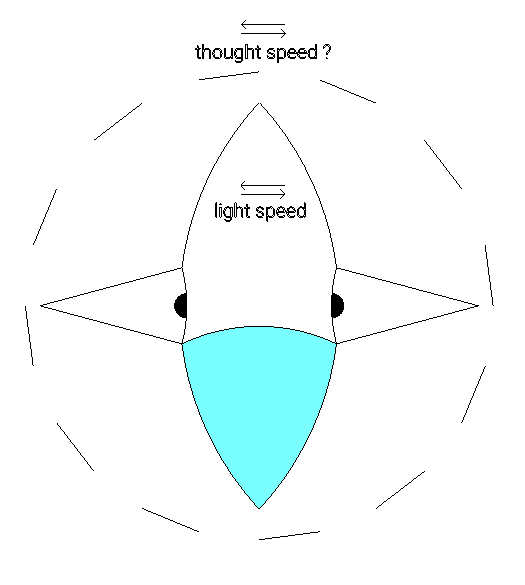
Capture.PNG
 

Attachments

  • Capture.PNG
    Capture.PNG
    2.8 KB · Views: 1,060
Last edited:
Science news on Phys.org
sAzt71 said:
To "think", is not a "thing". Therefore, thought, is not governed by the speed or frequency of light.
Hi sAzt71, I have a question for you:
Do thoughts travel?
And if they do, where do they travel from?

I also have a spoiler below...
The speed of light is also a limit for how fast signals can travel, which includes all forms of communication.
 
  • Like
Likes   Reactions: russ_watters
I can imagine a speed faster than light. I can even do calculations in a hypothetical theory in which such speeds are allowed. :smile:
 
sAzt71 said:
To "think", is not a "thing". Therefore, thought, is not governed by the speed or frequency of light.
Thoughts are just nerve impulses and chemical neuro transmitters, so they are all restricted by the same rules that govern other biological chemical reactions and physical electrical signals.

A link here to a few interesting points on the subject

https://hypertextbook.com/facts/2002/DavidParizh.shtml
 
So although "a thought" is not a physical object, the "thought" process involves physical objects within the brain and is therefore limited by c (although this limitation is irrelevant since the speeds involved are much slower anyway). The c limit might be of more importance in electronic or photonic AI.
 
sAzt71 said:
Do our Minds, receive Thought(s), from a Wave
What's the frequency, Kenneth?
 
  • Like
Likes   Reactions: Asymptotic and phinds
Jehannum said:
So although "a thought" is not a physical object, the "thought" process involves physical objects within the brain and is therefore limited by c (although this limitation is irrelevant since the speeds involved are much slower anyway). The c limit might be of more importance in electronic or photonic AI.

The dimensions of our Brain are; 20cm long x 10 cm high x 10 cm across, approximately.
 
sAzt71 said:
The dimensions of our Brain are; 20cm long x 10 cm high x 10 cm across, approximately.
In other words, less than 1 light-nanosecond in every dimension. Now how are you planning to localize a thought and time it to within plus or minus one nanosecond?
 
  • Like
Likes   Reactions: davenn
  • #10
New poster has ben reminded about posting mainstream peer-reviewed links to support their technical questions
jbriggs444 said:
In other words, less than 1 light-nanosecond in every dimension. Now how are you planning to localize a thought and time it to within plus or minus one nanosecond?

I recall, a docment, from a Doctor. with the, Size & Weight, for a Brain, from a deceased Professor.

Was the area of that Brain, equal to, less than or more than, the space of that Mind.
 
  • #11
sAzt71 said:
Was the area of that Brain, equal to, less than or more than, the space of that Mind.
What does that even mean?
 
  • Like
Likes   Reactions: lekh2003
  • #12
My goodness. Thread closed for a bit for Moderation...
 
  • Like
Likes   Reactions: lekh2003
  • #13
sAzt71 said:
I recall, a docment, from a Doctor. with the, Size & Weight, for a Brain, from a deceased Professor.

Was the area of that Brain, equal to, less than or more than, the space of that Mind.
Thread will remain closed unless the OP PMs me the links I requested.
 
  • #14
sAzt71 said:
Who can gauge the distance, thought has traversed, if at all any.
This is fairly easy to measure and is done as a diagnostic medical test on a routine basis. The speed of thought tops out at about 120 m/s. Far smaller than c.
 
  • Like
Likes   Reactions: Asymptotic and sAzt71

Similar threads

  • · Replies 6 ·
Replies
6
Views
3K
  • · Replies 18 ·
Replies
18
Views
3K
  • · Replies 12 ·
Replies
12
Views
2K
  • · Replies 14 ·
Replies
14
Views
3K
  • · Replies 4 ·
Replies
4
Views
4K
  • · Replies 16 ·
Replies
16
Views
3K
  • · Replies 2 ·
Replies
2
Views
3K
  • · Replies 6 ·
Replies
6
Views
2K
  • · Replies 4 ·
Replies
4
Views
2K
  • · Replies 6 ·
Replies
6
Views
2K