Off-set Coaxial Cable - Capacitance

Click For Summary

Discussion Overview

The discussion revolves around calculating the capacitance of an off-set coaxial cable, specifically focusing on the capacitance for a quarter of the cable. Participants explore the implications of the central conductor's position on the overall capacitance and voltage calculations.

Discussion Character

  • Technical explanation
  • Debate/contested
  • Mathematical reasoning

Main Points Raised

  • One participant presents the standard formula for the capacitance per unit length of a coaxial cable and queries how to adapt this for an off-set central conductor.
  • Another participant provides a reminder of the electric field and voltage calculations for a coaxial cable, suggesting that the capacitance can be derived from these principles.
  • A different participant expresses difficulty with the problem, noting that while charge (Q) remains constant, the voltage (and thus capacitance) will vary based on the position of the inner conductor.
  • This participant suggests that the capacitance will depend on the angle (theta) when considering the geometry of the cable, indicating a need for a function that relates the distances involved.

Areas of Agreement / Disagreement

Participants do not reach a consensus on how to calculate the capacitance for the off-set coaxial cable. There are competing views on how the position of the inner conductor affects the capacitance and voltage, with some uncertainty expressed regarding the integration needed to find a solution.

Contextual Notes

The discussion highlights limitations in the assumptions made about the geometry of the coaxial cable and the implications of the off-set conductor on capacitance calculations. The need for a specific function relating the distances involved is noted but remains unresolved.

thedean515
Messages
11
Reaction score
0
Hi,

As you know the capacitance per unit length of a standard coaxial cable is

[tex]C_{coax} = \frac{2 \pi \varepsilon_{0} \varepsilon_{r}}{\ln{\frac{b}{a}}}[/tex]

where b is the radius of the cable and a is radius of the central conductor.
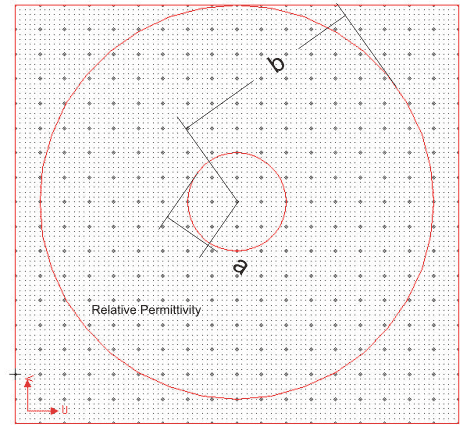
coax.png
.

If we only want to know the capacitance of a quarter of the cable, it is just [tex]\frac{1}{4}C_{coax}[/tex]

What if the cental conductor is off-set, how can we calculate the capacitance? Especiall I am interest to know the capacitance for only a quarter of the cable.

The off-set coax cable case is:
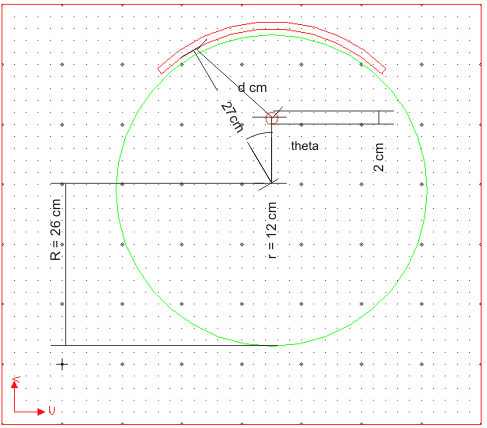
offset-coax.png
 
Physics news on Phys.org
part soultion

Hi,

Just to remind you the calculation for the coaxial cable case.

The electric field of an infinite line of charge is given

[tex]E = \frac{D}{\epsilon_0 \epsilon_r} = \hat{r} \frac{\rho_l}{2 \pi \epsilon_0 \epsilon_r r}[/tex]

in radial direction.


[tex]V = -\int_a^b Edl = \frac{Q}{2 \pi \epsilon_0 \epsilon_r}ln \frac{b}{a}[/tex]

Finally,

[tex]C = \frac{Q}{V} = \frac{2 \pi \epsilon_0 \epsilon_r}{ln \frac{b}{a}}[/tex]
 
Can anyone help me?
 
boy, that is difficult (for me anyway, I am probably at a similar level to you.)

As you said,

[tex]C = \frac{Q}{V}[/tex]

and, Q doesn't change depending on where you stick the inner conductor, right? I think this is right.

The trouble is really the voltage. The capacitance of a coax cable is the capacitance between the inner and outer conductors, right? The only reason you can say something as simple as, "this cable's capacitance is 6pF/meter.", is because the conductor is square in the middle.

Clearly, from the integral, Voltage (and therefore capacitance) changes as the conductors get further apart.

For this example, that means that the capacitance of the line will vary depending on how you're looking at it, do you know what I mean? You won't just be able to say, this is a 6pF line. If you draw the cable on a coordinate axis, the capacitance will vary in theta.

In short, find a function (of theta) that relates the distance from a to b. Integrate Edl from a to this function. the final answer will depend on theta.

I think.
 
Last edited:

Similar threads

  • · Replies 3 ·
Replies
3
Views
2K
  • · Replies 1 ·
Replies
1
Views
1K
  • · Replies 2 ·
Replies
2
Views
2K
  • · Replies 26 ·
Replies
26
Views
4K
  • · Replies 4 ·
Replies
4
Views
5K
  • · Replies 3 ·
Replies
3
Views
2K
  • · Replies 16 ·
Replies
16
Views
3K
  • · Replies 4 ·
Replies
4
Views
2K
  • · Replies 1 ·
Replies
1
Views
2K
  • · Replies 1 ·
Replies
1
Views
3K