Offset Torque: Solving the 1000N Problem

Click For Summary
SUMMARY

The discussion focuses on calculating offset torque in a design scenario involving a 1000N force applied at the top of a structure, pivoting around the left wheel. The key takeaway is that torque is calculated using the formula T = rFsin(θ), where only the perpendicular components of the force and distance are relevant. Participants confirm that either the perpendicular distance (h) or the length of the green line can be used to find the torque, as both approaches yield the same result. Additionally, for weight calculations, the mass (m) multiplied by the gravitational force (g) should be considered using the perpendicular distance from the pivot to the center of mass.

PREREQUISITES
  • Understanding of torque and its mathematical representation.
  • Familiarity with vector cross products.
  • Basic knowledge of forces and moments in physics.
  • Ability to visualize and interpret diagrams related to mechanical systems.
NEXT STEPS
  • Study the principles of torque and equilibrium in mechanical systems.
  • Learn about vector cross products and their applications in physics.
  • Explore the concept of center of mass and its significance in torque calculations.
  • Investigate real-world applications of torque in engineering design.
USEFUL FOR

Mechanical engineers, physics students, and anyone involved in design and analysis of mechanical systems will benefit from this discussion, particularly those working with torque calculations and equilibrium analysis.

DarkBlitz
Messages
22
Reaction score
0
Hello guys,

I am doing some basic design work and can't remember how offset torques work.
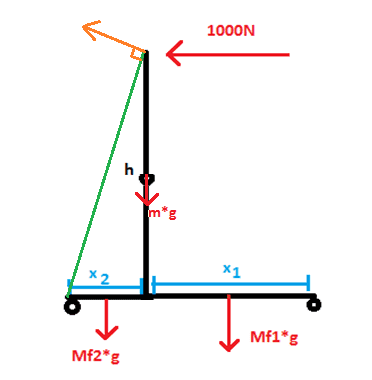
upload_2017-3-28_16-13-8.png


I am doing the sum of the torques should be equal to 0 in order to find the tipping point around either of the wheels.

My problem is with the 1000N applied at to top taking the pivot point around the left wheel.

Should I be using the component of the 1000N which is at right angles to the distance to the pivot point? (the green line) and take the green line as the distance? should I use 'h' as the distance to the pivot point with 1000N as the force? or a combination of both?

The same for m*g in the diagram. Should I assume that the centre of mass is where the weight is applied and take the perpendicular component?

Thanks very much for your help guys! Been a long time since I looked into this.
 
Engineering news on Phys.org
By definition, the torque is the result of a cross product of 2 vectors, i.e. ##\mathbf{T} = \mathbf{r} \times \mathbf{F}##. The magnitude of this torque (what you are looking for) is ##T = rF\sin\theta## where ##\theta## is the angle between the 2 vectors. This basically means that only the components of the vectors that are perpendicular to each other are considered.

You can see it as ##r_{\perp} F## or ##r F_{\perp}## as you wish, since both will give you the same answer: ##rF\sin\theta##.

The following is a representation of ##r F_{\perp}##:

512px-Torque%2C_position%2C_and_force.svg.png

The following is a representation of ##r_{\perp} F##:

télécharger.gif

So in your case, you take 1000 N times h ( or ##r_{\perp} F##). You could use ##r F_{\perp}## by using the length of the green line and by finding the perpendicular component of the 1000 N force (the orange line), it would give the same answer. It is just more complicated in this particular case.

Similarly, for the weight, you take mg times x2. Where x2 is the perpendicular component of the distance between the wheel and the center of mass.
 
  • Like
Likes   Reactions: DarkBlitz and Heral89
Thanks a lot! cleared it up!
 

Similar threads

  • · Replies 1 ·
Replies
1
Views
2K
Replies
7
Views
3K
Replies
14
Views
1K
  • · Replies 9 ·
Replies
9
Views
2K
Replies
9
Views
2K
  • · Replies 28 ·
Replies
28
Views
2K
  • · Replies 1 ·
Replies
1
Views
2K
  • · Replies 2 ·
Replies
2
Views
2K
  • · Replies 7 ·
Replies
7
Views
2K
Replies
2
Views
2K