Ohmic Losses In Capacitor Discharge

Click For Summary
SUMMARY

The discussion centers on the comparison of ohmic losses in two capacitor configurations: ten parallel 450V 1800uF capacitors with 138.8mOhm ESR versus one 450V 18000uF capacitor with 13.88mOhm ESR. Both configurations store 1,823J of energy, but the ten capacitors allow for controlled discharges, potentially enhancing system efficiency despite their higher ESR. The consensus is that when discharged in close intervals, the total current and resultant power loss due to ESR will be equivalent for both setups, leading to similar energy losses. The conversation also touches on the feasibility of using SCRs for controlling discharge in the ten-capacitor bank.

PREREQUISITES
  • Understanding of capacitor specifications, including voltage and capacitance ratings.
  • Knowledge of equivalent series resistance (ESR) and its impact on power loss.
  • Familiarity with SCR (Silicon Controlled Rectifier) functionality and applications.
  • Basic principles of electrical circuits, including current, voltage, and power calculations.
NEXT STEPS
  • Research the impact of ESR on capacitor performance in high-current applications.
  • Learn about SCR specifications and how to select appropriate SCRs for high-current discharge applications.
  • Investigate methods for controlling capacitor discharge intervals using microprocessors or integrated circuits.
  • Explore advanced capacitor configurations for optimizing energy efficiency in power systems.
USEFUL FOR

Electrical engineers, power electronics specialists, and hobbyists involved in high-current capacitor applications and energy efficiency optimization.

axi0m
Messages
59
Reaction score
0
Let's say that we have two capacitive sources of power:

1) ten parallel 450V 1800uF 138.8mOhm-ESR capacitors​

2) one 450V 18000uF 13.88mOhm-ESR capacitor​

Both sources contain 1,823J of energy. The source containing ten capacitors is advantageous for my purposes due to the fact that the capacitors can be discharged at set intervals, thus creating a longer, lower current pulse than the one large capacitor. My main priority is overall system efficiency.

The disadvantage with lower-capacitance capacitors is that they have a much higher equivalent series resistance (ESR.) Being that resistance in a circiut dissipates power, thus wasting energy, I would expect, in my mediocre electrical knowledge, that the source containing ten high-ESR capcitors would waste more energy than the other, thus leading to lower overall system efficiency.

However, my source of confusion is the fact that if all ten capacitors from the first source were placed in parallel and discharged simultaneously, the total resistance would be given by the equation below, which dictates total resistance of resistors in parallel, in this case, the ESR of the ten capacitors:
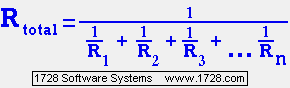
resistrs.gif


By this equation, the total ESR of all ten capacitors connected in parallel would be 13.88mOhms, the same ESR as the one large capacitor. Is it true that if all ten capacitors from source one were discharged not simultaneously, but in very close intervals, the total energy lost due to ohmics losses would be the same as in source two, the one large capacitor?

As always, thanks in advance for your help -- it's much appreciated.
 
Engineering news on Phys.org
The ESRs are not in parallel. They are in series with a capacitor and the combinations are in parallel.
However the effect is the same. Each of the smaller capacitors would discharge at 3242 amps
(450 / .1388) initially.
The large capacitor would discharge at 32420 Amps.

So, yes, the total current would be the same and the resistance is effectively the same, so the power loss is the same.
 
Last edited:
Yes.
 
vk6kro said:
Yes.

Haha, I checked your first reply from my phone and somehow overlooked the end of your post where you said power loss would be the same. Then by the time I saw it and deleted my post, you already replied. You're good! ;-)edit:
I see now you edited it. Sneaky sneaky...
 
Yes, I extended the comment a bit. Stating the obvious, I suppose.

These are serious currents, though. Are you sure these capacitors are rated for such currents?

The large capacitor would be dissipating 14 589 000 watts if only briefly.
 
vk6kro said:
Yes, I extended the comment a bit. Stating the obvious, I suppose.

I'm just having a hard time conceptualizing how adding more capacitors in parallel decreases total resistance, or ESR. It seems like some kind of double-slit photon experiment.


vk6kro said:
These are serious currents, though. Are you sure these capacitors are rated for such currents?

The large capacitor would be dissipating 14 589 000 watts if only briefly.

Yes, pretty sure. Aluminum electrolytic capacitors are used quite frequently for fast-discharge experiments including various electromagnetic launchers. I've even read about a representitive from Cornell-Dubilier that discussed using the same type of capacitor for 40kA+ discharge experiments -- from a single capacitor.
 
On a very related topic, I have another question.

I'm thinking of using the ten-capacitor bank with an SCR on each capacitor. Each SCR would be controlled by some kind of microprocessor or IC and could be fired at any given interval.

It appears that each capacitor will discharge at around 3kA+. Obviously, an SCR that is listed at this current would be well outside of a reasonable budget. I'm thinking that for such a short pulse duration, an SCR could handle around 10x its normal current limit -- does that seem reasonable? Thus, I could find one that's closer to 300A.
 
axi0m said:
I'm just having a hard time conceptualizing how adding more capacitors in parallel decreases total resistance, or ESR. It seems like some kind of double-slit photon experiment..
Suppose the total sum current is I, and the ESR is R ohms for each of 10 capacitors. Then the power loss in each ESR is (0.1 I)2 R = 0.01 I2 R. So the sum of the losses in 10 capacitors is 0.1 I2 R, or I2 R/10.
 
Quick question -- I'm interested in http://cgi.ebay.com/ws/eBayISAPI.dll?ViewItem&item=260442854571&ssPageName=STRK:MEWAX:IT" to switch power for the capacitors. It says SCR, however, I don't see a wire or even a terminal for the gate. I asked the seller about it, if it was really an "SCR", the person said simply that they didn't know.

Could this be anything but an SCR? ...being that it doesn't have another wire or visible terminal. I'm assuming the terminal for the gate is on the other side or something.
 
Last edited by a moderator:

Similar threads

  • · Replies 30 ·
2
Replies
30
Views
3K
  • · Replies 2 ·
Replies
2
Views
2K
  • · Replies 1 ·
Replies
1
Views
1K
  • · Replies 1 ·
Replies
1
Views
2K
Replies
6
Views
5K
  • · Replies 4 ·
Replies
4
Views
4K
  • · Replies 4 ·
Replies
4
Views
12K
  • · Replies 9 ·
Replies
9
Views
3K
  • · Replies 8 ·
Replies
8
Views
3K
  • · Replies 3 ·
Replies
3
Views
12K