Ohm's law, current density, free & bound charge

Join the discussion
Ask a follow-up here, or get your own question answered by working scientists, mathematicians and engineers — people, not an autocomplete.
Real named experts · corrections over time · the nuance an AI answer skips
16 replies · 2K views
Angela G
Messages
65
Reaction score
19
Homework Statement
A sphere with radius R and the dielectric constant χ_e has been charged with a uniform free
space charge density with the value ρ_f (e.g by being bombarded with α-particles which,
after being braked to rest, can no longer move).


b)Now suppose that the free charge distribution is not completely immobile, but that we can
have currents of free charge described by Ohm's law with the conductivity ## \sigma_{\alpha}## At t = 0
we imagine that, as in a), the free space charge density is ρ_f everywhere in the globe.
Determine how the free charge density in the globe varies in space and time for t> 0.
Relevant Equations
## \vec \nabla \cdot \vec J = - \frac{\partial \rho }{\partial t} ##
## \vec J = \sigma_{\alpha} \vec E ##
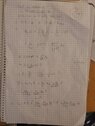
Hello, I wonder if you could give me some advice to how solve this question. What I was thinking to solve it was to determine J by using Ohms law, ## \vec J = \sigma_{\alpha} \vec E ## I already determined the E field for for the sphere, I got it from a) ("a)" was to determined all the bound charges and show that the sum of them is zero, I attached the solution) If you see there I solve the electric field by Using ## \vec D = \epsilon E ## where i I got ## \vec D## from gauss law for a gaussiuan sphere with radius r< R (inside the sphere) and got that the eletric field of this gaussian sphere is $$ \vec E = \frac{r \rho_f}{4\pi R^3}\frac{1}{\epsilon_0 \left ( 1+ X_e \right ) } \hat r$$. But I wonder if in this case( b) will r = R? or how can I proceed?

Edit: I realized that the field was incorrect, I re-wrote it and got $$ \vec E = \frac{1}{3}\frac{\rho_f r}{\epsilon_0 (1+X_e)} $$
 

Attachments
  • 20211011_165748.jpg
    20211011_165748.jpg
    43 KB · Views: 174
  • 20211011_165802.jpg
    20211011_165802.jpg
    36.6 KB · Views: 179
Last edited:
Physics news on Phys.org
Angela G said:
Edit: I realized that the field was incorrect, I re-wrote it and got $$ \vec E = \frac{1}{3}\frac{\rho_f r}{\epsilon_0 (1+X_e)} $$
Ok, that looks good. But you should include a unit vector to indicate the direction of ##\vec E##.

Instead of going to the trouble of finding the polarization ##\vec P## and the bound charge density, see if you can determine the time dependence of the free charge density from this expression for ##\vec E## and the two equations that you wrote for the "Relevant Equations".
 
I reread the original problem statement and it says that ##\chi_e## is the dielectric constant, not the susceptibility. Your expression for ##E## would be correct if ##\chi_e## is the susceptibility. So, you need to modify it
 
oh yes, I will fix that. What I'm stuck with is that the divergens of ##\vec J## because the field I determined is the field inside the sphere, so I don't know if I should change r to R. But if I do that the divergens will be zero because the R is constant. so I don't know if I should keep the r and derivate or what can I do?
 
You want to investigate how ##\rho_f## changes with time for any point inside the sphere. So, you want to leave ##r## as a variable in the expression for ##\vec J##. Then ##\vec \nabla \cdot \vec J## at some point inside the sphere will give you the negative of the rate of change of ##\rho_f## at that point.
 
ok, if I do so then the divergens will be $$ \vec \nabla \cdot \vec J = \frac{\rho_f \sigma_{\alpha}}{\epsilon_0 X_e} $$ Then move ## \rho_f ## to the right side of the divergens and get $$ - \frac{\sigma_{\alpha}}{\epsilon_0 X_e} = \frac{1}{\rho_f} \frac{\partial \rho}{\partial t} $$ or shoul I leave ## \rho_f## as a contant ?
 
Angela G said:
ok, if I do so then the divergens will be $$ \vec \nabla \cdot \vec J = \frac{\rho_f \sigma_{\alpha}}{\epsilon_0 X_e} $$
You've left out a minus sign as well as a time derivative on the right-hand side. (Edit: Nevermind! This is OK.)

Angela G said:
Then move ## \rho_f ## to the right side of the divergens and get $$ - \frac{\sigma_{\alpha}}{\epsilon_0 X_e} = \frac{1}{\rho_f} \frac{\partial \rho}{\partial t} $$ or shoul I leave ## \rho_f## as a contant ?
This looks better. Should ##\large \frac{\partial \rho}{\partial t}## be ##\large \frac{\partial \rho_f}{\partial t}##?

##\rho_f## is not a constant. You are looking for how ##\rho_f## varies with time.
 
Ok, Understan, How can I solve the DE? I think it is homogenius, right?

Edit: nevermind
 
Last edited:
I got first $$ - \frac{\sigma_{\alpha} dt}{\epsilon_0 X_e} = \frac{1}{\rho_f} d \rho_f \Longrightarrow \int - \frac{\sigma_{\alpha} dt}{\epsilon_0 X_e} = \int \frac{1}{\rho_f} d \rho_f \Longrightarrow -\frac{\sigma_{\alpha} t}{\epsilon_0 X_e} = \ln( \rho_f) + c $$ and then $$ \rho_{f,0} e^{-\frac{\sigma_{\alpha} t}{\epsilon_0 X_e}} = \rho_f (t)$$ is that the answer to the problem?
 
OK.

Your result is for a particular point inside the sphere. So, if ##\mathbf r## is the position vector of the point, you have shown $$\rho_f(\mathbf {r}, t) = \rho_f(\mathbf {r}, 0)e^{-\frac{\sigma_{\alpha} t}{\epsilon_0 \chi_e}}$$
In addition to finding how ##\rho_f(\mathbf {r}, t)## varies with time at a particular point, you are also asked to find how ##\rho_f(\mathbf {r}, t)## varies with position for any particular time ##t>0##. What can you say about this?
 
## \rho_f(\vec r,t)## decreases exponentially and ##\rho_f (\vec r, 0 ) is konstant with position
 
Last edited:
Angela G said:
## \rho_f(\vec r,t)## decreases exponentially and ##\rho_f (\vec r, 0 ) is konstant with position
Yes, ## \rho_f(\vec r,t)## decreases exponentially with time. And ##\rho_f (\vec r, 0 ##) is independent of position inside the sphere.

So, at some fixed time ##t>0##, how does ## \rho_f(\vec r,t)## vary with position?
 
I have a doubt.
We started with a charged sphere and the solution says the charge tends to zero (it goes as exp(-t)). Where did the charge go?
 
  • Skeptical
Likes   Reactions: Angela G
Gordianus said:
I have a doubt.
We started with a charged sphere and the solution says the charge tends to zero (it goes as exp(-t)). Where did the charge go?
The sphere acts as a conductor for the free charge. So, as electrostatic equilibrium is approached (t →∞), the free charge resides where it must reside on any conductor in equilibrium.

EDIT: You can check that all of the free charge ends up on the surface by evaluating ##\int_0^\infty J(R,t) 4 \pi R^2 dt## which gives the total amount of free charge that arrives at the surface.
 
Last edited: