Operator Language: Why d/dx*x - x*d/dx = 1

  • Context: Graduate 
  • Thread starter Thread starter Nezva
  • Start date Start date
  • Tags Tags
    Language Operator
Join the discussion
Ask a follow-up here, or get your own question answered by working scientists, mathematicians and engineers — people, not an autocomplete.
Real named experts · corrections over time · the nuance an AI answer skips
2 replies · 2K views
Nezva
Messages
46
Reaction score
0
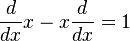
When linear operators A and B act on a function ψ(x), they don't always commute. A clear example is when operator B multiplies by x, while operator A takes the derivative with respect to x. Then

ba139ec4de3277dec6bf746cf8fb941f.png


which in operator language means that
f54e3202f439d8acb22e6675932c7659.png


To get the last equation they divided through by ψ but why is it true? I guess what I'm trying to say is that the second equation makes no sense => d/dx*x - x*d/dx doesn't always equal 1... so why do they say that?
 
Physics news on Phys.org
First, they don't divide it by [itex]\Psi[/itex]; they simply consider it the argument of the operator AB-BA. It's akin to denote a function by f only, instead of f(x), where the variable is explicit.

Second, in this context, d/dx*x - x*d/dx doesn't always equal 1; in fact, it never equals 1: it equals the identity operator I, the one that satisfies [itex]I\Psi=\Psi[/itex].
 
JSuarez said:
First, they don't divide it by [itex]\Psi[/itex]; they simply consider it the argument of the operator AB-BA. It's akin to denote a function by f only, instead of f(x), where the variable is explicit.

Second, in this context, d/dx*x - x*d/dx doesn't always equal 1; in fact, it never equals 1: it equals the identity operator I, the one that satisfies [itex]I\Psi=\Psi[/itex].

Thanks for stating it so clearly and concisely. Many issues were resolved.