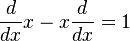
Operator Language: Why d/dx*x - x*d/dx = 1

  • Context: Graduate 
  • Thread starter Thread starter Nezva
  • Start date Start date
  • Tags Tags
    Language Operator
Click For Summary
SUMMARY

The discussion clarifies the misconception surrounding the operator equation d/dx*x - x*d/dx. It establishes that this expression does not equal 1 but rather represents the identity operator I, which satisfies IΨ = Ψ. The confusion arises from the improper division by the function Ψ, as the operators A and B do not commute when one is a multiplication operator and the other is a differentiation operator. This distinction is crucial for understanding operator algebra in quantum mechanics.

PREREQUISITES
  • Understanding of linear operators in quantum mechanics
  • Familiarity with differentiation and multiplication operators
  • Knowledge of operator commutation relations
  • Basic grasp of functional notation and arguments in mathematics
NEXT STEPS
  • Study the properties of linear operators in quantum mechanics
  • Learn about operator commutation and its implications in physics
  • Explore the identity operator and its role in operator algebra
  • Investigate the significance of functional notation in mathematical expressions
USEFUL FOR

Students and professionals in physics, particularly those studying quantum mechanics, as well as mathematicians interested in operator theory and functional analysis.

Nezva
Messages
46
Reaction score
0
When linear operators A and B act on a function ψ(x), they don't always commute. A clear example is when operator B multiplies by x, while operator A takes the derivative with respect to x. Then

ba139ec4de3277dec6bf746cf8fb941f.png


which in operator language means that
f54e3202f439d8acb22e6675932c7659.png


To get the last equation they divided through by ψ but why is it true? I guess what I'm trying to say is that the second equation makes no sense => d/dx*x - x*d/dx doesn't always equal 1... so why do they say that?
 
Physics news on Phys.org
First, they don't divide it by \Psi; they simply consider it the argument of the operator AB-BA. It's akin to denote a function by f only, instead of f(x), where the variable is explicit.

Second, in this context, d/dx*x - x*d/dx doesn't always equal 1; in fact, it never equals 1: it equals the identity operator I, the one that satisfies I\Psi=\Psi.
 
JSuarez said:
First, they don't divide it by \Psi; they simply consider it the argument of the operator AB-BA. It's akin to denote a function by f only, instead of f(x), where the variable is explicit.

Second, in this context, d/dx*x - x*d/dx doesn't always equal 1; in fact, it never equals 1: it equals the identity operator I, the one that satisfies I\Psi=\Psi.

Thanks for stating it so clearly and concisely. Many issues were resolved.
 

Similar threads

  • · Replies 11 ·
Replies
11
Views
2K
  • · Replies 14 ·
Replies
14
Views
3K
  • · Replies 3 ·
Replies
3
Views
3K
  • · Replies 2 ·
Replies
2
Views
2K
  • · Replies 5 ·
Replies
5
Views
2K
  • · Replies 8 ·
Replies
8
Views
3K
  • · Replies 59 ·
2
Replies
59
Views
6K
  • · Replies 4 ·
Replies
4
Views
3K
  • · Replies 4 ·
Replies
4
Views
2K
  • · Replies 23 ·
Replies
23
Views
3K