SteveeGeorge
- 4
- 1
Hi all,
I have a problem, and in need of some help.
I am an optical engineer, currently designing an attentuator for near infrared lasers (10.6μm). The attenuator consists of two enhanced ZnSe Brewster windows that rotate in opposite directions and different angles to exactly re-align polarization.
I have attached my calculations as images, so to display each step of my workings. I have accounted for the refractive indexes and transmission coefficients of both brewster windows. My objective is to formulate an expression for the 2nd brewster window angle in respects to the 1st brewster window angle to perfectly realign the P polarization, which I have taken to be in the X direction:
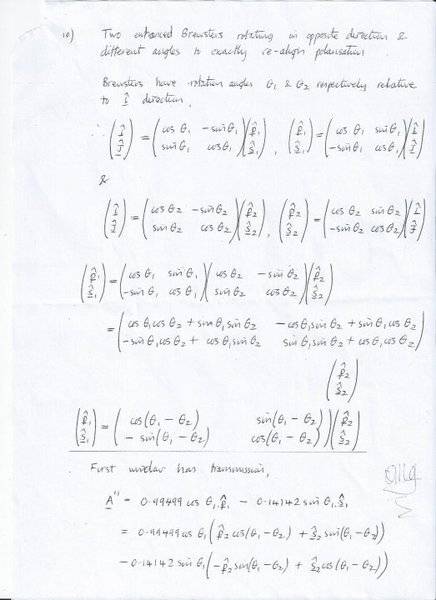
Here is the coordinate transforms and the transmission of the first Brewster windows (internal and external surfaces).

After calculating the final transmission of both windows, I assumed that since the angle of polarization is respective to x direction, the J component equates to zero (Re-alignment).
How do I formulate an expression for theta2, respective to theta1?
If anyone could shine some light on my problem, it would be greatly appreciated!
Thanks
-Steve
I have a problem, and in need of some help.
I am an optical engineer, currently designing an attentuator for near infrared lasers (10.6μm). The attenuator consists of two enhanced ZnSe Brewster windows that rotate in opposite directions and different angles to exactly re-align polarization.
I have attached my calculations as images, so to display each step of my workings. I have accounted for the refractive indexes and transmission coefficients of both brewster windows. My objective is to formulate an expression for the 2nd brewster window angle in respects to the 1st brewster window angle to perfectly realign the P polarization, which I have taken to be in the X direction:
Here is the coordinate transforms and the transmission of the first Brewster windows (internal and external surfaces).
After calculating the final transmission of both windows, I assumed that since the angle of polarization is respective to x direction, the J component equates to zero (Re-alignment).
How do I formulate an expression for theta2, respective to theta1?
If anyone could shine some light on my problem, it would be greatly appreciated!
Thanks
-Steve
Attachments


Last edited: