Orthogonal Projection Onto a Subspace?

Click For Summary

Homework Help Overview

The discussion revolves around calculating the orthogonal projection of a vector onto a subspace in the context of linear algebra, specifically focusing on the interpretation of results and definitions related to projections.

Discussion Character

  • Conceptual clarification, Mathematical reasoning

Approaches and Questions Raised

  • The original poster attempts to understand the calculation of orthogonal projections and expresses confusion regarding the results provided by their lecturer. Participants discuss the components of the projection and the definitions involved.

Discussion Status

Some participants have offered clarifications regarding the calculations and definitions of projections. There is an ongoing exploration of different interpretations of the results, particularly concerning the subtraction of components and the definition of the projection itself.

Contextual Notes

The original poster mentions a time constraint due to an upcoming exam and expresses difficulty in finding resources to clarify their understanding. There is also a discussion about specific numerical results that appear to differ from the original poster's expectations.

Danny89
Messages
3
Reaction score
0
Hey,

I have a linear algebra exam tomorrow and am finding it hard to figure out how to calculate an orthogonal projection onto a subspace.

Here is the actual question type i am stuck on:
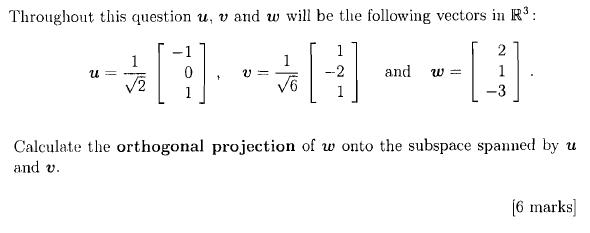
q2b.jpg


I have spent ages searching the depths of google and other such places for a solution but with no look. I am really stuck and it would be greatly appreciated if someone could maybe give me a helping hand and try explain this to me.

Thanks.
 
Physics news on Phys.org
Notice that your u and v are already orthogonal unit vectors. So the component of w in the u direction would be w dot u and in the v direction would be w dot v. So the nearest point in the plane to w would be (w dot u)u + (w dot v)v. Subtract this from w to get the orthogonal projection.
 
Hey thanks for the reply.

I'm a bit confused though. You see i actually managed to get the solution for this problem from my lecturer just there:

ans.jpg


But he doesn't subtract from w that i know of and his result for <w,u>u is
1/2 [5]
[0]
[-5]

should it not be:
1/2 [2]
[0]
[-3]?

do you know why this is? i have been tricking around with it and just can't seem to understand it. It would appear to be straightforward enough but i just can't see it.
 
What he has calculated is the "shadow" of w on the subspace which is what he apparently meant by the orthogonal projection onto the subspace. What I suggested to you was the component of w orthogonal to the subspace. Stick with his definition. His calculation is correct; just don't subtract it from w.
 
Thanks a million, a real help!
 
Danny89 said:
his result for <w,u>u is
1/2 [5]
[0]
[-5]

should it not be:
1/2 [2]
[0]
[-3]?

do you know why this is?
The quantity <w,u> is a plain old number. In this case, <w,u>=-5. He then multiplies the vector [1,0,-1] by it. To get the scalar multiple of a vector, you just multiply each component by the scalar, so you get [5,0,-5].
 

Similar threads

  • · Replies 9 ·
Replies
9
Views
2K
  • · Replies 4 ·
Replies
4
Views
2K
  • · Replies 5 ·
Replies
5
Views
2K
  • · Replies 3 ·
Replies
3
Views
4K
  • · Replies 3 ·
Replies
3
Views
2K
  • · Replies 5 ·
Replies
5
Views
3K
Replies
6
Views
2K
  • · Replies 13 ·
Replies
13
Views
6K
Replies
7
Views
2K
  • · Replies 5 ·
Replies
5
Views
4K