Orthogonality of Associated Laguerre Polynomial

Click For Summary
SUMMARY

The discussion focuses on proving the orthogonality of associated Laguerre polynomials, specifically using Rodrigues' form and the differential equation for \( L_n^k \) and \( L_m^k \). Participants suggest substituting these forms into the mutual orthogonality equation and manipulating the resulting expressions. The differential equation provided is \( x \frac{d^2 L_n^{k}}{dx^2} +(k+1-x) \frac{dL_n^{k}}{dx} +n L_n^k =0 \). The key to resolving the orthogonality proof lies in correctly applying this differential equation and finding an integrating factor.

PREREQUISITES
  • Understanding of associated Laguerre polynomials
  • Familiarity with Rodrigues' formula
  • Knowledge of differential equations
  • Ability to manipulate polynomial expressions
NEXT STEPS
  • Study the properties of associated Laguerre polynomials
  • Learn how to apply Rodrigues' formula in polynomial proofs
  • Explore techniques for solving differential equations
  • Research integrating factors in the context of differential equations
USEFUL FOR

Mathematicians, physicists, and students studying orthogonal polynomials, particularly those working with associated Laguerre polynomials and their applications in quantum mechanics and numerical analysis.

Muh. Fauzi M.
Messages
17
Reaction score
1
I have a problem when trying to proof orthogonality of associated Laguerre polynomial. I substitute Rodrigue's form of associated Laguerre polynomial :
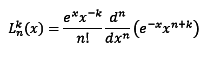
upload_2015-3-17_17-49-19.png

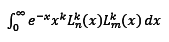
to mutual orthogonality equation :

upload_2015-3-17_17-49-40.png

and set, first for
upload_2015-3-17_17-50-7.png
and second for
upload_2015-3-17_17-50-20.png
.

But after some step, I get trouble with this stuff :
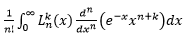
upload_2015-3-17_17-50-31.png

I've already search solution for this form but still no light. Any body here could help?
 
Physics news on Phys.org
The best way is using the differential equation. Write it for ## L^k_n ## and ## L^k_m ##. Then multiply the first by ## L^k_m## and the second by ## L^k_n ##. Then subtract one from the other. Come back if you encounter a problem!
 
Last edited:
Shyan said:
The best way is using the differential equation. Write it for ## L^k_n ## and ## L^k_m ##. Then multiply the first by ## L^k_m## and the second by ## L^k_n ##. Then subtract one from the other. Come back if you encounter a problem!
Well I still didn't get it. ## L^k_n ## has a rodrigues form and also associated Laguerre polynomial. Which one I need to use?
 
Muh. Fauzi M. said:
Well I still didn't get it. ## L^k_n ## has a rodrigues form and also associated Laguerre polynomial. Which one I need to use?
I said the differential equation, which is:
## x \frac{d^2 L_n^{k}}{dx^2} +(k+1-x) \frac{dL_n^{k}}{dx} +n L_n^k =0##
 
Shyan said:
I said the differential equation, which is:
## x \frac{d^2 L_n^{k}}{dx^2} +(k+1-x) \frac{dL_n^{k}}{dx} +n L_n^k =0##
Nah... I got it. But still, I am stuck when connecting it with the orthogonality...
 
Muh. Fauzi M. said:
Nah... I got it. But still, I am stuck when connecting it with the orthogonality...
I explained it in that post! Just write the equation two times for ## L_m^k ## and ## L_n^k##. Then multiply the first by ## L_n^k## and the second by ## L_m^k ## and subtract one from the other. Then find an integrating factor and multiply the equation by it. You'll find out how to continue but come back if you didn't.
 

Similar threads

  • · Replies 1 ·
Replies
1
Views
2K
  • · Replies 3 ·
Replies
3
Views
2K
  • · Replies 1 ·
Replies
1
Views
3K
  • · Replies 6 ·
Replies
6
Views
4K
  • · Replies 4 ·
Replies
4
Views
5K
Replies
8
Views
9K
  • · Replies 2 ·
Replies
2
Views
6K
  • · Replies 2 ·
Replies
2
Views
2K
  • · Replies 7 ·
Replies
7
Views
2K
  • · Replies 3 ·
Replies
3
Views
4K